


Quick Answer: What Goes in Chinese Wedding Tea?
Chinese wedding tea may be brewed from tea leaves, prepared as a fruit-and-seed infusion, or combine both. Sweet tea (甜茶, tiánchá) expresses wishes for a sweet marriage, but its ingredients depend on the family.
- Tea base: Choose a familiar leaf tea or the family’s preferred sweet infusion.
- Common additions: Red dates, lotus seeds and dried longan appear in many documented versions.
- Other sweet ingredients: Some Singapore versions include lily bulbs, rock sugar or candied winter melon.
- Family meaning: Sweetness and descendants are recurring wishes, rather than promised effects.
There is no single nationwide wedding-tea recipe. Agree the drink with the families before buying a ceremonial ingredient set.
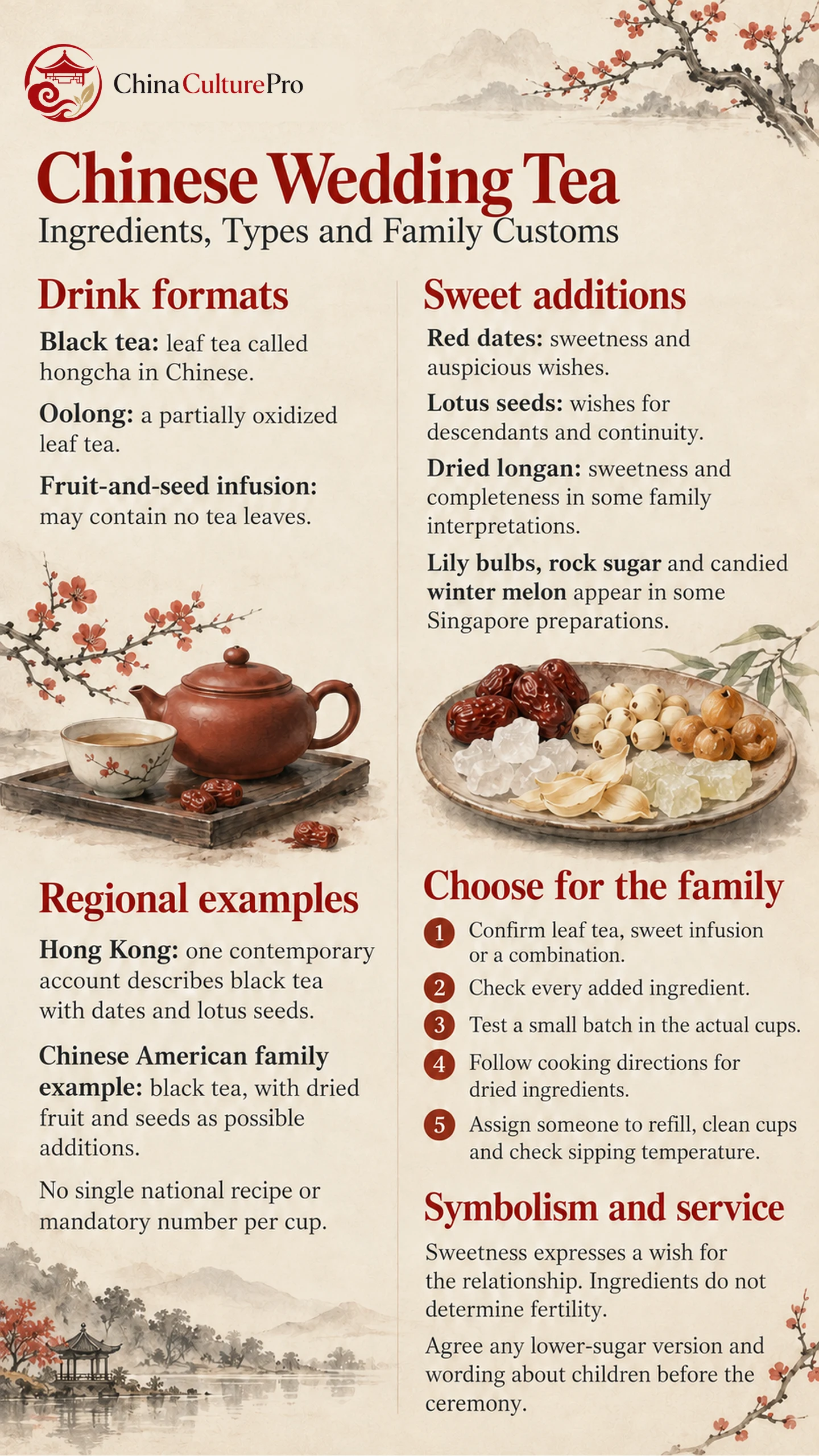
Choosing the tea is a smaller task than planning the whole ceremony, but a few distinctions prevent confusion. A packet of tea leaves, a pot of longan-and-date infusion and a tray of symbolic wedding foods are different things. Decide what guests will actually drink, then choose the additions that matter to the household.
Tea Leaves and Sweet Infusions Are Different Choices
Decide first whether the drink needs tea leaves. Wedding descriptions sometimes use “tea” broadly for a sweet ceremonial drink, so the name alone does not tell you what is in the pot. Ask whoever normally prepares it in the family.
| Drink format | What it means | Practical choice |
|---|---|---|
| Black tea (红茶, hóngchá) | Leaf tea known in Chinese as hongcha | A familiar option when the family wants a recognizable tea base |
| Oolong (乌龙茶, wūlóngchá) | A partially oxidized leaf tea | An alternative when its aroma and taste suit the relatives |
| Fruit-and-seed infusion | A drink prepared from ingredients such as dates and longan, without necessarily containing tea leaves | Confirm whether the household calls this its wedding sweet tea |
Tea processing distinguishes black tea from oolong; a drink made only from dried fruit is a different preparation.[5] The Chinese name for black tea translates literally as “red tea.” That does not make any red-colored fruit drink black tea, and it should not be confused with the separate dark-tea category.
There is no need to buy an expensive prestige tea solely for the ceremony. If relatives prefer oolong, choose one they already enjoy. If the family wants a sweet infusion, adding unfamiliar leaves may complicate a drink that was never intended to showcase a particular tea variety. The broader Chinese tea culture provides context for these different uses of the word tea.
Sweet Additions and Their Wedding Meanings
Red dates and lotus seeds are especially recognizable additions. Their wedding associations connect sweetness with wishes for descendants, including wordplay involving “early,” “child” and continuity. These are ceremonial readings of ingredients, not evidence that drinking them changes fertility.[1]
| Addition | Role in a wedding drink | Preparation distinction |
|---|---|---|
| Red dates | Sweetness and auspicious wishes, often connected with early children | Dried fruit contributes flavor as well as appearance |
| Lotus seeds | Wishes for descendants and continuity | Raw dried seeds and candied ready-to-eat seeds need different handling |
| Dried longan | Sweetness and wishes for completeness in some family interpretations | Its flesh flavors the drink; it is not a tea leaf |
| Lily bulbs | Included in some Singapore sets with wishes for lasting harmony | Confirm the edible ingredient intended by the recipe |
| Rock sugar | Makes the wish for a sweet marriage literal in the cup | The amount is a taste choice, not a measure of the blessing |
| Candied winter melon | Another sweet addition in some Singapore versions | Already sweetened, so account for it before adding more sugar |
The last three belong to particular documented preparations; they are not compulsory extras for every Chinese wedding.[2] Nor does a bag sold as a wedding set establish a national standard. A set may combine items intended for betrothal gifts, bed setting and tea, although the family uses them differently in each setting.
If explaining the ingredients to guests, describe the shared wish first: a sweet relationship and a flourishing household. Where a phrase specifically wishes for sons, translate it accurately and let the couple decide whether to use it. Wedding wishes also offer language centered on affection and growing old together.
Regional Examples Without a Universal Recipe
A contemporary Hong Kong account describes black tea with lotus seeds and red dates, while noting that green tea is less commonly used in that example.[3] That is a local preference, not a prohibition on green tea across Chinese communities.
A documented Chinese American family celebration uses black tea and discusses dates, dried longan and lotus seeds as possible additions. Its value is that it shows one family making practical choices for its own ceremony, rather than establishing what every diaspora household must serve.[4]
Singapore preparations can include a wider sweet-ingredient set, including lily bulbs and candied winter melon.[2] Differences may follow dialect-group traditions, relatives’ memories, available ingredients or the couple’s adaptation. National borders alone cannot predict the contents of an individual cup.
The same caution applies to quantities. One account describes two red dates; other recipes and family checklists arrange ingredients differently.[1] If a parent expects a pair of dates or seeds in each cup, clarify that detail. If nobody has that expectation, there is no reason to invent it from an unrelated checklist. Regional wedding traditions help place these examples within a more varied picture.
Choosing and Preparing a Drink the Family Can Share
Settle the drink before choosing the tea set. Confirming its base and sweetness early avoids changing the recipe while relatives are waiting.
- Confirm the base: Ask whether the expected drink is leaf tea, a sweet infusion or a combination.
- Check the ingredients: Keep a clear list so guests can identify additions they avoid; do not introduce nuts or other extras simply because they appear in a different wedding ritual.
- Test a small batch: Use the actual ingredients and cups, and adjust the strength and sweetness to the family’s preference.
- Separate preparation needs: Follow the ingredient’s cooking directions; a hard dried lotus seed should not be treated like a candied seed ready to serve.
- Plan the service: Assign someone to refill the pot, manage clean cups and check that the drink is comfortable to sip.
Serve a drink people can enjoy rather than a very strong brew left steeping through a long ceremony. If using leaf tea, follow its brewing guidance and separate the leaves when appropriate; if using cooked fruit or seeds, plan that preparation separately. Avoid making the first trial on the wedding morning.
For the order of relatives, kneeling choices and gift exchange, use the separate wedding tea ceremony guide. The tea ceremony script addresses family titles and spoken invitations. Keeping those decisions separate makes the ingredient choice much easier to resolve.
FAQs About Chinese Wedding Tea
What is the best tea for a Chinese wedding ceremony?
Choose the family’s familiar tea or sweet infusion. Black tea is a practical starting point when leaf tea is wanted; oolong is another option if the relatives prefer it. No single variety is required nationwide.
Does wedding tea need red dates and lotus seeds?
They are common symbolic additions, especially in sweet-tea traditions, but the recipe is not universal. Confirm whether they are expected in your household before treating them as essential.
Must every cup contain two dates or two seeds?
Only if that is the family version being followed. Paired ingredients appear in some accounts, but neither the number nor the arrangement should be presented as a rule for every Chinese wedding.
Can the wedding tea be served without added sugar?
Yes, if the family agrees. Dried fruit may already make the drink sweet, and a symbolic wish does not require a fixed sugar quantity. Confirm any adaptation before the ceremony.
Sources
[1] Chinese Historical and Cultural Project. Chinese Wedding Tea Ceremony
[2] The Chinese Wedding Shop. Wedding Day
[3] Family and Women Portal, Hong Kong. Dai Kam Jie (Bride’s Chaperone) Explains the Contemporary Take on Traditional Weddings: A Rich Blend of Heritage and Heartfelt Blessings
[4] Kaitlin Leung. How to Do a Chinese Wedding Tea Ceremony
[5] Tea and Herbal Association of Canada. Know Your Tea