

Quick Answer: What Comes First at a Chinese Wedding?
There is no single Chinese wedding timetable. A day may move from getting ready and a family welcome to tea ceremonies, photographs, a ceremony and a banquet, but families can combine, reorder or separate these events.
- Agree on the customs and people involved before assigning clock times.
- Anchor the schedule to confirmed venue, ceremony and meal arrangements.
- Allow for travel, changing clothes, food, rest and the movement of relatives between events.
The schedule below is an illustrative planning example, not a required ritual order or a claim about how every Chinese wedding works.
A wedding timeline connects meaningful moments with the practical work needed to make them happen. The tea helper needs time to seat relatives; the photographer needs the right people present; the couple needs space to eat and change.
Use the broader Chinese wedding traditions guide to decide what matters to your families. Then build the running order around those decisions, rather than trying to fit every possible custom into one day.
Before the Day: Agree on the Customs You Will Keep
Start with a family conversation about the form of the celebration, locations, budget and who will participate. Joint decisions and flexibility are central to modern wedding-planning guidance; a suggested traditional sequence is not a command to reproduce every step.[1]
Guo da li (过大礼, guò dà lǐ), a formal betrothal gift presentation in some communities, belongs before the wedding when the families choose to observe it.[4] Agree on the date and gifts separately; it need not compete with the wedding morning. Use the betrothal guide to settle that event’s details.
Some families also keep shang tou (上头, shàng tóu), the hair-combing ceremony, before the wedding.[4] Confirm the participants, place and any preferred timing with the family instead of assuming a midnight ceremony. The hair-combing guide explains the ritual and its variations.
These decisions should happen before invitations and transport are finalized. If an auspicious date or departure time matters to your family, identify it early as a planning preference, then check whether the venue and participants can accommodate it. Do not leave competing expectations for the photographer or host to resolve on the morning itself.
An Adaptable Wedding-Day Schedule
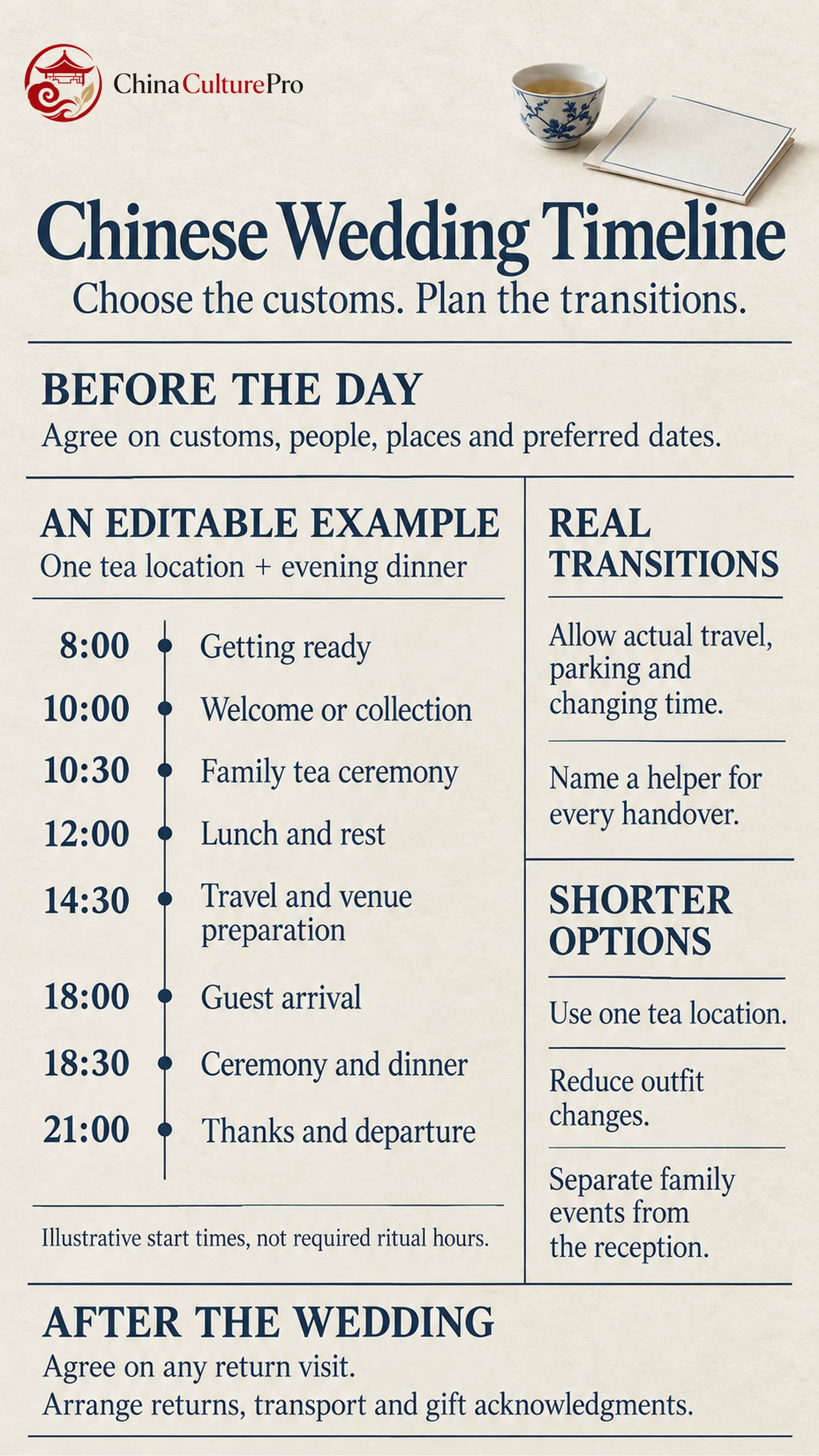
This original example assumes a family tea ceremony in one place and dinner at a nearby venue. It leaves an afternoon break and uses a 6 p.m. guest arrival. The times are editable planning blocks, not typical durations guaranteed by a source. Your actual preparation, travel and guest needs may require a different start or a separate day.
| Example time | Stage | What the block includes |
|---|---|---|
| 8:00–10:00 a.m. | Getting ready | Dressing, hair, makeup if wanted, breakfast and detail photographs |
| 10:00–10:30 a.m. | Welcome or collection | A family welcome; brief door games only if chosen |
| 10:30 a.m.–noon | Family tea ceremony | Seating, serving tea, blessings, gifts and family photographs |
| Noon–2:30 p.m. | Lunch and rest | Food, a real break and any agreed preparation for later events |
| 2:30–5:00 p.m. | Travel and venue preparation | The actual transfer, dressing, sound checks and selected portraits |
| 6:00–6:30 p.m. | Guest arrival | Reception, finding seats and final host checks |
| 6:30–9:00 p.m. | Ceremony and dinner | The chosen ceremony, meal service, speeches and table visits |
| From 9:00 p.m. | Thanks and departure | Farewells, transport, gifts and belongings handed to named helpers |
There is a deliberate gap before guest arrival for final adjustments; do not automatically fill it with another activity. The sample also groups the formal ceremony with dinner for convenience. A separately booked civil or religious ceremony needs its own confirmed appointment and travel block.
If you keep wedding door games, agree on a stopping point before they begin. For the tea ceremony, count actual recipients and rehearse one presentation. A large family or two separate homes can make the sample’s morning block unsuitable.
Build the Timetable Around Real Transitions
Write down the arrangements you cannot casually move: venue access, a booked ceremony, meal service and transport availability. Work backward from these anchors. Practitioner timelines commonly combine morning family events with an evening banquet, but also emphasize buffers, delegated roles and a protected meal or rest break.[2]
Measure the transitions rather than counting only the headline events. Travel includes getting everyone into vehicles, parking and entering the next venue. An outfit change may include removing jewellery, adjusting fastenings and refreshing hair. The wedding dress guide can help you test those movements at a fitting.
Assign one person to each handover. A family helper calls relatives for tea and photographs; a transport contact checks departures; the host coordinates with the banquet team. Put names and contact details on the private run sheet, with a clear instruction about who decides if an optional activity must be shortened.
Check the sequence aloud with those people. The host’s tea ceremony cue sheet should match the names and order on the timetable. Coordinate speeches and outfit changes with banquet service so the couple is not away when a planned presentation begins.
Modern Ways to Make the Day Shorter
A shorter day can preserve the family moments you value. Consider bringing both families to one tea location, removing a transfer, limiting outfit changes or holding a small family event before the larger reception. A lunch banquet may suit your venue and relatives better than dinner; discuss the arrangement rather than treating the evening sample as a rule.
The history itself is varied. A 1940 Peranakan bridal film is explained in the context of an elaborate wedding tradition lasting twelve days, with different rituals across the celebration.[3] That historical example belongs to a particular community and period. It is not evidence that a modern couple must stretch their wedding over twelve days—or compress that entire tradition into one morning.
Choose a smaller set of meaningful events and give them sufficient time. If an activity involves only close relatives, make that guest list clear in the invitation information instead of asking every banquet guest to arrive hours earlier.
After the Wedding: Agree on Visits and Follow-Up
Huimen (回门, huímén), a post-wedding return visit to the bride’s family in some traditions, may be part of the family’s plans.[5] Agree on its date and form directly; a shared meal can be a separate event rather than an extra journey squeezed into the wedding night.
Also assign the practical close of the celebration: returning borrowed clothing or equipment, arranging transport for relatives and acknowledging wedding gifts. Keep these tasks on a follow-up list so they do not crowd out the farewell itself.
Circulate one final version of the schedule to the people using it. If a timing changes, identify who will tell the host, venue and transport contacts. A timetable is useful when everyone is working from the same decisions, not merely when it looks complete on paper.
FAQs About Chinese Wedding Timelines
Does the groom’s family always receive tea first?
No universal order applies. Confirm the order with both families and write it into the serving list, especially if tea is offered at two locations.
Do Chinese wedding banquets have to be in the evening?
No. A lunch or dinner celebration can work depending on local practice, the venue and the people attending. Choose the meal time before building the rest of the day around it.
Can the tea ceremony happen on another day?
It can if the couple and participating relatives agree. Separating an intimate family ceremony from the larger reception may simplify travel and reduce time pressure.
What if an auspicious time conflicts with the venue?
Discuss which moment the preferred time applies to and whether the arrangement can change. Confirm a workable agreement with the family and venue before issuing the final schedule.
Sources
[1] Ministry of the Interior, Taiwan. 現代國民婚禮(精簡版)
[2] VowToDo. The Wedding Day, Hour by Hour
[3] National Archives of Singapore. Footage of a Peranakan Chinese Bride, 1940
[4] Hong Kong Family and Women Information Portal. 摩登大妗姐講解傳統婚禮現代版 傳承文化感受滿滿祝福
[5] Ministry of Education, Taiwan. 回門