
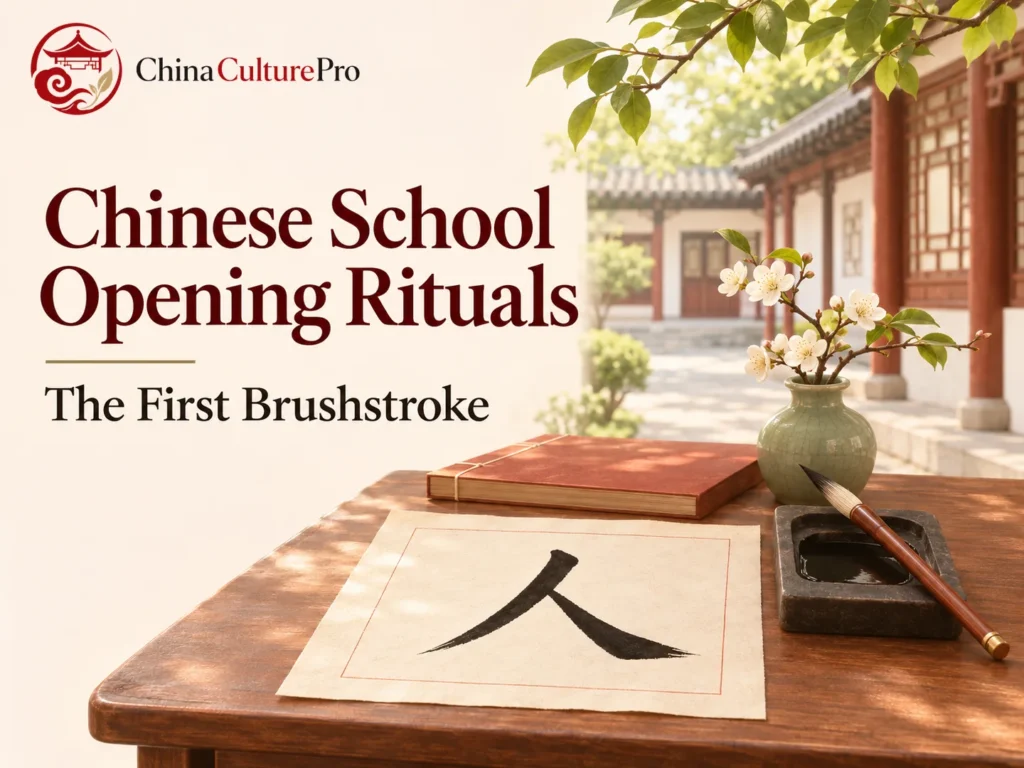

Quick Answer: What Is a Chinese First-Writing Ceremony?
A first-writing ceremony (开笔礼, kāibǐlǐ) is a way some Chinese primary schools welcome new pupils. Children may straighten their clothes, bow to teachers and make a first symbolic brushstroke.[1][2][3]
- Beginning school. The event marks a change in the child’s role.[1]
- Learning a gesture. Writing or tracing a character gives the child something to do.[3][4]
- Joining as a family. At some schools, parents accompany children as they enter.[1][2]
The programme varies by school and community.

A doorway can make the first day of school feel like the beginning of a new stage. At a 2024 ceremony in Yongzhou, parents walked through with their children and helped put their robes in order.[1]
What Children Do in a First-Writing Ceremony
A teacher can show children how to straighten their collars or sleeves before they bow or begin writing. At an event in Yanhe, a pupil described learning to write 人 (rén), meaning “person.”[1][3]
Other activities can include a symbolic forehead mark, a drumbeat or reading a passage together. At a Dongguan ceremony, children called out their aspirations after the drum. The event used sound and speech to show what the pupils hoped to do with their schooling.[2]
What Older School Entry Records Describe
Qing local gazetteers describe several names and forms for welcoming students into government schools. A record from Huoshan, Anhui, mentions a formal visit to a temple and a meeting with teachers. That evidence describes the formal welcome for students in a particular school system.[5]
A modern school entry rite (入泮礼, rùpànlǐ) at Beijing’s Confucius Temple and Imperial College Museum used older ceremonial ideas to welcome pupils in 2009. Children wore historical-style clothing, paid respects to teachers of the past and traced characters. Tracing a character let pupils participate in the welcome as learners.[4]
Where Parents Take Part
At the Dongguan primary school, relatives accompanied first-year pupils through a gateway before the flag-raising and the first-writing ceremony. At the Yongzhou event, a teacher first demonstrated how to straighten the clothing. Parents helped children follow the demonstration.[1][2]
Teacher respect ceremonies focus more directly on the bond with a teacher. Later, Chinese graduation traditions mark the completion of a stage of study.
FAQs About Chinese School Opening Rituals
Does every primary school hold a first-writing ceremony?
The reported events are individual school programmes. Schools may choose other ways to welcome pupils or use only some of the activities described here.[1][2][3]
Why do pupils bow during some ceremonies?
The bow expresses respect to teachers or earlier teachers honoured by the school. The intended recipient depends on the setting.[2][4]
Sources
[1] Yongzhou Education Bureau. Fuqiang Primary School First-Writing Ceremony
[2] Dongguan Municipal Government. Zhangmutou Central Primary School Welcomes First-Year Pupils
[3] Yanhe News. Yanhe Minzu Primary School First-Writing Ceremony
[4] Beijing Cultural Heritage Bureau. Confucius Temple and Imperial College Museum School Entry Rite
[5] Renmin University Institute of Qing History. School Entry Rites in Qing Local Gazetteers