
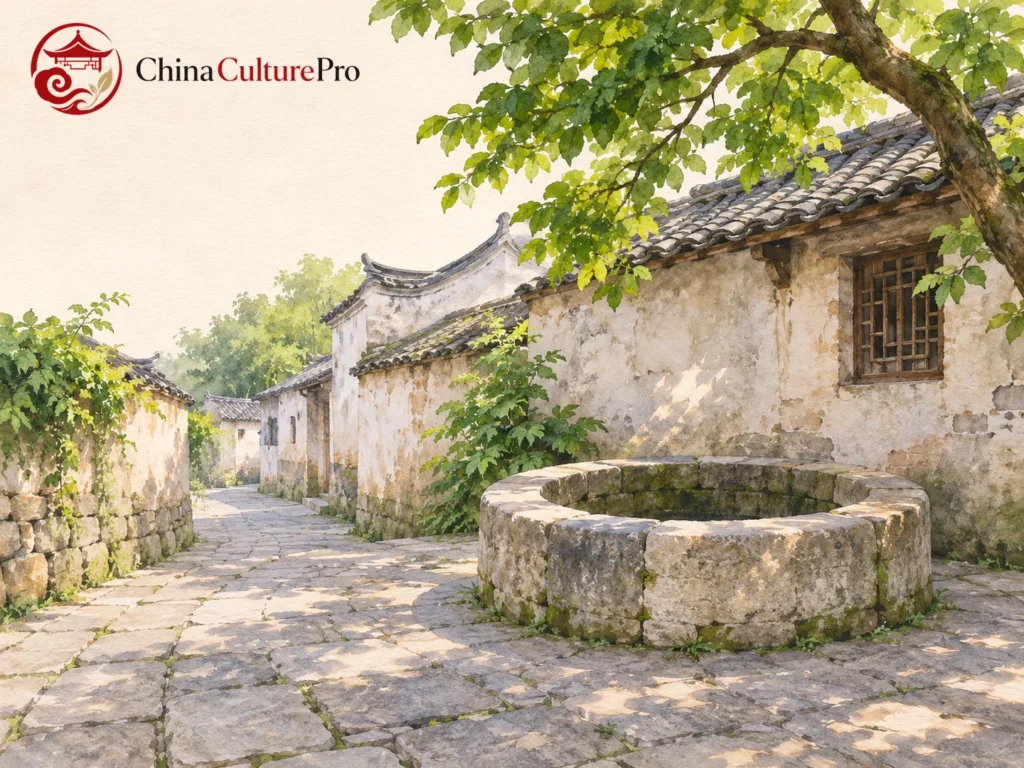

Quick Answer
A Chinese communal well, or public well (公井, gōngjǐng), could supply several households or even more than one village. The heritage record for Ping Shan in Hong Kong identifies a well once used by two villages. A study of Tongli in Jiangsu records both public wells and wells inside residences. Location helps explain access, while the historical account identifies who actually used a well.[1][2]
- Shared use: A well could serve residents beyond the group that built it.[1]
- Placement: Wells in a lane or inside a house can have different histories.[1][2]
- Evidence: A surviving stone rim gives a physical clue. A map, survey or local account can document use.[1][2][3]
A well’s history and its current function are separate details.[1][2]

A well on a lane can be easy to overlook. For the households that relied on it, its position shaped a regular trip. In Ping Shan, the recorded users came from two villages. In Tongli, records of public and residential wells help explain how people could draw water at different scales of settlement.[1][2]
A Well Shared by Two Villages
The Hong Kong Antiquities and Monuments Office describes an old well on the trail between Yeung Hau Temple and Sheung Cheung Wai. According to local Tang villagers, people from Hang Tau Tsuen built it. The office says the exact construction date is unknown. It records the well as a former main source of drinking water for both villages.[1]
The well could serve a wider group than the people credited with building it. The route past the well places it in the landscape alongside houses and communal buildings.[1]
Public Wells and Wells Inside Homes
A study published by Heidelberg Asian Studies Publishing describes thirty-one wells recorded in Tongli by 2011. Its categories include public wells and the residential well (宅井, zháijǐng), with examples found in courtyards, small open interior spaces and indoors. That count describes the wells recorded by the survey at that point.[2]
The study also discusses public wells historically funded by wealthy families. That records a distinction between who paid for a well and who could draw water from it. A well inside a residence belongs to a different kind of access arrangement.[2]
What the Surrounding Space Can Tell You
The lane, courtyard or gate around a well helps explain its relationship to dwellings. A study of fortified settlements records wells as part of the shared facilities inside some settlements. Their location within an enclosure could give residents access without leaving the complex. Check which site the plan describes before applying that arrangement to another settlement.[3]
Other buildings can show similar differences of scale. The guide to Chinese clan halls and family homes compares lineage spaces and domestic rooms. The well adds another clue about which parts of a settlement several households used together.[1][2][3]
How Historic Wells Are Remembered
A heritage trail can mark a former well even after it has stopped serving its historic purpose. The Ping Shan entry preserves a local account of construction and a record of older use. That information helps readers interpret the stonework without assuming the site works as it did before.[1]
In Tongli, the survey records that some public wells disappeared while private wells survived. The wells still visible tell only part of the history of water access. Comparing an old record with the present plan can help identify what changed.[2]
FAQs About Chinese Communal Wells
Was Every Village Well Communal?
The documented examples include wells shared by several households and wells inside residences. The builders, users and location can help identify an individual well.[1][2]
Does an Old Well’s Present Appearance Show Its Original Use?
The visible structure can show where the well was placed. A local account, map or survey can record who used it and for what purpose.[1][2][3]
Sources
[1] Hong Kong Antiquities and Monuments Office. Old Well on the Ping Shan Heritage Trail
[2] Heidelberg Asian Studies Publishing. Tackling Urban Monotony, Tongli Ancient Water Town
[3] Buildings. Spatial characteristics of fortified settlements and shared facilities