

Quick Answer
A child’s first haircut appears in Chinese family records as a way of marking early infancy. Sources describe cutting or shaving the first hair (胎毛, tāimáo) on different dates. A Taiwanese folk painting depicts a twenty-fourth-day custom. An account from Matsu associates the haircut with the full month (满月, mǎnyuè).[1][2][3]
- Date: Sources name day twenty-four and the full month, among other examples.[1][2]
- Occasion: In Matsu, a haircut and naming could take place in connection with a full-month gathering.[2]
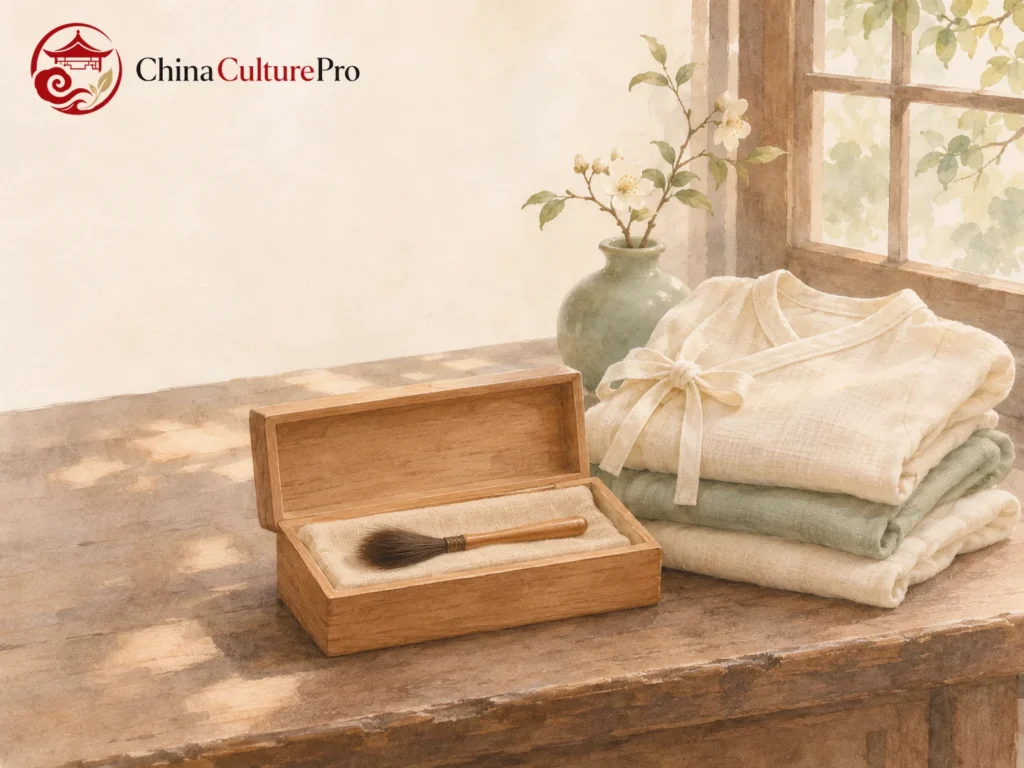
- Keepsake: A Hakka oral-history interview records a family making a brush with the first hair.[3]
A family’s own account can tell you whether the haircut and the gathering were held together.[2][3][4]

A date in a family album may say when a baby first had their hair cut, while a caption describes a feast or a keepsake. The painting, island record and interview preserve different details about when the custom happened and what a family kept.[1][2][3]
Why the Timing Varies
Taiwan’s National Cultural Memory Database records a folk painting by Huang Jintian about a haircut on the twenty-fourth day. Its catalogue connects that date with the Twenty-Four Exemplars of Filial Piety, a group of stories about devotion to parents. The same record mentions other dates, including day twelve and the full month.[1]
That catalogue explains the meaning attached to the painted scene. A separate Matsu record identifies the full month instead. The two records give the same act different places in the family calendar.[1][2]
What a First Haircut Could Mark
The Matsu record places a first haircut alongside naming and a feast to which relatives and friends were invited. The gathering marked the completion of the baby’s first month. The haircut could be one part of a larger occasion in that local account.[2]
Accounts of the Chinese full-month celebration also describe gifts or food shared with relatives. A folklore dictionary entry for the full month records clothing and food gifts. The way one family welcomes relatives may differ from the way it marks the haircut itself.[2][4]
How Families Kept a Memento
A Hakka oral-history interview in Taiwan’s Digital Archives records Li Yongcheng’s account of a first haircut at the full month. He describes using the cut hair to make a brush as a keepsake. The keepsake is a detail from this interview.[3]
A brush by itself may have little to identify the event. The oral account connects the object to the first haircut and identifies the date the family followed.[3]
How to Read a Family Account Today
Start with the birth date and the wording of the caption. If the family remembers a full-month event, ask what happened at the gathering and whether the haircut occurred then. If a document mentions a day number, ask how the family counted it. The examples here include more than one way of marking infancy.[1][2][3][4]
The Chinese hundred-day celebration is another milestone. Its name identifies a point in infancy. A family may place events on different dates, so a photograph of a haircut and a feast invitation need their own descriptions.
FAQs About Chinese First-Haircut Traditions
Does the First Haircut Have to Be at the Full Month?
The historical examples vary. The Matsu record places it at the full month, while the Taiwanese painting records a twenty-fourth-day example. Use the family’s own account to identify its date.[1][2]
Is the First Haircut the Same as the Hundred-Day Celebration?
The first haircut is the act of cutting a child’s first hair. A hundred-day celebration marks a point in the child’s first months. A family record can tell you whether those occasions were linked.
Sources
[1] Taiwan National Cultural Memory Database. Huang Jintian’s painting of a twenty-fourth-day haircut
[2] Taiwan National Cultural Memory Database. Matsu full-month customs
[3] Taiwan Digital Archives. Hakka oral history of a first haircut
[4] Taiwan Folklore and Material Culture Dictionary. Full-month observances