

Quick Answer: How Did Chinese Neighbours Help Each Other?
In documented Chinese villages, neighbours helped one another with labour, skills, gifts and money. Households might work one another’s fields, supply hands for a funeral or pool contributions for a large expense.[1][2][3]
- Labour. Families exchanged work or lent animals and tools when more hands were needed.[1]
- Life events. Neighbours carried out tasks a household could not handle alone.[1][2]
- Pooled funds. Members of some groups took turns receiving a sum collected from all participants.[1][3]
The obligations and the people included varied by village, group and event.

At harvest time, a household might need extra hands for several days. At a funeral, it might need a group for a few hours. Mutual aid made it possible to draw on neighbours’ time and skills in each case, with different expectations about when the help would be returned.[1][2]
Exchanging Labour When a Household Needed It
Labour exchange (換工, huàngōng) could mean that several households worked one family’s fields for a few days and then moved to another’s. Households could balance the exchange through a comparable amount of work. Some arrangements exchanged a particular skill or access to a draft animal for extra hands.[1]
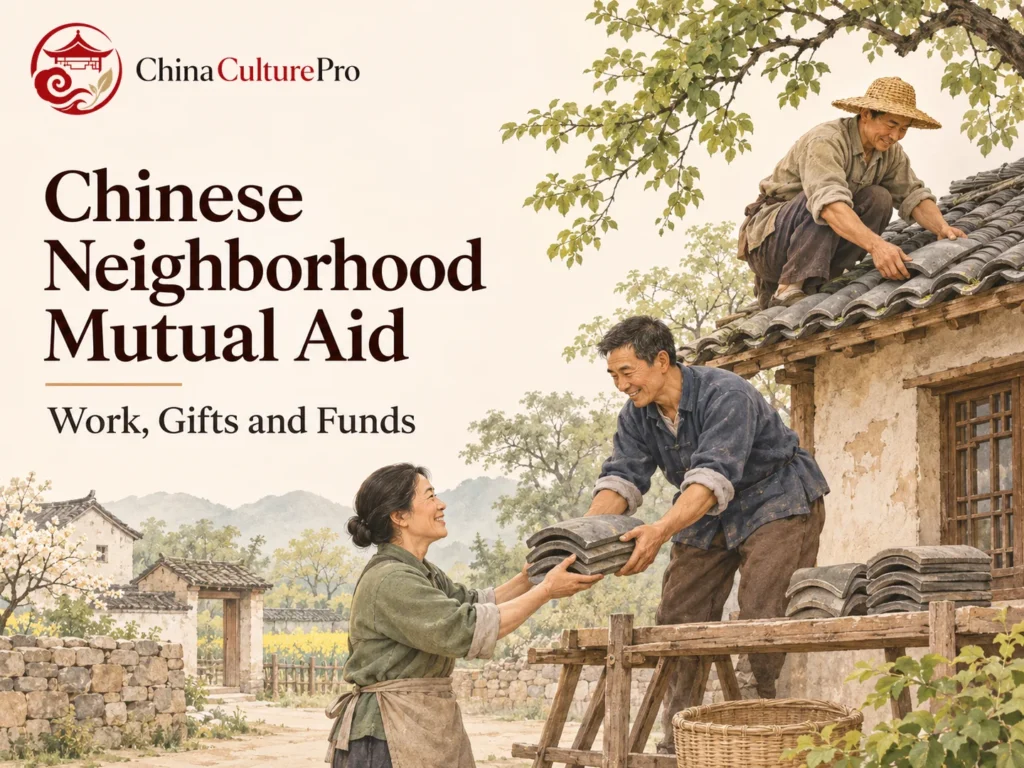
Building a house called for a different set of tasks. Neighbours could carry tiles and other materials, mix mud or bring water. The owner might serve food and tea and later help on another family’s building project.[1]
How Neighbours Helped at Weddings and Funerals
An account of village custom describes weddings where people took responsibility for buying supplies, preparing a meal, receiving guests or keeping a record of gifts. A person with the skill to run a banquet contributed something different from a relative who brought money.[1]
In a Shandong case, a funeral gift ledger (吊簿, diàobù) recorded who gave what. Such a record could guide later exchanges between households. Chinese funeral money envelopes explain the monetary gift itself. A gift’s entry could be consulted when the donor’s household later held a ceremony.[4]
How Mutual-Aid Groups Pooled Money
A mutual-aid society (合會, héhuì) could collect a contribution from each member at regular meetings. One member received the combined amount in a round, and others received it in later rounds. The order could differ. Historical records describe arrangements using lots, dice or bids.[1][3]
This kind of fund gave someone access to a sum larger than a single contribution. The group committed to repeated contributions over a set of meetings.[1][3]
FAQs About Chinese Neighborhood Mutual Aid
Was all help repaid immediately?
No. Fieldwork and accounts of village custom describe returning labour during a later work period or reciprocating at another family’s event. A ledger could preserve the contribution until the next occasion.[1][4]
How could transport change the work neighbours did?
In an oral history from the Taihu area, people remembered coming from nearby houses to carry a coffin. Motor vehicles later removed the need for that particular group task.[2]
Sources
[1] Chinese Academy of Sciences, agricultural history resource. An Introduction to Chinese Village Customary Law
[2] Cahiers d’Extrême-Asie. Oral History and Local Social History in the Taihu Lake Basin
[3] Business History. Risk Management and Rotating Savings Associations in Prewar Shanxi
[4] Shandong University Institute for Advanced Confucian Studies. Funeral Gift Ledgers and Relations by Marriage