

Quick Answer: How Did Chinese Porcelain Travel Overseas?
Chinese porcelain moved through several sea networks. The routes grouped under the Maritime Silk Road (海上丝绸之路, Hǎishàng Sīchóu Zhī Lù) linked Chinese ports with Southeast Asia and markets farther west. European merchants later bought wares for their home markets, while ships from Manila carried porcelain across the Pacific to Mexico.[1][2][3][4]
- Asian trade: Tang shipwreck cargo and the remains of Song and Yuan ports show networks in operation centuries before regular European purchases.[1][2]
- European trade: Portuguese merchants helped expand shipments to Europe in the sixteenth century. Dutch and other companies later bought large volumes.[3][6]
- Pacific trade: Manila was a transfer port. Galleons carried Asian goods to Acapulco and took American silver back across the ocean.[4][5]
A kiln name tells you where a piece was made. To trace its voyage, look for evidence about shipment, discovery or documented ownership.

A blue-and-white dish could leave an inland workshop, change ships at a trading port and be sold thousands of miles away. Even dishes with similar decoration could follow different routes. Three clues help you distinguish them: the place of manufacture, the cargo or records they traveled with, and where they ended up.
What the Tang Shipwreck Reveals About Early Ceramic Trade
A ninth-century wreck discovered off Belitung, in present-day Indonesia, carried tens of thousands of Chinese ceramics. Changsha wares from inland Hunan dominated the cargo. A smaller number of pieces represented other ceramic traditions. Finds of Changsha wares at the Tang harbor at Yangzhou help explain how products from inland kilns reached the maritime trade.[1]
The distinction between ceramics and porcelain matters here. The wreck demonstrates a large export trade in Chinese ceramics. Calling all its wares porcelain obscures the different bodies and glazes in the cargo. It also makes a later European association of Chinese porcelain with fine blue-and-white tableware seem older and more universal than it was.[1][6]
The findspot establishes that the vessel reached waters off Belitung. The final destination and the intended buyers of individual pieces remain uncertain. The wider Maritime Silk Road gives the regional context for the voyage. The wreck itself gives direct evidence of what was moving together at one moment.[1][2]
How Quanzhou Connected Kilns and Sea Lanes
Quanzhou became a major trading port on China’s southeastern coast between the tenth and fourteenth centuries. The surviving landscape includes ceramic-production sites, docks, bridges and remains associated with maritime administration. Together they document how workshops in the hinterland were connected to the waterfront and to customers beyond it.[2]
It helps to think of a port as several links in a chain. A kiln identifies a place of manufacture, a bridge or road helps explain inland movement, and a dock marks where goods entered a shipping network. A collection of related sites gives a stronger picture of that network than a single object found far from the port. The history of Longquan celadon offers a related example of a Chinese ceramic tradition that reached overseas markets.[2]
How Porcelain Reached European Buyers
Portuguese merchants expanded access to Chinese porcelain during the sixteenth century. Some buyers wanted pieces with familiar signs or shapes. A surviving blue-and-white ewer made at Jingdezhen (景德镇, Jǐngdézhèn) carries Portuguese royal arms. Its body and underglaze decoration point to Chinese manufacture, while its heraldry gives unusually specific evidence of the market it was made for. The piece does not, by itself, tell us which ship carried it.[3]
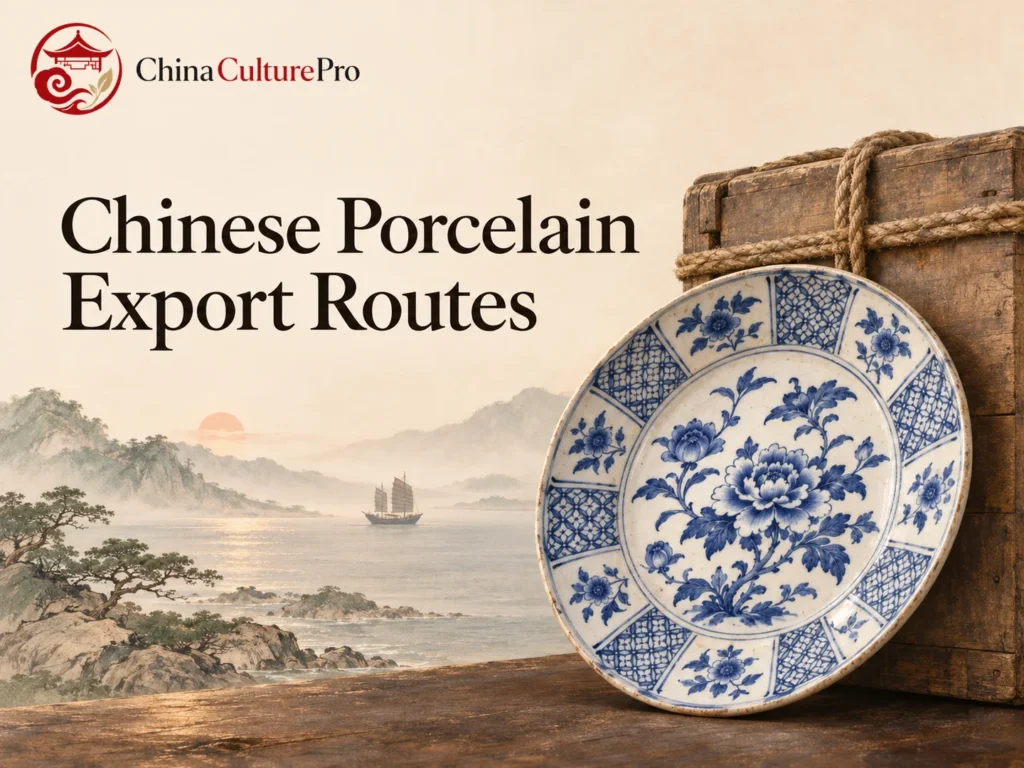
Portuguese and Dutch merchants also carried blue-and-white dishes with a central scene and a rim divided into alternating decorative panels. This type is known as kraak porcelain. The pattern helps identify a kind of export ware. Dishes of that type traveled through more than one trading network. The wider history of Ming porcelain puts these export designs beside wares from different kiln centers and markets.[5][6]
Merchants sometimes packed heavy ceramics low in a ship, where their weight helped provide ballast. Other cargo occupied different spaces. This makes porcelain a useful part of the shipping record. A load of dishes shows both a demand overseas and the practical choices of people who had to fit heavy, breakable goods onto long voyages.[3][5]
How Porcelain Crossed the Pacific to Mexico
The Manila galleon trade linked the Philippines and Acapulco from 1565 to 1815. Chinese merchants brought goods to Manila, where porcelain changed hands and was loaded for the crossing to Mexico. The same network carried American silver west across the Pacific. At Acapulco, traders could sell porcelain locally or move it onward to other American markets. Some Asian goods continued across Mexico and eventually to Spain.[4][5]
The route helps explain why export porcelain could carry European-style designs and still have an early history in the Americas. A dish sold in Mexico could have crossed the Pacific directly from Manila. A similar dish sold in Europe might have reached its buyer through Portuguese or Dutch channels. For an individual object, look for documentary clues such as a wreck association, a recorded purchase or a museum entry that traces the chain of owners. A guide to reading museum collections explains how to use those labels.[3][4][5]
FAQs About Chinese Porcelain Export Routes
Did all Chinese export porcelain come from Jingdezhen?
Jingdezhen was a major center for fine export porcelain, especially blue-and-white pieces. The wider overseas ceramics trade also drew on other places. Sites around Quanzhou and the Tang wreck’s Changsha wares document different production and distribution networks.[1][2][3]
Can a porcelain pattern identify the ship or route?
Usually, decoration narrows the type, date or intended market. To place a piece on a particular voyage, look for additional evidence such as a securely recorded shipwreck or cargo document. Kraak dishes, for instance, reached Europe and the Americas through different networks.[5][6]
Sources
[1] Smithsonian National Museum of Asian Art. Shipwrecked: Tang Treasures and Monsoon Winds
[2] UNESCO World Heritage Centre. Quanzhou: Emporium of the World in Song–Yuan China
[3] The Metropolitan Museum of Art. East and West: Chinese Export Porcelain
[4] The Metropolitan Museum of Art. The Manila Galleon Trade, 1565–1815
[5] Teresa Canepa, Revista de Arqueología Americana. The Spanish Trade in Kraak Porcelain to the New World
[6] Victoria and Albert Museum. Chinese Blue-and-White Ceramics