
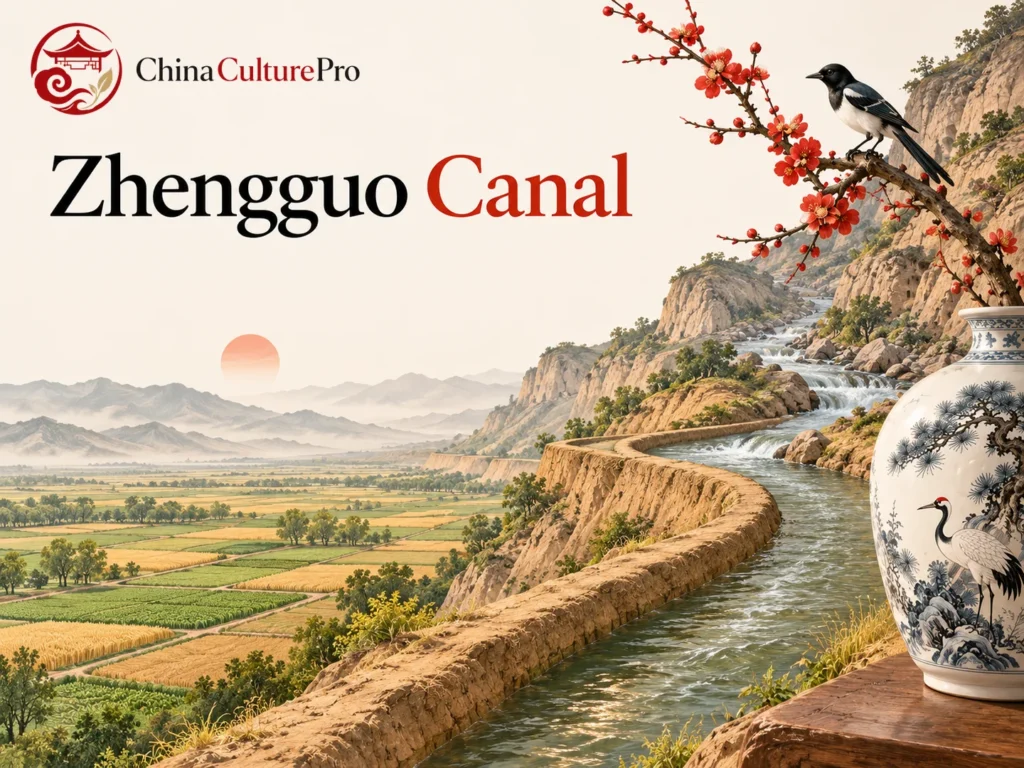

Quick Answer: What Was the Zhengguo Canal?
The Zhengguo Canal (郑国渠, Zhèngguó Qú) was a large irrigation project in the Qin state, begun in 246 BCE. It took water from the Jing River and followed an eastward route across the Guanzhong Plain in what is now Shaanxi.[1][2]
- Source: The Jing River supplied water at the western end.[1][2]
- Route: The main canal followed the terrain toward the Luo River.[1][3]
- Purpose: Water branched toward farmland at lower elevations.[1][3][4]
The system’s intake and channels were rebuilt as the river and irrigation needs changed.[1][3]

Think of the canal as a line along the upper edge of farmland. From a suitably high intake, water could reach a broad area below it. That explains both the project’s agricultural value and why securing water at the intake became a recurring problem.[1][3][4]
Why the Canal Ran East From the Jing River
The main channel followed the land’s contours on an eastward course. From there, water could travel toward lower ground through smaller irrigation channels. Remaining high enough in the landscape was important because it preserved the difference in elevation needed to feed fields by gravity.[1][3][4]
The canal crossed several existing waterways, and the historic route ended at the Luo River. The arrangement differs from the Lingqu Canal, which linked different river basins and was built to support transport. Zhengguo’s central task was distributing water across farmland.[1][3][4][5]
What the Records of the Grand Historian Tell Us
The Records of the Grand Historian says the state of Han sent the hydraulic engineer Zheng Guo to encourage Qin to undertake the project, hoping a large public work would occupy Qin’s resources. When the plan was exposed, the narrative says Qin kept the work going because it could benefit its own agriculture. The canal took Zheng Guo’s name.[2]
The account links better irrigation with Qin’s growing strength before Qin unification. It is evidence for how an early historian understood the project’s political importance. Its claims about agricultural prosperity cannot isolate the canal’s contribution from the other changes that helped Qin expand.[1][2]
How Later Builders Kept the Irrigation System Working
The intake did not stay in one place. The irrigation commission records an upstream shift in 95 BCE and later works that altered the intake, widened sections or added diversion tunnels. As the Jing cut its bed lower, maintaining a route into higher canals required new work.[1][3]
The irrigation district that came to be known as Jinghui continued the regional use of Jing River water. Its modern diversion facilities belong to a later phase. The historical system is visible through successive works, regulations and inscriptions as well as the surviving landscape.[1][3]
FAQs About the Zhengguo Canal
When did construction of the Zhengguo Canal begin?
The International Commission on Irrigation and Drainage gives 246 BCE for the initial construction. This was during the Qin state, before the founding of the Qin dynasty in 221 BCE.[1][2]
How long was the original Zhengguo Canal?
The early account gives more than 300 li. Modern publications by the irrigation commission report different estimates, including about 125 and 150 km. These sources agree on the eastward Jing-to-Luo route.[1][2][4]
Is the modern Jinghui Canal the same structure?
The Jinghui system carries forward the region’s irrigation use of the Jing River. Its newer diversion works, including the dam, belong to later stages of construction.[1][3]
Sources
[1] International Commission on Irrigation and Drainage. Zhengguo Canal Irrigation System
[2] Sima Qian, Chinese Text Project. Records of the Grand Historian, Treatise on Rivers and Canals
[3] International Commission on Irrigation and Drainage. Compendium of World Heritage Irrigation Structures
[4] International Commission on Irrigation and Drainage. Historical Water Sustainability
[5] UNESCO World Heritage Centre. Lingqu Canal, Tentative List