


Quick Answer: What Is a Chinese Huasheng?
Huasheng (花胜, huā shèng), also written 华胜, is a cut-paper or silk flower ornament worn in the hair.[1] A seasonal record describes exchanging huasheng on Human Day (人日, rénrì).[2]
- Materials: Cut paper and silk are documented for floral ornaments.[1]
- Placement: A flower could be put in a bun or tied to a branch.[1]
- Festival: A seasonal record mentions flower gifts as well as separate human-shaped decorations.[2]
Check the wording of the record before giving any flower-shaped pin the same name.
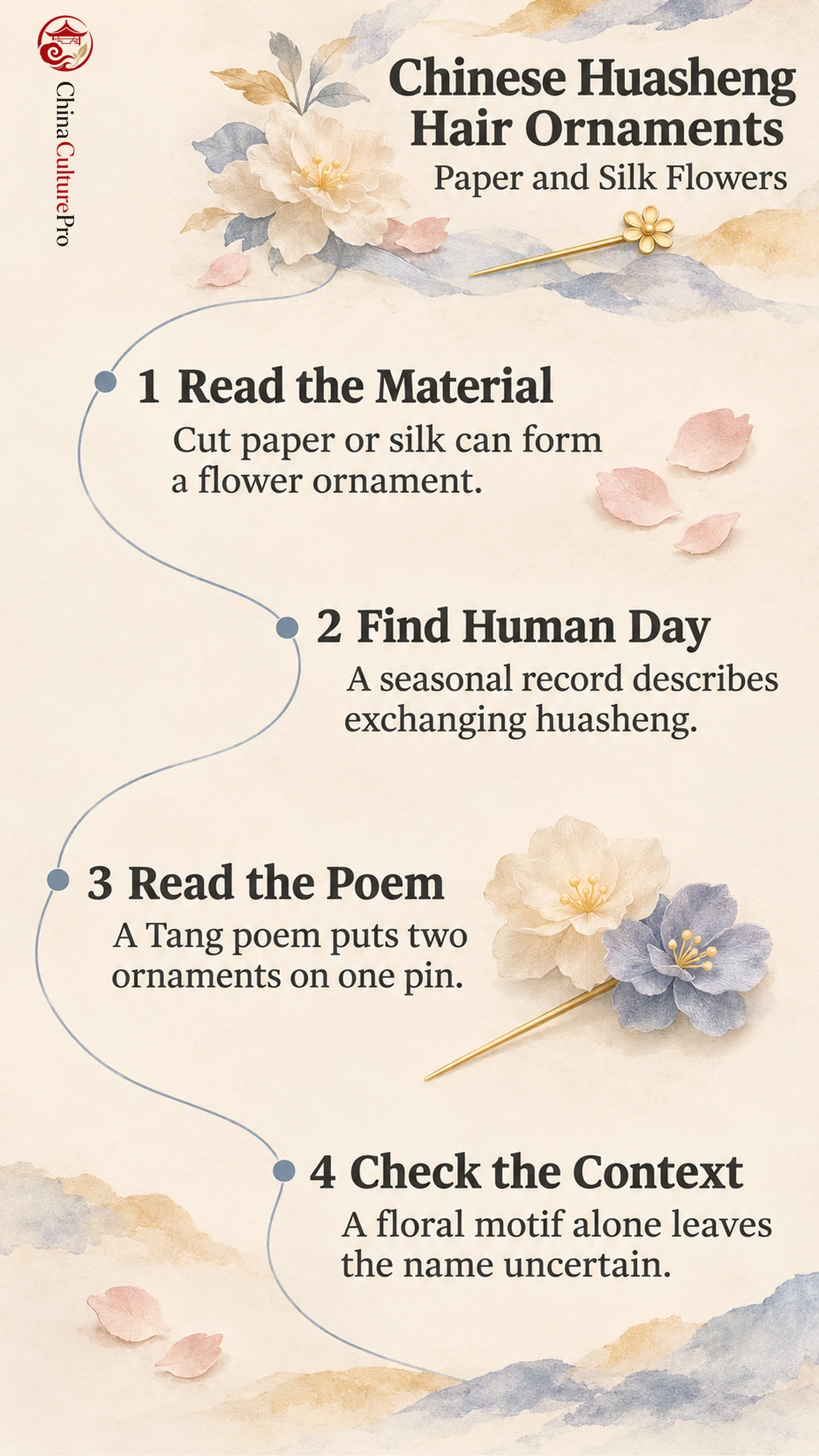
The written record preserves flowers light enough to attach to a bun or branch. It also preserves other festive forms. Their shapes, attachments and occasions give clues about how each was used.
Read the Flower Shape and Materials
The dictionary entry describes flowers cut from paper or silk. The outline itself carries the flower shape. The definition allows for an ornament placed in a bun or tied to a branch. One example of the written name appears in Yuan Zhen’s Tale of Yingying, in which a gift includes a huasheng and something for the lips. The gift places the flower alongside other personal adornments.[1]
Paper, silk and gold foil all appear in historical descriptions of related seasonal decorations. Read the material in its own passage. Gold foil is named for human-shaped cutouts in the Jing and Chu account.[2][4]
What the Human Day Account Records
Seasonal Records of Jing and Chu places Human Day on the seventh day of the first lunar month. The account describes figures cut from colored material or gold foil and displayed on a screen or worn near the hair. It separately records making huasheng for people to exchange. Read the gift exchange separately from the description of figures placed on a screen or in the hair.[2]
The same text describes wearing cut swallows at the Start of Spring (立春, lìchūn). This is a solar term, while Human Day is counted from the first day of the lunar month. The Chinese New Year days guide puts the seventh day in the broader festival sequence.[2][4]
How a Tang Poem Describes the Attachment
Zhang Ji’s poem opens with Human Day and the Start of Spring falling together. The speaker imagines two caisheng (彩胜, cǎishèng), or colorful festive ornaments, on a single gold hairpin. The detail establishes the arrangement in the poem, with two ornaments on one pin. It leaves their exact shape and material unstated.[3]
For that reason, a reconstruction based on the poem can show two pieces on a pin while leaving other design choices open. The guide to Tang poetry gives context for reading a few lines as a scene rather than as a complete description of dress.
Distinguish Huasheng From Other Hair Ornaments
Check what the source calls the ornament and how it was attached. Chinese hair combs have a row of teeth. Buyao hair ornaments are associated with moving details. A floral decoration may be described by its shape or occasion, even when its support is a pin or comb.
Related names for spring decorations also occur in accounts of screen display. Check the stated placement before assuming that a piece was worn. Use the narrower flower name when the shape and context support it.[1][4]
FAQs About Chinese Huasheng
Were huasheng made of real flowers?
The dictionary describes flower forms cut from paper or silk. They could be attached to branches or worn in the hair.[1]
Are Human Day and the Start of Spring the same?
Human Day is the seventh day of the first lunar month. The Start of Spring is a solar term. Zhang Ji describes an occasion when they fell on the same day.[2][3]
Is every floral hairpin a huasheng?
A flower motif alone leaves the name uncertain. Look for a record naming the ornament and evidence of its material, placement or use.[1][4]
Sources
[1] Ministry of Education, Taiwan. Huasheng Dictionary Entry
[2] Zong Lin. Seasonal Records of Jing and Chu
[3] Zhang Ji. Human Day Falls on the Start of Spring
[4] Wang Zilin, Journal of Gugong Studies. Furnishings of the Qianlong Emperor’s Retirement Palace