

Quick Answer: What Is a Buyao Hair Ornament?
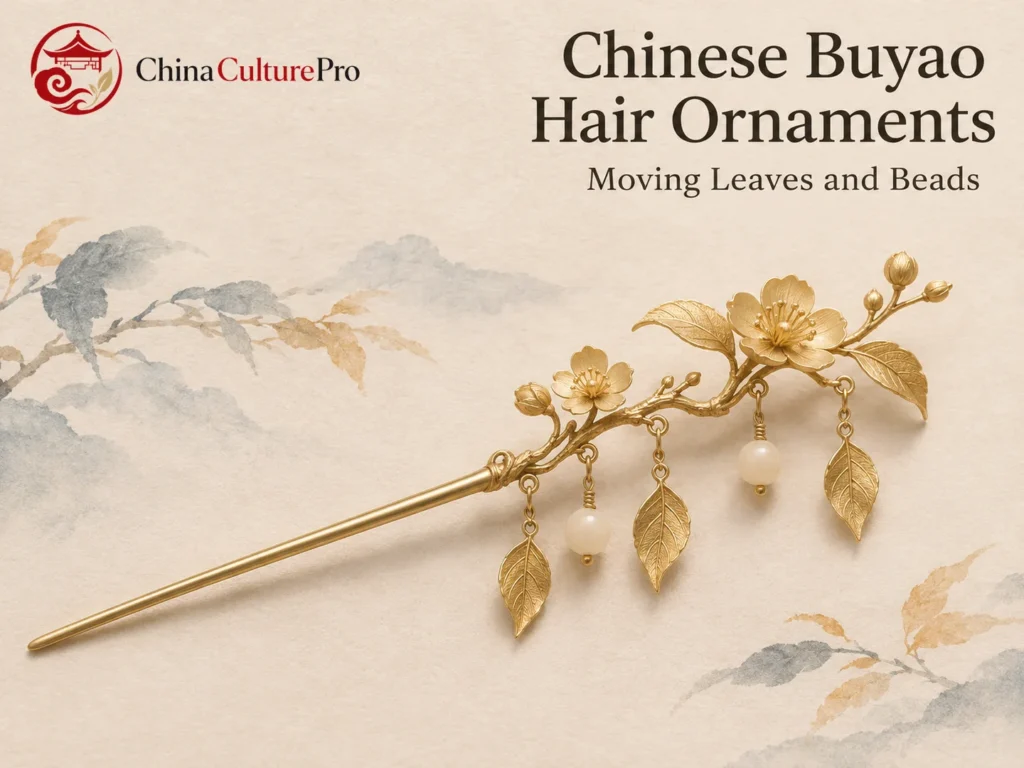
A buyao (步摇, bùyáo) is a Chinese head ornament designed to move as the wearer walks. Small leaves can hang from rings, beads can swing on drops and thin branches can flex. The name refers to this movement.[1][4][6]
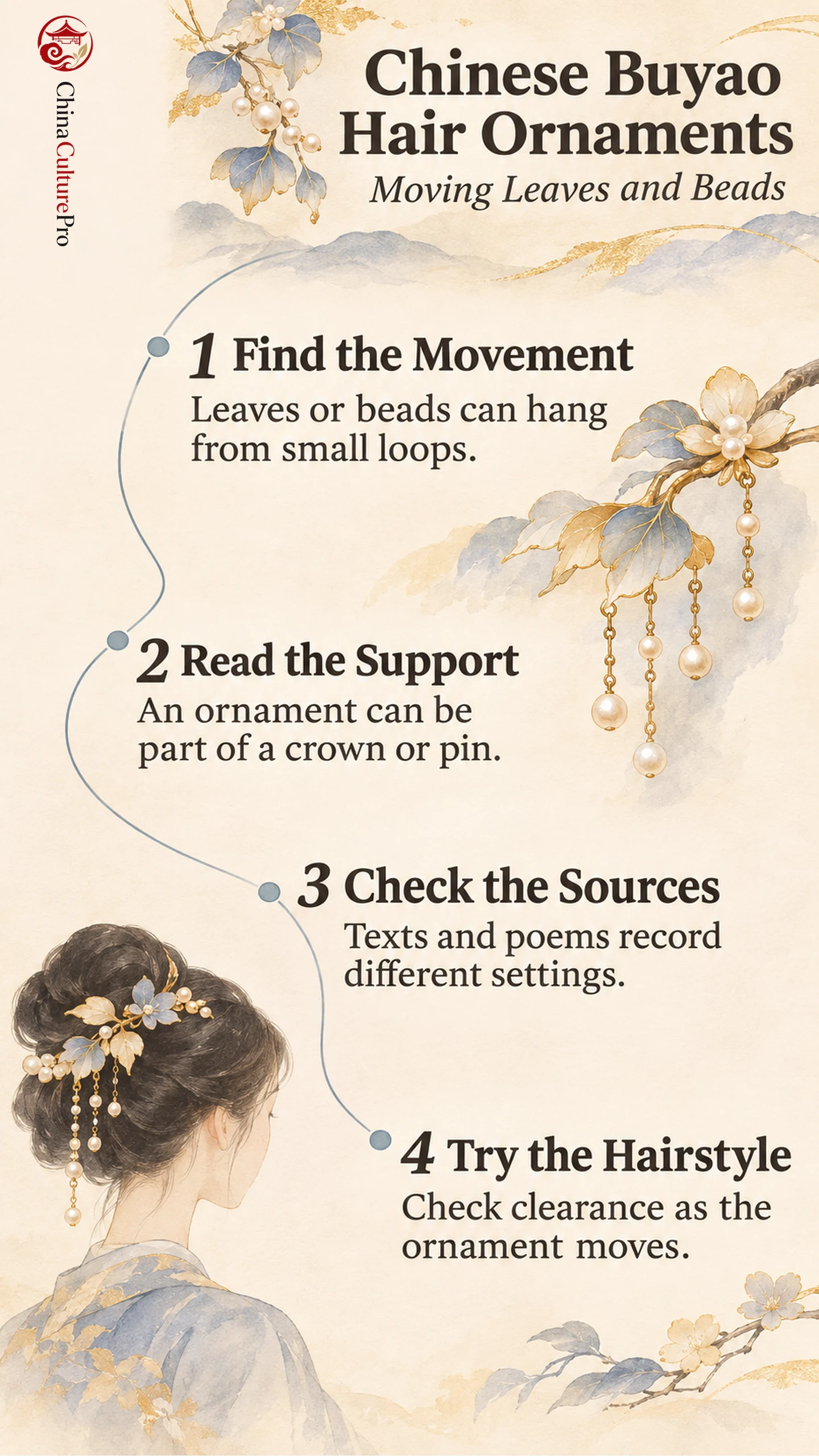
- Look for the joint: Some gold examples suspend each leaf from a separate loop.[1][2]
- Look at the support: A movable ornament can be attached to a pin or form part of a crown.[2][3][6]
- Check the space around it: Hanging or flexible parts need room to move around the hair and costume.
Compare the moving parts and the mounting before identifying an ornament from its decoration.
A gold leaf suspended from a ring responds to a step differently from a leaf fixed solidly to a hairpin. Look at the ends of a branch and the joints between pieces. The connections show which parts can swing or flex when the wearer moves.
Find the Parts That Move
Start at the part that anchors the ornament. On an individual pin, this may be a stem that sits in the hair. Then look for loops, hanging beads or spring-like branches. Taiwan Historica describes both hanging ornaments and branches formed from curled silver wire. The movement depends on the connection between the decorative part and its support.[6]
Read a close-up from the base to the tips. A loop can hold a dangling leaf without fixing it rigidly. A Chinese hair comb has a different kind of support, and huasheng ornaments have their own forms and settings. Hair ornaments can share floral motifs while using different structures.
Compare Gold Leaves and Crown Ornaments
A National Museum of China buyao uses a horse-head base with branching shapes like antlers. A small loop at each branch tip holds a gold leaf, and the base and branches have inset decoration. The museum discusses it in the context of northern steppe traditions.[1]
A related piece has an ox-head base. The museum describes casting the head and horns and adding colored inlays. Fourteen peach-shaped gold leaves hang at the tips. Compare the small loops to see how thin leaves can move independently of the heavier base.[2]
A gold buyao crown from the Northern Yan burial of Feng Sufu gives a separate example. The museum describes six branches, each with three loops holding separate leaves. Researchers tried combining the excavated frame with a gold cicada ornament found in the same tomb to explore the original arrangement. The listed frame is 29 centimeters high. Its size and branches show what the metalwork preserves, while the reconstruction proposes how separate pieces may have sat together.[3]
What Texts and Poetry Describe
The encyclopedia Taiping Yulan preserves an earlier explanation connecting the name with moving beads. It also quotes an account of an empress’s ornament that combines gold, white beads and branching forms. The text describes ceremonial ornament in one context.[4]
In Bai Juyi’s Song of Everlasting Sorrow, a gold buyao appears among the details of Lady Yang’s appearance. The poem establishes a literary use of the name and the gold ornament in its scene. Read it alongside Tang poetry and use dated objects or images to study the cut and layering of Tang women’s clothing.[5]
Check a Buyao With the Hairstyle
Check the mounting before you choose the longest drops. For a modern pin, try it in the intended hairstyle and turn your head to see whether the ornament shifts. Leave enough clearance around your face and around hanging earrings.
If the outfit includes a bridal crown or a bridal fan, rehearse the combination. Note where each drop or branch travels when the wearer turns. Check the motion while walking and lowering the fan.
FAQs About Chinese Buyao Hair Ornaments
Is every Chinese hairpin a buyao?
The name refers to a design with moving elements. A pin with a hanging bead or flexible branch can show this feature. A fixed ornament stays in the same position relative to its stem.[6]
Did all buyao use gold?
Several excavated examples use gold, while other descriptions include beads, jade and flexible silver wire. Check the material and the method separately.[1][4][6]
Were historic buyao only individual hairpins?
The term can describe an individual ornament or movable pieces mounted on a crown. The Northern Yan find is an example of crown construction.[2][3]
Sources
[1] National Museum of China. Gold Buyao With a Horse Head and Antler-Like Branches
[2] National Museum of China. Gold Buyao With an Ox Head and Antler-Like Branches
[3] Shenzhen Museum. Gold Buyao Crown From the Feng Sufu Burial
[4] Taiping Yulan. Buyao, Volume 715
[5] Bai Juyi. Song of Everlasting Sorrow
[6] Taiwan Historica. Folk Objects: Buyao