


Quick Answer: What Does a Chinese Garden Bridge Do?
A Chinese garden bridge connects paths across water and gives people a place to see the garden from a different position. Its height, turns and cover can change what comes into view during the crossing.[1][2][3][5]
- Flat bridge: A low span keeps the walker close to the surface of the water.[1][5]
- Arched bridge: A rising deck changes the height of the eye and creates a distinct outline above the water.[1]
- Covered or turning bridge: A roof can frame views across the water. Turns bring the walker toward different parts of the garden.[1][2][4][5]
Look at where the bridge begins and ends, then compare the view from its middle with the view from the bank.[1][5]
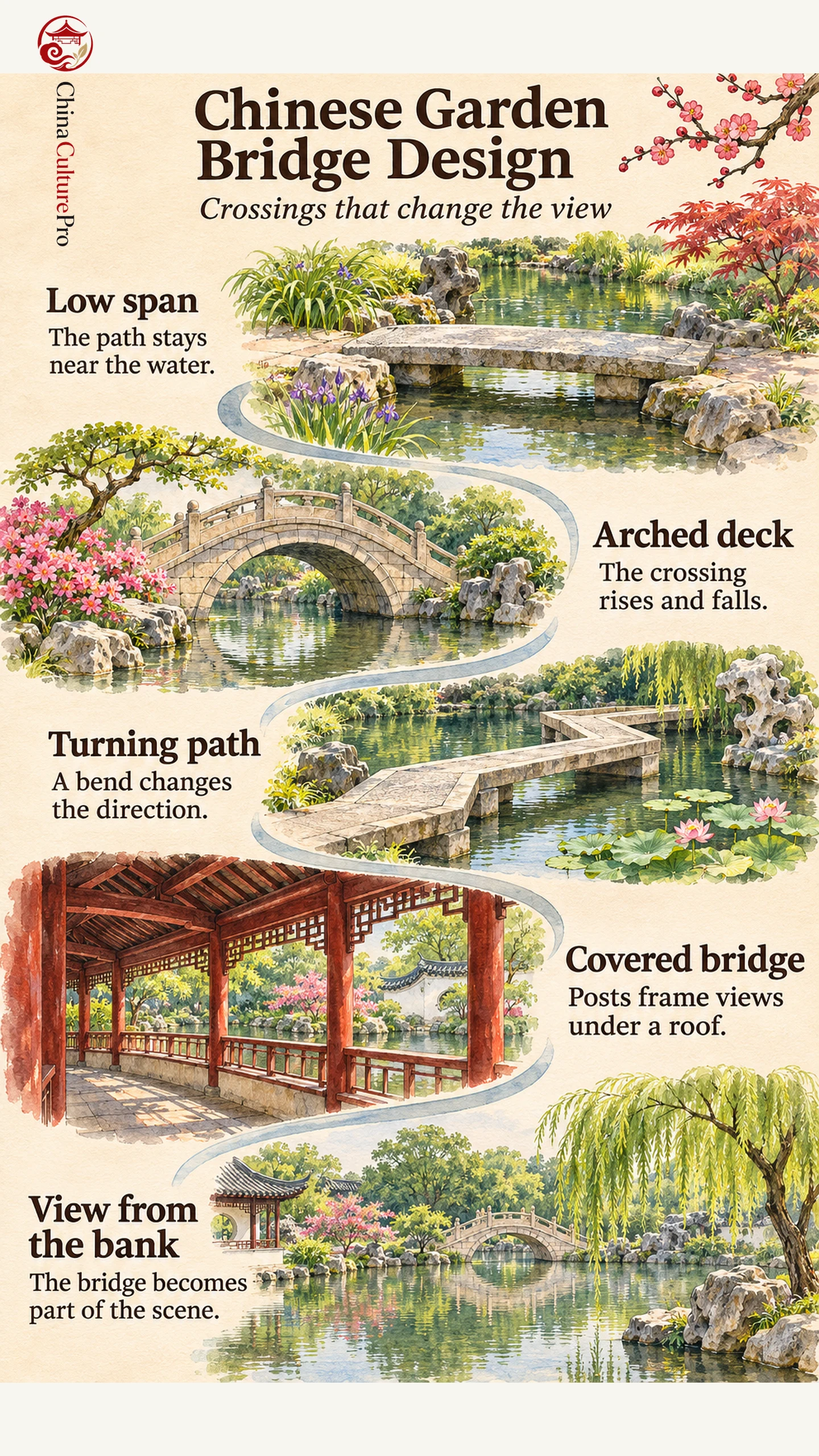
A bridge that looks small from a pavilion can divide a large scene into several views once you step onto it. Its deck carries the path, while its roof or railing can become part of the scene seen from across the pond.[1][2][5]
Flat, Arched, Zigzag and Covered Crossings
| Form | What changes during a crossing |
|---|---|
| Flat or low | The path stays close to the water and can continue the level of the banks. |
| Arched | The deck rises toward a high point, then brings the walker down toward the opposite shore. |
| Zigzag | Turns change the walker’s direction across the water. |
| Covered | A roof and its supports enclose part of the view and provide shelter. |
These words describe different aspects of a bridge. A roof can cover a nearly level passage, and a low deck can turn in plan. Chinese covered bridges discusses the roofed passage as a building type. In a garden, the crossing also contributes to the composition of paths, banks and water.[1][3][4][5]
Two Suzhou Bridges at Different Scales
The Small Flying Rainbow Bridge (小飞虹, Xiǎofēihóng) in the Humble Administrator’s Garden is a three-span stone bridge with a roofed passage. A Jiangsu account places it on the north side of the Small Canglang water court. From outside, its railings and roof mark a line across the water. From inside, the supports and openings determine which part of the court can be seen at a given point.[1][2][5]
The Yinjing Bridge (引静桥, Yǐnjìng Qiáo) in the Master-of-Nets Garden makes a much shorter crossing. The Jiangsu account gives its length as 2.4 meters. Its small scale puts the pond and surrounding buildings in the foreground of the composition. Compare what a short bridge can do near a narrow part of the water with what a roofed passage does across a larger court. Both gardens are part of UNESCO’s Classical Gardens of Suzhou property.[1][3]
What Changes as You Cross
Begin at the approach, where the destination can be partly screened by a wall, bank or planting. A small change of height makes the water’s edge visible from a different angle. A turn can bring another bank or pavilion into view. Shanghai’s Nine Zigzag Bridge (九曲桥, Jiǔqū Qiáo) is a documented example of a route with successive changes of direction near the approach to Yuyuan Garden.[4][5]
Look back after crossing. From the far bank, a low bridge can separate near and distant water in the same view. Its reflection can repeat the shape when the water is still. Chinese garden water design explores the pond and its edges. Chinese garden views and framing examines how the sequence of viewpoints makes the scene change.[2][3][5]
FAQs About Chinese Garden Bridge Design
Are all Chinese garden bridges zigzag?
Chinese garden bridges include straight, arched, covered and turning forms. A zigzag bridge gives the path successive changes of direction.[1][4]
Why is a bridge sometimes covered?
A roof shelters the crossing and creates an interior passage from which people can look out. Suzhou’s Small Flying Rainbow Bridge is a documented example.[1][2]
What should you look for when crossing a garden bridge?
Compare the direction of the path, the height of the deck and the view toward each bank. Those features show how the bridge connects movement with the water and the garden around it.[1][5]
Sources
[1] Jiangsu culture and tourism journal. Suzhou garden bridges, including Small Flying Rainbow and Yinjing
[2] Suzhou Municipal Bureau of Culture, Radio, Television and Tourism. Humble Administrator’s Garden and its bridges
[3] UNESCO World Heritage Centre. Classical Gardens of Suzhou
[4] Shanghai municipal portal. Yuyuan Garden and the Nine Zigzag Bridge
[5] Smarthistory. Garden of the Humble Administrator and its changing views