


Quick Answer: What Does Water Do in a Chinese Garden?
Water design (理水, lǐshuǐ) arranges the shape of a pond, the form of its banks and the positions from which people see it. In Suzhou’s classical gardens, broad basins create open views, while islands, narrow channels and bridges can make connected water look like several scenes.[1]
- Basin: An open surface gives the eye room to travel.
- Edge: Stone, plants and buildings define where land meets water.
- Reflection: A still surface brings an image of the surroundings into the pond.
The Master of the Nets Garden and the Humble Administrator’s Garden show how the balance between open water and smaller bays can suit different settings.
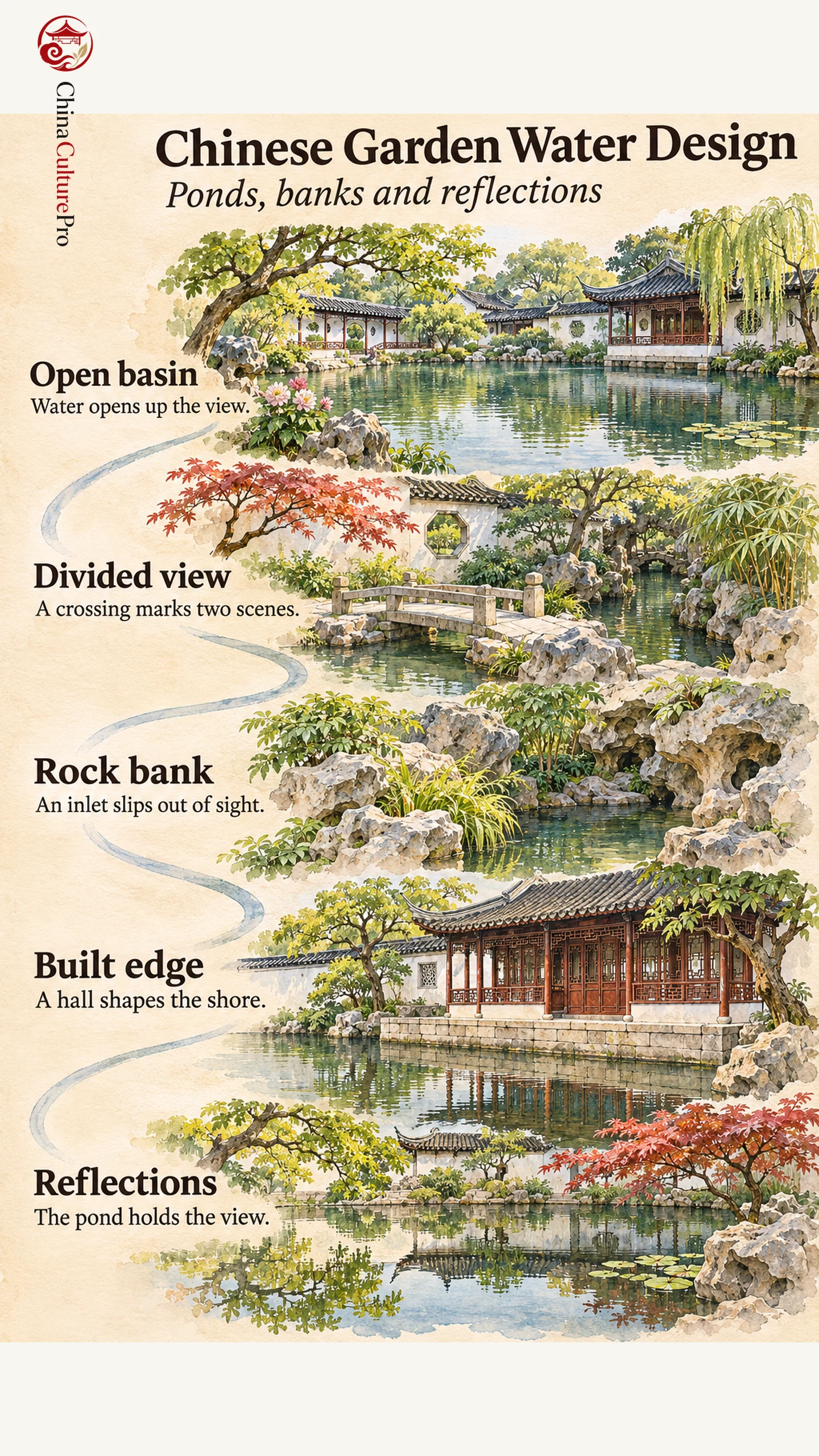
Look across a Suzhou garden pond and you may see the same pavilion twice, once on the bank and again in the water. The pool also directs the route around it and helps determine how much of the garden you see from each stop.
Open Ponds and Divided Water in Suzhou
The Suzhou garden authority distinguishes the effect of collecting water into a broad area from that of dividing the view into smaller parts. The Master of the Nets Garden has a concentrated main pond with low structures along its edge. Smaller inlets interrupt the shoreline without breaking up the main basin. The open basin remains the primary scene.[1]
In the central section of the Humble Administrator’s Garden, islands, trees, buildings and crossings interrupt views of a connected body of water. A broad section north of the Hall of Distant Fragrance anchors the composition. Narrower branches and water courts produce more enclosed scenes.[1] A viewer can see the main pool from one place and follow a much smaller stretch from another.
A garden bridge can mark a division where the water narrows. The eye reads the two sides as different areas, even while the water remains connected underneath. UNESCO’s account of Suzhou emphasizes how stone, water, plants and buildings work together in miniature landscapes.[2]
How Banks and Buildings Shape the Water’s Edge
An irregular rock bank can make the meeting of land and water look gradual. A straight built edge gives a courtyard or pavilion a sharper outline. The Suzhou garden authority records both earthen and stone banks and describes the use of waterside buildings to vary the shore.[1] A single pond can present a rough bank at one end and a long architectural edge at another.
At the Master of the Nets Garden, the authority describes recesses among the rocks at the pond edge where the surface appears to continue out of sight.[1] A small opening gives the impression of more water beyond. Here the suggestion of distance comes from the profile of the shore as much as from the pond’s actual size.
The bank also decides where a viewer can look down at water or across it. Close to a low edge, nearby ripples and plants stand out. From inside a waterside hall, the far shore can fill the opening as a single broad scene.
Reflections, Plants and Views Across the Pond
Reflections change with weather, light and viewpoint. In calm water, a roof and its reflection form a tall shape across the shore. When wind breaks the reflection, the water becomes more visible as a surface in its own right. A bed of lotus can obscure part of that surface, an example of how seasonal planting changes a familiar view.
The Huntington’s Suzhou-inspired garden places its Lake of Reflected Fragrance in a natural basin that once collected seasonal rain. Its paths and buildings provide views around and above the lake.[3] Comparing a low view with a high one shows how garden framing depends on the position of the viewer.
FAQs About Chinese Garden Water Design
Are Suzhou garden ponds naturally formed?
Many were excavated or shaped. The Suzhou account describes ponds made in a landscape with waterways and a high water table. Their present shapes reflect design as well as local conditions.[1]
Does a bridge divide a pond into separate bodies of water?
A bridge can divide the view while leaving the water connected. Look at the opening beneath the crossing and the shore on both sides.[1]
Why are some views of water kept narrow?
A narrow view can make the water seem to continue beyond the visible edge. It also creates a smaller scene to set against a broad, open pond.
Sources
[1] Suzhou Gardens and Landscaping Administration. Water Design in Suzhou Gardens
[2] UNESCO World Heritage Centre. Classical Gardens of Suzhou
[3] The Huntington. Liu Fang Yuan and the Lake of Reflected Fragrance