
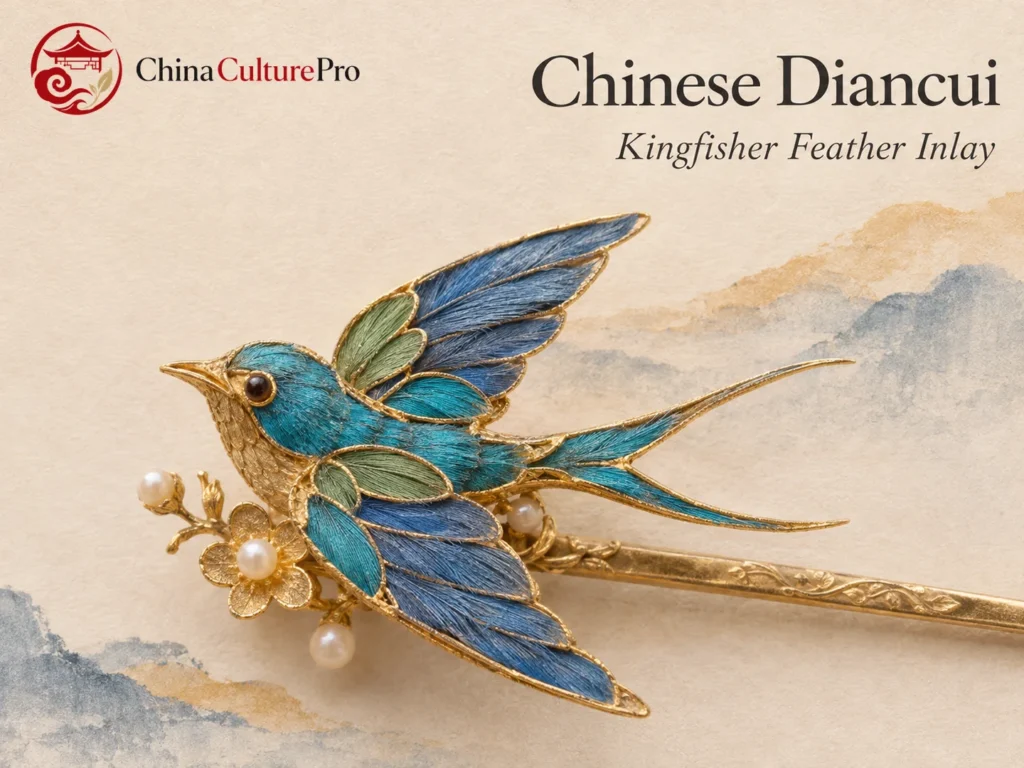

Quick Answer: What Is Chinese Diancui?
Diancui (点翠, diǎncuì) is a Chinese decorative technique that uses kingfisher feathers to color part of an object. On jewelry, the feathers can be fixed within metal outlines to form blue or blue-green passages in a design.[1]
- Support: Metal frames or outlines can define the feather-covered areas.[1]
- Color: Microscopic structures in the feathers produce much of the visible blue.[2][3]
- Objects: The technique appears on crowns, headdresses and smaller ornaments.[1][4][5]
Use the documented material and a close view of the surface to distinguish feather work from blue enamel.

A metal outline can make a blue wing or flower look like enamel. On a diancui ornament, the blue area can instead be made of fine feathers. In a close view, follow the blue surface all the way to the metal edge.
See How the Feathers Sit on the Support
In historical metalwork, metal lines can trace the pattern around lower areas on a support. Feather material is attached in those areas. Gold-colored edges, pearl settings and stones can sit beside the feathers on the same object. The technique supplies color inside a design that may also contain metalwork and stone settings.[1]
A court hanging screen dated to the seventeenth or eighteenth century carries feather decoration across a larger scene of birds and flowers. Conservation analysis identified kingfisher feathers and feathers from other birds, arranged in different ways on the support. The screen is an example of the technique beyond small personal ornaments.[6]
Why the Blue Changes Across a Design
Kingfisher feather blue is structural color. Tiny features in the feather interact with light so that the surface appears blue. Microscopic study of Qing court objects also found that the direction and density of the feathers and the color below them can affect how a passage looks.[2][3]
In a detail image, compare neighboring areas inside the same outline. Their blue may vary as the feather direction changes. Experimental conservation research also found that pressure or adhesive can affect visible color. Use the condition record to distinguish a deliberately darker area from a later change.[2][3]
Compare a Crown, a Headdress and a Swallow
On the Ming crown of Empress Xiaoduan, eight feather-decorated phoenixes occupy the front and a ninth phoenix sits behind. Pearl drops, gemstones and gold ornaments share a lacquered bamboo and silk structure. Compare the object’s ceremonial context with modern bridal crowns inspired by fengguan.[5]
A Qing headdress known as a dianzi (钿子, diànzi) uses feather work beneath floral ornaments made with pearls, coral and other stones. Its frame uses iron wire wrapped in black textile. A nineteenth-century swallow hair ornament uses a gilded silver support with blue feather work, glass, pearls and ruby. The swallow’s association with marriage gives it a trousseau context without identifying who wore the surviving example.[1][4]
Tell Feather Inlay From Fired Enamel
In diancui, a blue area contains feather material attached to a support. In Chinese enamel jewelry, color can come from glass fused to metal. Metal outlines may appear in both. For a comparison of how the outlines themselves are formed in enamel, see cloisonné and champlevé.[3]
Look for feather texture in a high-resolution detail and confirm it in the material list. On a hair ornament, check the feather surface separately from any dangling beads or ornaments. The guide to Chinese buyao hair ornaments shows what to look for in suspended or flexible decorations.
FAQs About Chinese Diancui
Why does diancui look blue?
The microscopic structure of the feathers produces the visible blue. Direction, packing and the backing can change how the color appears in an ornament.[2]
Was diancui used only for hair ornaments?
No. An imperial hanging screen with birds and flowers preserves feather decoration on a larger surface.[6]
Is a blue field with gold outlines always feather work?
Metal can outline both feather and glass decoration. Check the material named in the catalog and the close-up appearance of the blue surface.[1][3]
Sources
[1] The Palace Museum. Qing Diancui Headdress
[2] Gu and colleagues, The Palace Museum. Microscopic Inspection of Qing Court Feather Work
[3] Michaela Paulson and Ellen Pearlstein. Visible Effects of Adhesive and Pressure on Color in Kingfisher Feathers
[4] The Walters Art Museum. Swallow-Shaped Hair Ornament
[5] National Museum of China. Empress Xiaoduan’s Nine-Dragon and Nine-Phoenix Crown
[6] Gu and colleagues, Heritage Science. Feather Decoration on a Chinese Imperial Hanging Screen