

Quick Answer: What Were Chinese Court Necklaces?
Qing court necklaces, or chaozhu (朝珠, cháozhū), were ceremonial accessories with a long loop of beads and attached strands.[4]
- Main beads: Documented sets include necklaces with 108 pearls or 108 glass beads in the loop.[1][2]
- Fittings: Larger separators, textile ribbons and pendants can be made of different materials from the main beads.[1][2]
- Court use: Dress rules gave eligibility to particular groups of officials and members of the imperial household.[4]
Use the material list with the object’s provenance before assigning a wearer or rank.

The color of the main loop is only one feature of a Qing court necklace. To read its construction, trace the strand and then look for material changes where the loop meets the separators, silk and pendant fittings.
Read the Materials by Component
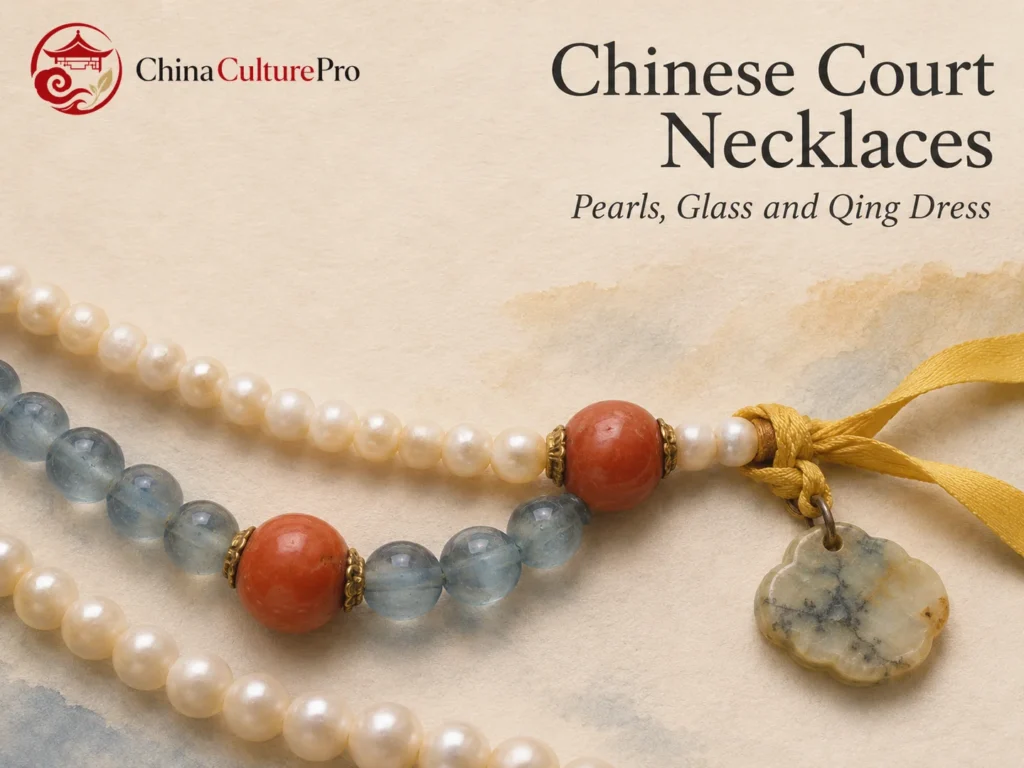
A Shunzhi-period necklace with Eastern pearls (东珠, dōngzhū), freshwater pearls from northeastern China, uses four coral dividers. A yellow ribbon connects the loop assembly to the beiyun (背云, bèiyún), the ornament worn at the back. The side strings add turquoise and ruby. The changes in material help you distinguish the main loop from the separate parts suspended from it.[1]
On a nineteenth-century example from the imperial workshops, the main loop alternates light blue glass spheres with small pale spacers. The small pale discs separate the larger blue glass beads along the loop. See the Qing court beads guide for the full wearing arrangement and the conventional bead count.[2]
Compare Three Qing Necklaces
The catalog material tells you what a particular object is made of. Compare the main material with the smaller features listed for each object.
| Documented necklace | Materials in the catalog |
|---|---|
| Shunzhi Eastern pearl necklace | Freshwater pearl loop, coral dividers and a yellow textile ribbon.[1] |
| Nineteenth-century imperial workshop necklace | 108 light blue glass spheres with small ivory spacers and pink crystal elements.[2] |
| Nineteenth-century official necklace | Amber, jadeite and imitation coral.[3] |
Another court necklace is cataloged as a combination of glass, stone and kingfisher feather. A photograph of a glossy bead may leave its material uncertain. Feather also produces vivid color through a different structure. The Chinese diancui guide explains the feather material.[5]
Understand What Rank Rules Controlled
The Qing court adapted a bead arrangement associated with Buddhist rosaries into part of prescribed dress. Eighteenth-century illustrated regulations codified the court’s ceremonial ensemble. The rules included civil officials from the fifth rank and military officers from the fourth rank, as well as the emperor and members of the imperial household.[4]
The palace account restricts Eastern pearl necklaces to the emperor, empress dowager and empress at major palace ceremonies. Read that restriction with the specific material named in the record, Eastern pearls. For the role of the rest of the ensemble, see the guide to Qing court and informal robes.[1]
Identify Court Necklaces in Context
A Qing neck ring called a lingyue (领约, lǐngyuē) served a different purpose in women’s ceremonial dress. A surviving circular gilt-copper ring is set with dyed bone and pearl and has a yellow tie. Its rigid metal band sits at the neck, while the beaded chaozhu hangs as a long loop.[7]
Strung jade and other materials appear in much earlier dress. One Warring States set combines jade, agate, turquoise and crystal. The object record identifies it as a waist ornament. See the Chinese jade pendants guide for more examples of how these groups were strung and worn.[6]
Use the main loop, attached strands and back ornament together to identify a Qing court necklace. Then check the documentation for the date, dress type and person. A material identification tells you about an object even when the name or rank of its wearer is unknown.
FAQs About Chinese Court Necklaces
Could Qing court necklaces use glass?
Yes. One example attributed to the imperial workshops uses blue glass for all 108 main beads. Its other components include crystal, textile and stone.[2]
What are Eastern pearls?
In Qing court dress records, Eastern pearls are freshwater pearls from northeastern China. They were prized for particular types of regalia.[1]
Does bead color identify the wearer’s rank?
Color was one part of court dress. Use the catalog material, ribbons and evidence of the original wearer or occasion to interpret the necklace.[3][4]
Sources
[1] The Palace Museum. Shunzhi Court Necklace With Eastern Pearls
[2] Corning Museum of Glass. Ceremonial Court Beads, 51.6.293
[3] The Metropolitan Museum of Art. Official Necklace, 02.18.924
[4] Smithsonian National Museum of Asian Art. Chinese Court Necklace in Blue Glass
[5] Isabella Stewart Gardner Museum. Court Necklace, C15e27
[6] National Museum of China. Warring States Jade Pendant Set
[7] The Palace Museum. Gilt Copper Neck Ring With Dyed Bone