

Quick Answer: What Are Chinese Antiquities?
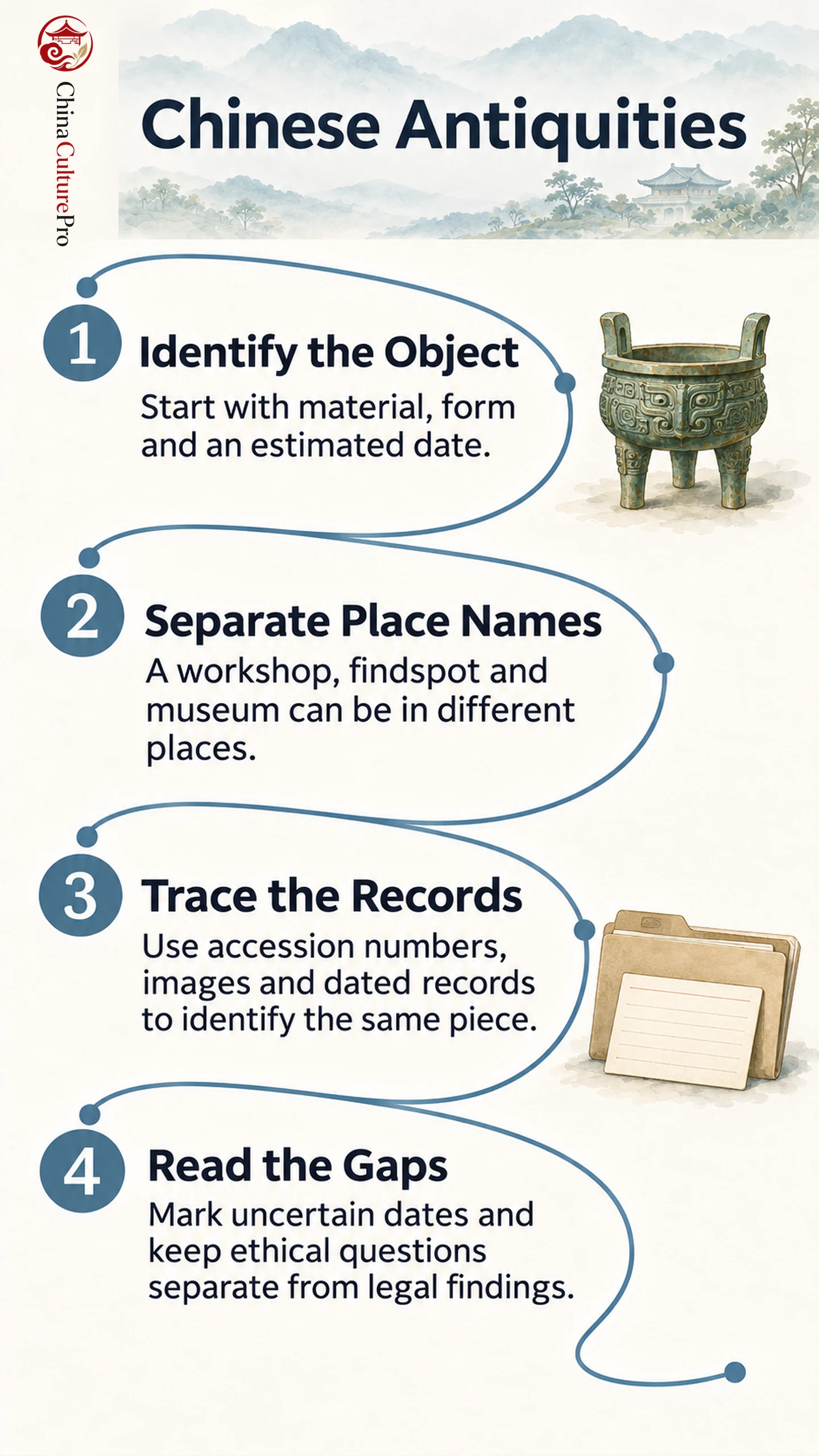
Chinese antiquities include objects from earlier periods such as bronze vessels, carved jade, ceramics and sculpture. A collection record can describe the object’s material and estimated date, its place of discovery, and who held it.[1][2]
- Object type: Form and material help identify what survives.
- Archaeological context: A recorded find can show where the object lay and what was found alongside it.
- Provenance: Ownership and custody records trace the object through collections or institutions.
A label may be precise about one of these fields and tentative about another.
A bronze vessel and its museum label tell different parts of the same story. The vessel preserves evidence of its manufacture, while the label may record a tomb, a donor or a gap in the years between discovery and display.
What Kinds of Objects Appear in Collections?
Begin with the kind of object the record describes. Look for a named form as well as a material. A handle or perforation can narrow down how an object was used, while a surviving inscription may supply a name.
| Object type | What to look for |
|---|---|
| Bronze vessels | Handles, lids, legs and inscriptions help distinguish vessel forms and may preserve names. |
| Carved jade | Shape, perforations and carving can help distinguish ornaments, fittings and ritual forms. |
| Ceramics | The body, glaze and shape can help relate a piece to a production tradition. |
| Sculpture | Material, pose and attributes can help identify a figure or its role within a larger ensemble. |
Guides to Chinese bronze vessels and jade carving explain the vocabulary behind these catalogue descriptions. Proposed dates and functions depend on the particular object and the available evidence.[2][3]
Where an Object Was Made, Found and Kept
Production place is where an object was made. A findspot is where it was recovered. An archaeological context also records how it lay in relation to a burial, building, shipwreck or other finds. A Longquan celadon vase recovered from the Sinan shipwreck off Korea illustrates how far production and discovery can be separated. The museum lists Sinan under “Provenance,” where the field identifies the recovery area. Its description separately places the kilns in Zhejiang.[2][7]
In 1976, excavators recovered two bronze owl vessels from the tomb of Fu Hao (妇好, Fù Hǎo) at Yinxu (殷墟, Yīnxū) in Anyang, Henan. Each is a zun (尊, zūn), a type of wine vessel. The recorded discovery establishes that the two pieces were found together. They are now held by the National Museum of China and the Henan Museum.[3]
For these vessels, the tomb explains why the two pieces can be studied together even when they are displayed in different museums.
Reading the Evidence Behind an Ownership History
Provenance researchers match dated records to a particular object. An old photograph can help identify the piece through a distinctive detail. An inventory, invoice or accession entry may put it in a collection at a particular date. Compare dimensions, marks and images when two records use a broad description such as “bronze vessel.”[1][2]
The Metropolitan Museum of Art gives sword 30.65.1 a date of about 600 and lists it as a gift from George D. Pratt in 1930. Its description qualifies the proposed tomb findspot near Luoyang with the words “said to have been found.” The gift and the reported discovery have different kinds of support. The credit line anchors a point in the sword’s history and leaves earlier transfers to other evidence.[4]
Use the accession number to find related catalogue entries and separate confirmed dates from estimates or reports. A gap is a period for which the published record gives limited evidence. When the timeline jumps from one confirmed date to another, look for a related collection record or a published update.[1][2]
A dated photograph or exhibition catalogue can establish that an object was in a place by a certain year. That is a narrower conclusion than a complete chain of title. Check what the record actually dates. A catalogue published in one year may reproduce a much older photograph, while an accession entry may record a gift of an object already on loan.[1][2]
Why Gaps Matter and What 1970 Means
Removing an object without documenting its archaeological setting can erase evidence about how it was deposited, what lay beside it and how a site changed over time. Even a well-preserved vessel may retain little evidence of those relationships on its own. An ownership gap can raise a different set of questions about custody and transfer.[2][5]
The 1970 UNESCO Convention sets out measures for States Parties against illicit movement and transfer of cultural property. Article 6 addresses export certificates. Separately, the Association of Art Museum Directors’ 2013 acquisition guidelines generally ask member museums for evidence that covered objects were outside their probable country of modern discovery before the 1970 benchmark or legally exported afterward. The guidelines also discuss exceptions.[5][6]
A gap calls for further research. Read which period is missing and what the institution has published about it before drawing conclusions. The treaty, applicable law and a museum’s professional policy answer different questions.[1][5][6]
FAQs About Chinese Antiquities
Does an old object automatically have a documented provenance?
Age and ownership history are separate. Researchers may date a piece through its materials or comparisons even when earlier records of its custody are sparse.
What does “said to have been found” mean?
It signals that the catalogue is reporting a findspot with a qualification. Look for an excavation report or related object record for a more direct account.
Does a museum accession date establish when an object left China?
It anchors a museum collection event. A prior export would require evidence about an earlier movement.
Is 1970 a universal cutoff for legal ownership?
The year marks a treaty and appears in some museum acquisition standards. Individual ownership questions depend on the applicable law and the particular evidence.
Sources
[1] Smithsonian Institution. Provenance
[2] Smithsonian National Museum of Asian Art. Guidelines and Procedures for Provenance Research
[3] National Museum of China. Expert Commentary on the Fu Hao Bronze Owl Vessel
[4] The Metropolitan Museum of Art. Sword with Scabbard Mounts, 30.65.1
[5] UNESCO. 1970 Convention on the Illicit Import, Export and Transfer of Ownership of Cultural Property
[6] Association of Art Museum Directors. Guidelines on the Acquisition of Archaeological Material and Ancient Art
[7] National Museum of Korea. Longquan Celadon from the Sinan Shipwreck