


Quick Answer: What Is Chinese Academy Architecture?
A Chinese academy (书院, shūyuàn) was an institution for study, teaching and scholarly exchange. Its buildings could include a lecture hall, a library, rooms for students and spaces for honoring teachers or Confucius. Courtyards and gates organize the route between these spaces.[1][2][3]
- Find the lecture hall: It can occupy a prominent place in the teaching compound.[2][3]
- Look for the books: A separate building may hold the collection.[1][2]
- Read the ritual spaces: Temples and shrines can occupy their own courts.[2][3][4]
Begin with the buildings’ uses. The arrangement of those functions can differ between academies.[1][2][4]
A doorway, a court and a hall can look similar across different Chinese compounds. At an academy, the names and uses of the buildings tell you how the institution worked.[1][2]
How an Academy Organizes Learning
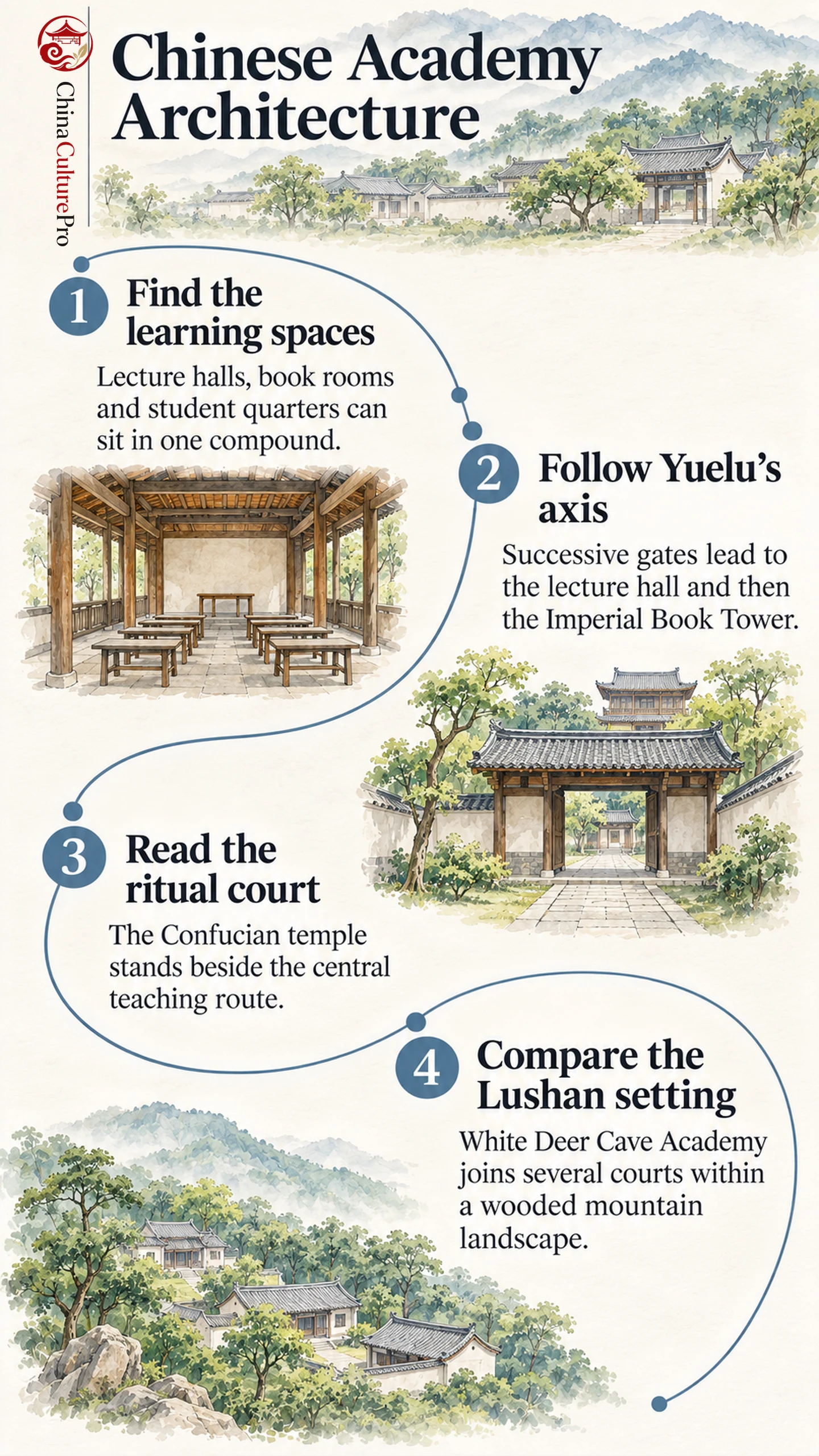
The lecture hall gives formal teaching and discussion a shared room. A library keeps books available beyond the lesson, and student quarters bring study into daily life at the academy. In some academies, a shrine or temple gives ceremonies and remembrance a place of their own.[1][2][3]
Together these spaces show how Chinese education traditions extended from a lecture to private reading, residence and ritual. Follow the route between halls to see which activities the layout groups together and which it places in another court.[1][2][3]
The Central Route at Yuelu Academy
At Yuelu Academy in Changsha, Hunan University’s building record places the lecture hall near the center. The main route goes through successive gates to the hall and then to the Imperial Book Tower. The Confucian temple occupies a separate area beside the teaching buildings. The university identifies Dacheng Hall as that temple’s principal ceremonial space. Student quarters and smaller shrines also occupy flanking areas, so the academy’s main route tells only part of the spatial story.[2][3]
Yuelu was founded in 976. The university dates the surviving five-bay lecture hall to a rebuilding in 1687 and major repairs in 1868. It also records several previous versions of the library and a 1986 rebuilding of the present tower. On the central route, the reconstructed book tower still stands beyond the lecture hall. The placement preserves a connection between the two functions even though the structures date from different campaigns.[2][3]
White Deer Cave Academy in the Lushan Landscape
UNESCO records the White Deer Cave Academy at Mount Lushan in Jiangxi as first established in 940 and revived by Zhu Xi in the late twelfth century. The complex expanded over time to include halls, libraries and ritual buildings. Its mountain setting is part of the larger Lushan cultural landscape.[4]
A site account describes several adjacent courts with their own gates, linked within the compound. Read the individual groups as well as the path that connects them. Stone inscriptions add another way to read the academy, preserving written accounts of teaching and the site. The academy gives physical context to the history of Neo-Confucian learning.[4][5]
FAQs About Chinese Academy Architecture
What did an academy’s book tower do?
It held books used by the institution. At Yuelu, the university records collections assembled through gifts, purchases and publications.[2]
Why might an academy have a temple?
A temple or shrine provides a place for rites honoring teachers or sages. At Yuelu, the Confucian temple serves that ritual role.[1][2]
Are the buildings the same age as the academy?
A foundation date can predate surviving buildings by centuries. Rebuilding and repairs are part of the histories of both Yuelu and White Deer Cave.[2][4]
Sources
[1] Andy Kirkpatrick and Zhichang Xu. Shuyuan and Chinese Writing Instruction
[2] Hunan University, Yuelu Academy. Historic Buildings of the Academy
[3] Hunan Provincial Government. Yuelu Academy and Its Courtyard Layout
[4] UNESCO World Heritage Centre. Lushan National Park and White Deer Cave Academy
[5] Hunan Provincial CPPCC. The Courtyards and Inscriptions of White Deer Cave Academy