
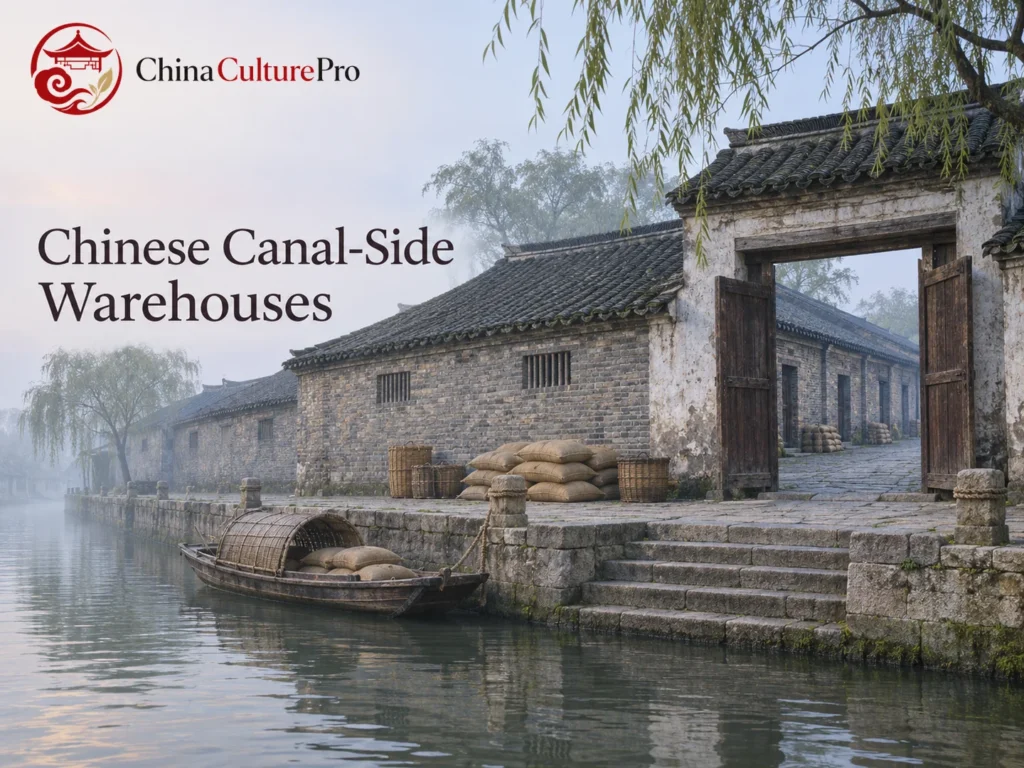

Quick Answer: What Were Chinese Canal-Side Warehouses?
Chinese canal-side warehouses held goods between stages of a journey. In the system of state grain transport (漕运, cáoyùn), storage facilities let officials collect and hold grain for later movement or distribution. A depot might include a landing, a yard and multiple stores.[1][2]
- At the water: The landing connects the boat to the depot.[2][6]
- Inside the compound: Several storage spaces can share a working yard.[3][5][6]
- Below ground: Excavated pits at Huiluo show another way of holding grain in the canal network.[3][4]
The surviving fabric varies by site. Some warehouses stand beside a landing, while others are known from excavated pits or foundations.[3][5][6]

A boat could bring grain into a city in bulk. The depot allowed the cargo to stay on land until it was needed elsewhere. That interval between deliveries helps explain why storage was such a large part of the canal’s built infrastructure.[1][2]
How the Wharf and Warehouse Worked Together
The landing is where the cargo changes hands and leaves the water. Store rooms or pits hold it after unloading. A yard between the stores gives workers a place to move loads across the compound. Where a granary had rooms for processing or administration, those activities could occupy buildings of their own.[2][3][6]
The canal also supported markets and trades. UNESCO identifies official storage and transport of strategic goods as part of the imperial system. The China Grand Canal Museum traces urban and commercial activity alongside it. A building’s position near the water gives a clue to its use, but records or archaeology are needed to identify an official depot.[1][2]
What the Remains at Huiluo and Hexiwu Show
Huiluo near Luoyang served the Sui capital. Excavation has identified a large rectangular compound with management space in the middle, groups of underground storage pits on either side and circulation routes. The management area and roads help explain how separate banks of pits could operate as one depot.[3][4]
At Hexiwu in Tianjin, researchers found twelve building foundations grouped as a storage courtyard. The conservation team interprets the remains as part of a Yuan imperial granary complex. The foundations give the courtyard plan. Roof height and details of the individual stores cannot be read directly from them.[5]
Fuyi Granary and Its Landing in Hangzhou
Fuyi Granary was built between 1880 and 1884 at the junction of the Grand Canal and the Shengli River. Long rows of store rooms formed the core of the Qing compound. A local account also records spaces for husking and pounding rice. The surviving unloading landing helps connect those activities to the water route.[6][7]
The site now includes restored buildings and cultural spaces. Stand at the canal side of the compound and look back toward the rows. The short route inland is as revealing as the rooflines in this example of Chinese architecture.[6][7]
FAQs About Chinese Canal-Side Warehouses
Did a canal granary have to stand directly on the water?
A wharf gave access to the water. Storage spaces could be set back from it within the larger depot.[3][6]
What kind of storage survives at Huiluo?
Excavated circular pits show where grain was held in the Sui compound near Luoyang.[3][4]
What survives at Fuyi Granary?
Much of the original layout and the unloading landing survive. The standing complex includes restored buildings.[6][7]
Sources
[1] UNESCO World Heritage Centre. The Grand Canal
[2] China Grand Canal Museum. The Grand Canal of China
[3] CNR Research Repository. Underground Built Heritage in China, Japan and Italy
[4] Shigaku Zasshi. Sui and Tang Granaries at Luoyang
[5] Xinhua via Hunan Provincial Government. Granary Ruins on an Ancient Waterway Found in North China
[6] Zhejiang Provincial Heritage Authorities. Grand Canal World Heritage Conservation and Management Plan
[7] Hangzhou CPPCC. The Fuyi Granary Compound and Canal Landing