


Quick Answer: What Does a Camellia Mean in Chinese Art?
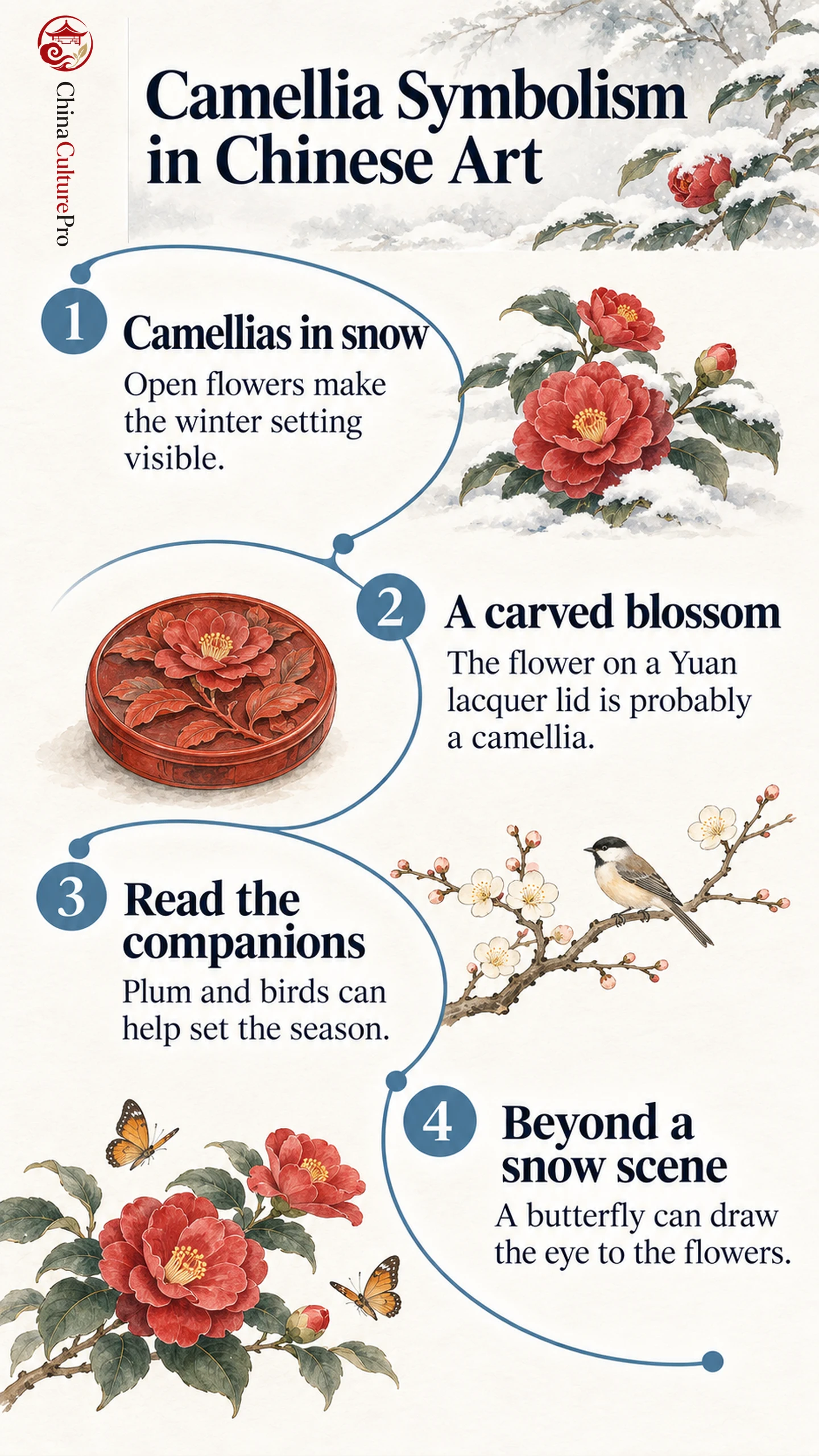
A camellia (山茶, shānchá) can suggest winter and endurance in Chinese art, especially when open flowers appear against snow. In a painting, snow or companion plants can establish the season. On carved lacquer, the flowers can be harder to identify.[1][2][3][4]
- A bloom against snow: Open petals make the cold setting and continued flowering visible at once.[2][3]
- A carved blossom: Rounded layers can resemble a camellia even when the material hides botanical details.[1]
- A flower among others: Plum branches, birds or animals can shift the meaning of the whole scene.[3][4]
Start with the documented scene or object before treating the camellia as a fixed good-luck emblem.
A red bloom in a winter painting can stand out from a distance. On a red lacquer lid, the same color is already part of the material. That difference affects what you can infer from the flower.[1][3]
Camellias in Snow Paintings
Camellia After a Snow, catalogued under the Song painter Lin Chun, makes the timing of the scene part of its title. Look for the relation between the blossoms and the snow rather than asking which abstract idea a flower represents in isolation. The plant’s appearance after snowfall gives the image its particular seasonal character.[2]
Zhou Yuan’s A Stag, a Doe, and Red Camellias in Snow, dated 1367, takes up the same seasonal contrast on a larger scale. The silk painting measures about 180 centimeters tall. The deer and the flowering plants belong to one snowy setting. As the flower catches the eye, it also helps direct attention across the space the animals occupy.[3]
A deer in Chinese art can carry a sound-based wish about official income or appear in a scene of longevity. The object record for Zhou Yuan’s painting identifies the animals and the flowers without specifying that kind of phrase. Snow and red blooms give the viewer a stronger basis for the seasonal reading than the mere presence of deer gives for a particular blessing.[3]
A Likely Camellia on a Yuan Lacquer Box
A fourteenth-century circular box with carved red and green lacquer has a large layered blossom on the lid. The box measures 10.2 centimeters across. The flower is identified as a probable camellia and associated with winter and endurance. It is a plausible reading, but the simplified carving does not preserve everything a botanist would need to name a species.[1]
Compare the blossom with the leaves and buds in its design. A broad, open flower seen from above may be unmistakable as a flower while its exact identity is uncertain. The red color here is the lacquer used to carve the relief. The color of the carved relief belongs to the lacquer layers. The contours of the petals and leaves give you evidence about the subject.[1]
What the Other Plants and Animals Add
In late Ming painting manuals, camellia and plum could appear together with birds in compositions evoking winter. The use of several plants helps establish season in Chinese painting. A camellia belongs in this kind of winter grouping without belonging to the specific Three Friends of Winter, a familiar group made up of pine, bamboo and plum.[4][5]
The camellia can also appear in a composition that asks the viewer to notice something other than snow. Guo Weiqu’s undated Camellia and Butterflies, a hanging scroll in ink and color on paper, places the insects among the flowers. The combination makes a flower-and-insect subject. The butterflies draw attention to the flowering branches. They give the viewer a different clue from the snow in the paintings by Lin Chun and Zhou Yuan.[2][3][6]
Season can work differently for another flower. The autumn begonia often gains its seasonal reading from the poem, title or group of flowers in which it appears. The camellia in snow makes that connection directly visible.[2][3]
FAQs About Camellia Symbolism
Why does camellia suggest winter in Chinese painting?
Its flowers can be depicted open during cold weather. Snow or a grouping with plum and birds provides a seasonal clue in documented examples.[2][3][4]
Can a red blossom alone identify a camellia?
Color alone is a weak clue. Compare the shape, foliage, title and medium. The flower on the Yuan lacquer box is identified as a probable camellia.[1]
Sources
[1] The Metropolitan Museum of Art. Box with Camellia
[2] National Palace Museum. Camellia After a Snow
[3] Smithsonian Institution, National Museum of Asian Art. A Stag, a Doe, and Red Camellias in Snow
[4] Nicholas K. Menzies, Curtis’s Botanical Magazine. Representations of the Camellia in China and During Its Early Career in the West
[5] The Metropolitan Museum of Art. Chinese Gardens: Pavilions, Studios, Retreats
[6] The Metropolitan Museum of Art. Straddling East and West: Guo Weiqu, Camellia and Butterflies