


Quick Answer: What Are Buddhist Bells Used for in China?
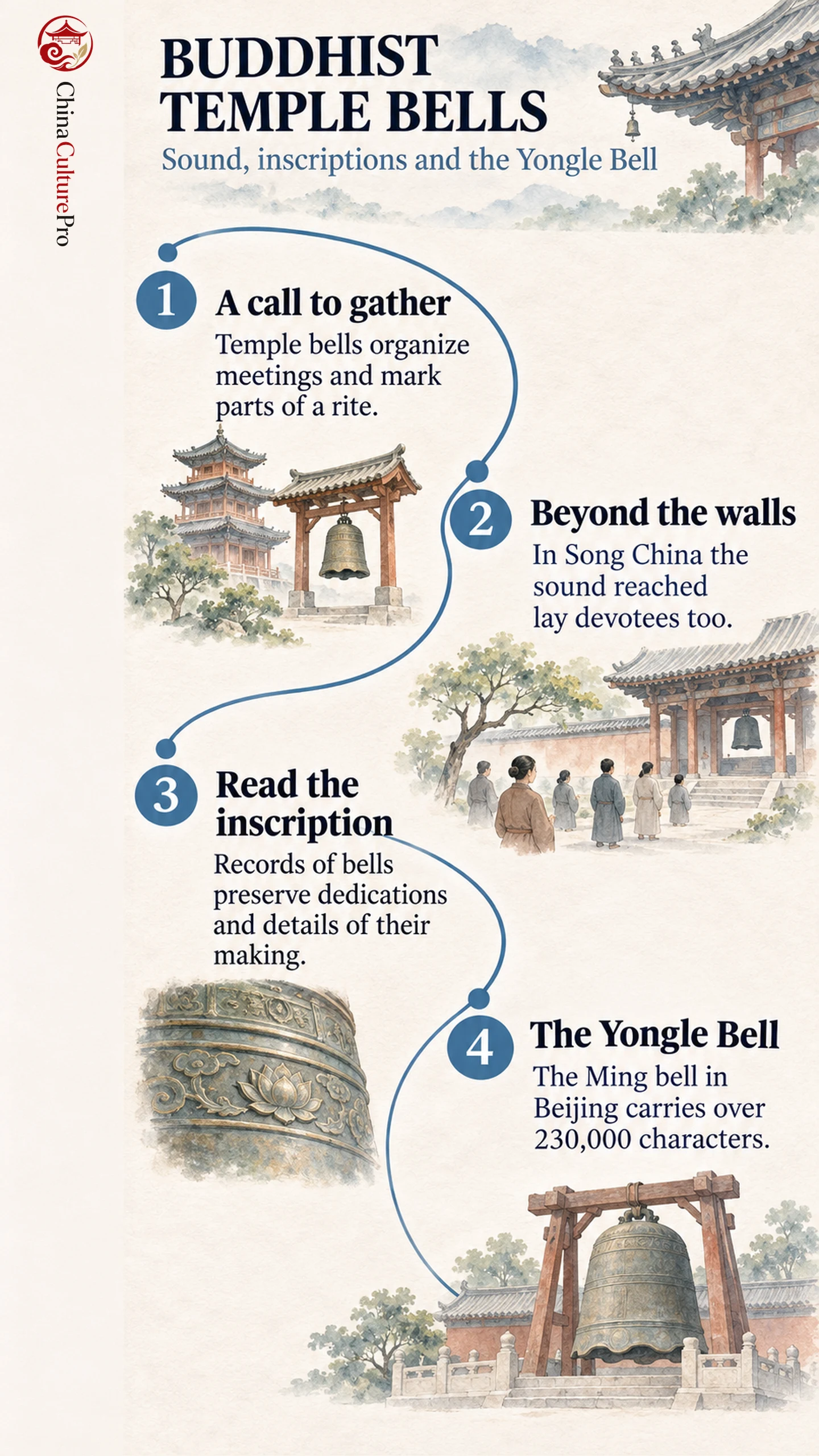
A large Buddhist temple bell (梵钟, fànzhōng) can summon a monastic community, mark a ritual moment and carry a signal beyond the temple grounds. Inscriptions on bells can also preserve prayers, dedications and evidence of who supported their casting.[1][2]
- Daily life: A bell can announce a gathering or mark the transition from one part of a service to the next.[2]
- People outside the temple: Research on Song bells shows that their sound could reach lay devotees as well as resident monks and nuns.[1]
- Famous example: Beijing’s Yongle Bell (永乐大钟, Yǒnglè Dàzhōng) carries Buddhist texts cast across its surfaces.[3][4]
The meaning of a sound depends on which instrument is ringing and what is happening at that temple.
A bell hanging in a tower and a bell inside a practice hall can serve different groups of listeners. One medieval set of regulations goes further, giving a wooden board, a gong and two bells different jobs within the same evening.
How Bells Organized a Monastery
The surviving Yuan-era version of the Baizhang regulations for Chan monasteries describes an evening rite that starts with wooden boards summoning practitioners. A gong announces the abbot’s arrival. The large bell marks his incense offering, and the practice hall bell signals the dismissal. The example shows how several sounds could organize one ceremony without a spoken announcement.[2]
A large bell could also be heard farther from the hall, including by lay Buddhists outside the monastery. Within a service, a wooden fish can help give recitation a steady pulse. The location and timing help a listener distinguish a call to assemble from a sound within the service.[1][2]
What Bell Inscriptions Can Tell Us
Many of the bells studied by historian Suzanne Burdorf are now known through records of their inscriptions. These sources document the resources involved in casting bells and the relationships between monasteries and their neighbors. Even without the original sound, a record can show who took part in making an instrument that would serve monks, nuns and people in the surrounding community. See Buddhist lay societies for another view of how lay people supported Buddhist institutions.[1]
The Yongle Bell and Its Present Home
The Yongle Bell was cast during the Yongle reign of the Ming dynasty. It now hangs in the tower at Dazhong Temple (大钟寺, Dàzhōng Sì) in Beijing. The Beijing cultural heritage bureau gives its mouth as 3.3 metres across and its mass as 46.5 tonnes.[3]
The lettering runs across both inner and outer surfaces. The museum counts more than 230,000 characters in scriptures, mantras and other inscriptions. The date of the casting belongs to the Ming, while the bell’s installation at its present temple took place under the Qing.[3][4]
FAQs About Buddhist Bells in China
Does every temple ring its bell 108 times?
Some temples use a sequence of 108 strikes. Other ritual signals use shorter counts. The occasion and the temple’s own practice determine the pattern.[2][5]
Why write Buddhist scriptures on a bell?
On the Yongle Bell the cast scriptures and mantras preserve Buddhist texts in cast bronze.
Is the large bell the same as a wooden fish?
They are different instruments. The large bell can carry a signal through a complex. A wooden fish commonly marks the rhythm of recitation.
Sources
[1] Suzanne Burdorf. Alerting the Masses: Buddhist Communication through Bells in Song Dynasty China
[2] Shohei Ichimura, translator. The Baizhang Zen Monastic Regulations
[3] Beijing Municipal Cultural Heritage Bureau. Dazhong Temple Ancient Bell Museum
[4] Huo Sijia. The Yongle Bell in Its Historical Settings
[5] Kong Meng San Phor Kark See Monastery. Hall of Great Strength