


Quick Answer: Who Was Bai Qi?
Bai Qi (白起, Bái Qǐ) was a Qin general in the third century BCE, during the Warring States era before the empire.[1][6]
- Known for: Major campaigns against Qin’s rivals and the defeat of Zhao at Changping in 260 BCE.
- Death: Ordered to take his own life in 257 BCE after conflict with Qin’s king over further campaigning.
- Historical issue: The killing of surrendered troops dominates his reputation; the transmitted figures require careful interpretation.[1][2]
Ancient accounts establish his reputation without providing a modern verified casualty count.
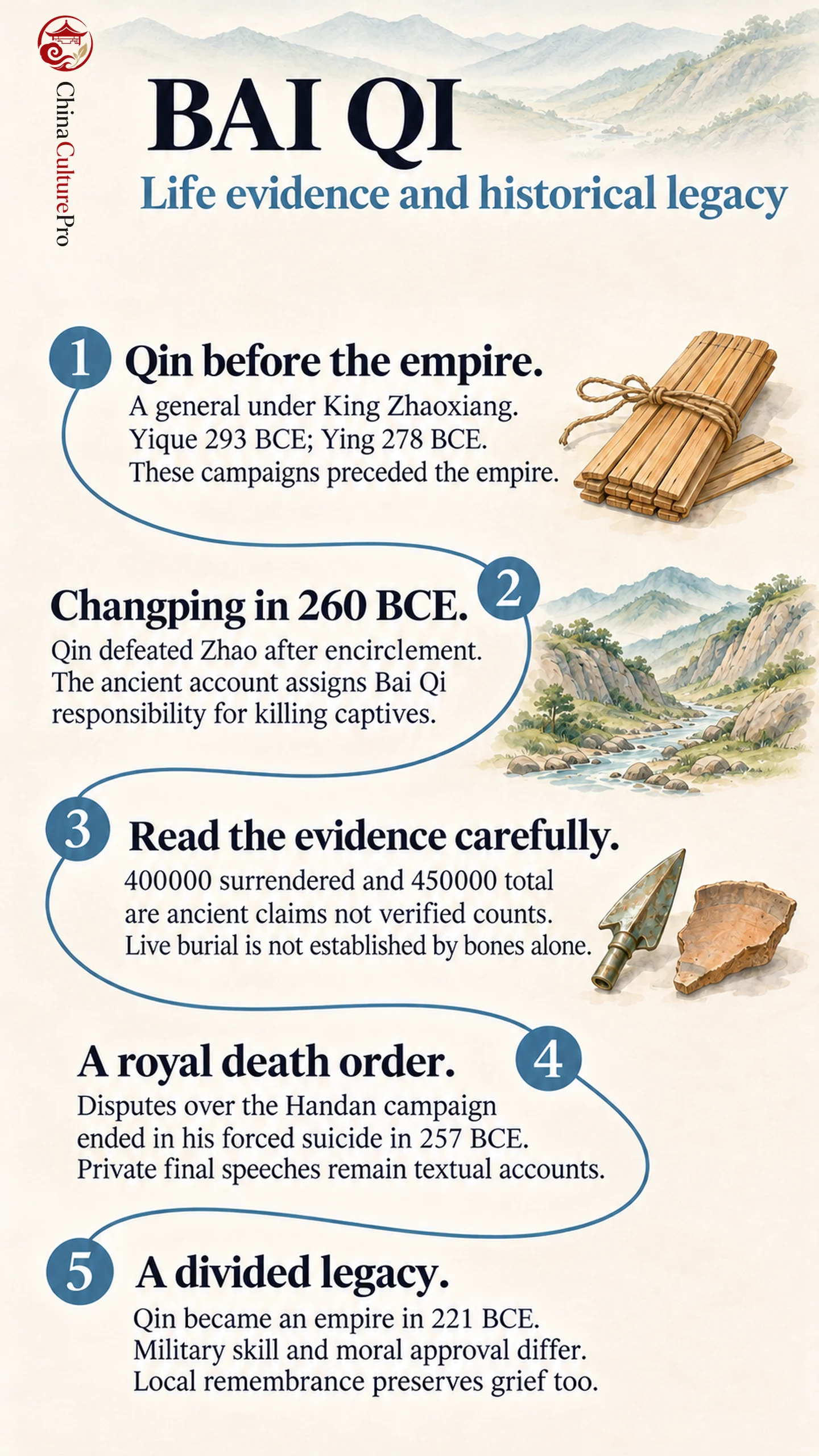
Bai Qi’s reputation combines battlefield success with the killing of defeated soldiers. Understanding him requires a short chronology and attention to how that story survives: in ancient historical writing, modern studies and local remembrance, each with different limits.
A Career in Qin Before the Empire
Bai Qi served King Zhaoxiang of Qin, not the later Qin Shi Huang. He rose during the Warring States period, when rival kingdoms fought over territory and resources. His title, Lord of Wuan (武安君, Wǔ’ān Jūn), was an honor, not an imperial reign name.[1][2]
| Date | Place | Place in his career |
|---|---|---|
| 293 BCE | Yique | Defeated the allied forces of Han and Wei. |
| 278 BCE | Ying | Captured the capital of Chu; the court moved east. |
| 260 BCE | Changping | Commanded Qin’s decisive defeat of Zhao’s army. |
| 257 BCE | Duyou | Died under a royal order to commit suicide. |
Capturing Ying forced Chu’s court to relocate; it did not end the kingdom. The career record also counts cities taken, which should not be converted into a tally of battles won or used to certify a perfect battlefield record.[1]
Changping: Command, Encirclement and Surrender
Changping, near present-day Gaoping in Shanxi, followed Qin’s pressure on Han’s Shangdang territory and Zhao’s involvement there. It was a struggle over strategic territory, rather than an isolated personal duel between two generals.[2]
The Records of the Grand Historian (史记, Shǐjì), commonly called Shiji, describes Qin secretly appointing Bai Qi after Zhao replaced Lian Po with Zhao Kuo. A feigned retreat drew Zhao’s forces forward; Qin detachments cut their rear and supplies. Zhao Kuo died during an attempted breakout, and the defeated army surrendered. The account then attributes the mass killing of captives to Bai Qi.[1]
That narrative explains the battlefield reversal. Modern analysis also asks why Zhao faced Qin without sufficient strategic support. Reducing the defeat to one inexperienced commander leaves out the states’ unequal strength and diplomatic choices.[2][3]
What the Sources Can and Cannot Prove
The Shiji distinguishes 400,000 surrendered soldiers from a campaign total of 450,000 killed or captured. Neither figure is a modern forensic count. Scholars disagree over whether such numbers are inflated or become more plausible when ancient military totals include support personnel.[1][2][3]
| Evidence | What it contributes | Limit |
|---|---|---|
| Ancient narrative | Preserves the sequence and remembered responsibility. | Its speeches and totals are not contemporary recordings. |
| Modern military studies | Test strategy, population and what army totals included. | Different reconstructions reach different conclusions. |
| Excavated remains | Provide material evidence from the associated battlefield landscape. | A limited excavated sample cannot establish the complete casualty total. |
The historian Sima Qian wrote long after Bai Qi’s lifetime. His work remains indispensable, while its inherited sources and narrative framing need comparison with independent evidence. Treating it either as a verbatim transcript or as worthless legend would miss that distinction.[4]
“Buried alive” is not established simply by finding human remains. Discussion of the Yonglu excavation notes an absence of evidence for mass live burial. This limits a particular reconstruction of the deaths; it does not provide a new total or erase the historical tradition of killing prisoners.[5]
Why Bai Qi Was Ordered to Die
Bai Qi’s death followed disagreement over attacking Handan, Zhao’s capital, and worsening relations with the chancellor Fan Sui. In the received account, he argued that Qin’s losses and the likelihood of outside intervention made the campaign dangerous. He repeatedly refused command, lost his rank and was ordered away. A royal messenger then brought the order for his suicide at Duyou in 257 BCE.[1]
The same account places a reflection on the Changping killings in his final words. That passage matters to his moral portrait, but readers cannot verify a private final conversation from an independent contemporary transcript. His conflict with the king and the literary presentation of his death should be considered separately.[1][4]
Military Achievement and a Divided Legacy
Military success did not immediately settle the struggle between the states. Qin failed to take Handan when Zhao received help from other kingdoms. The Qin Empire began in 221 BCE, decades after Bai Qi’s death. His campaigns helped Qin’s expansion, while the later unification depended on further wars and political decisions.[2][6]
Remembrance also differs from celebration. Around Gukou in Gaoping, memorial places and local traditions preserve grief and condemnation associated with the battle. They show how communities remember the dead, rather than independently proving the exact location or mechanism of every killing.[7]
Among Chinese historical figures, Bai Qi poses a persistent question: how should military ability be judged alongside responsibility for atrocities? Distinguishing history and later legend keeps that judgment grounded in evidence rather than an invented record of private motives.
FAQs About Bai Qi
Did Bai Qi serve Qin Shi Huang?
No. Bai Qi served King Zhaoxiang and died in 257 BCE. Ying Zheng, later known as Qin Shi Huang, became king in 247 BCE and proclaimed the empire in 221 BCE.[1][6]
Did Bai Qi kill 400,000 prisoners at Changping?
The ancient account assigns him responsibility for killing surrendered Zhao troops and gives 400,000 as their number. The scale remains debated; it should be presented as a transmitted figure, not a confirmed headcount.[1][2][3]
When was Bai Qi born?
His birth year is not securely established by the principal account. A precise age or birthday in a popular biography needs evidence beyond the surviving career narrative.[1][2]
Sources
[1] Sima Qian. Shiji, Chapter 73: Biographies of Bai Qi and Wang Jian
[2] Leijia Wu. A Study on the Battle of Changping
[3] Zhang Guangzhi. 有关秦赵长平之战的几个问题
[4] Yuri Pines. Biases and Their Sources: Qin History in the Shiji
[5] Yuri Pines. 从《商君书·徕民》看商鞅学派的思想变迁
[6] Asian Art Museum. An Introduction to the Qin Empire (221–206 BCE)
[7] Jincheng Municipal Government. 胡晓刚专题调研长平之战历史文化公园保护和开发工作