


Quick Answer: What Holds the Autumn Meditations Together?
Eight Autumn Meditations (秋兴八首, Qiū Xìng Bā Shǒu) by Du Fu (杜甫, Dù Fǔ) links an autumn landscape with displacement, remembered life and concern for the capital. Poem I establishes those pressures through a gorge, chrysanthemums, a moored boat and the sounds of preparing clothing.
- Begin with Poem I: Its four couplets move from a vast landscape toward intimate attachments.
- Read the time carefully: The chrysanthemums mark another autumn passing.
- Continue through the cycle: Later poems develop the remembered capital and the speaker’s changed circumstances.
This guide translates all of Poem I and gives a brief route through the remaining seven. It does not present full English translations of the entire cycle.
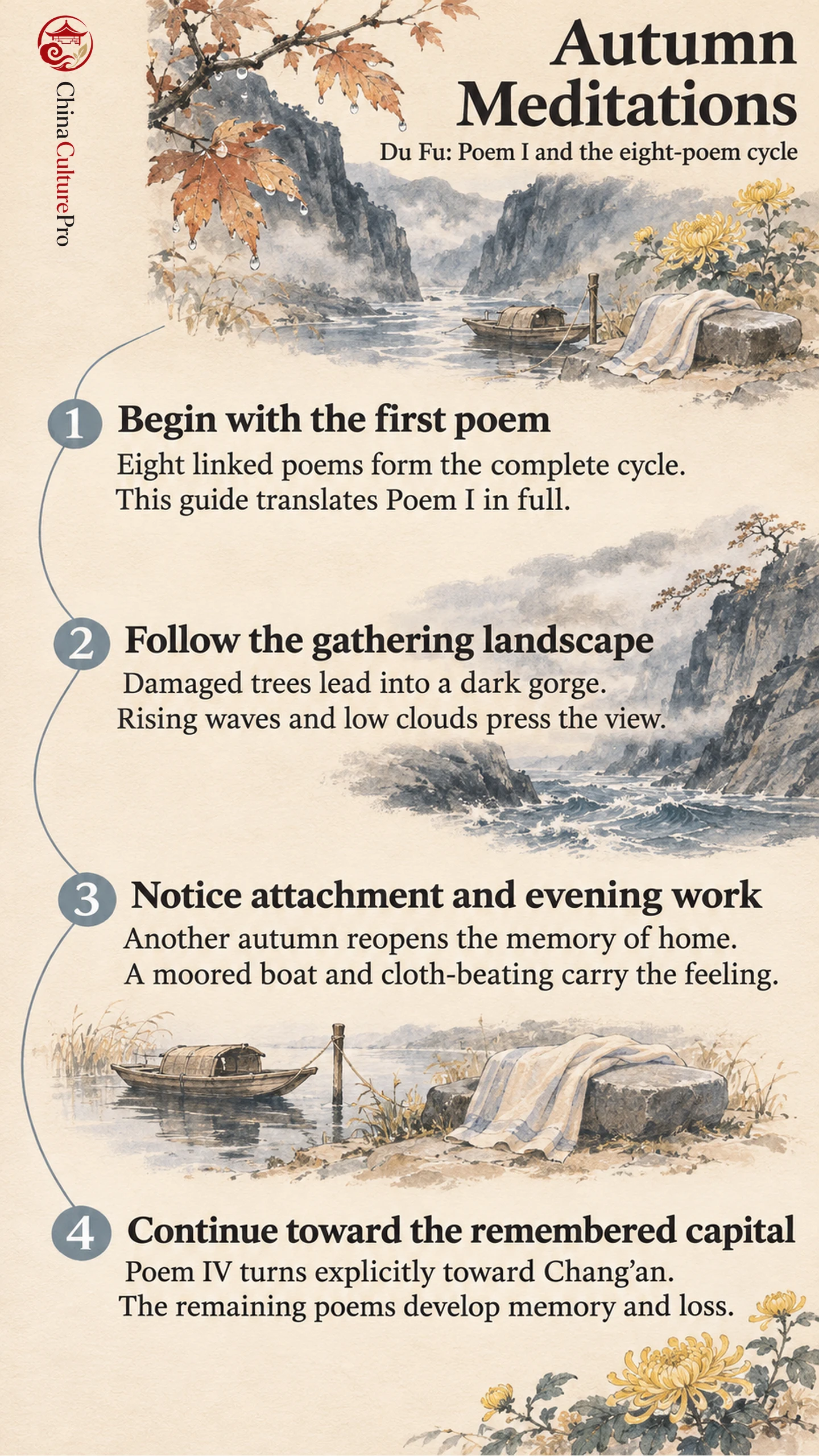
Autumn is more than background here. Its visible changes make passing time felt, while the boat and distant home prevent the speaker from simply becoming absorbed in the view. The poem’s final sounds then bring other people’s seasonal work into that unsettled scene.
Begin with Poem I and Its Eight Lines
The eight linked, seven-character regulated poems date to 766, when Du Fu was staying in Kuizhou (夔州, Kuí Zhōu). [3]
Poem I names Wu Mountain (巫山, Wū Shān), Wu Gorge (巫峡, Wū Xiá) and Baidicheng (白帝城, Bái Dì Chéng), White Emperor City. Here is its complete text with an original, unrhymed English rendering. [1]
| Chinese couplet | Plain English rendering |
|---|---|
| 玉露凋伤枫树林,巫山巫峡气萧森。 | Jade-bright dew withers the maple woods; Wu Mountain and Wu Gorge lie in bleak air. [1] |
| 江间波浪兼天涌,塞上风云接地阴。 | River waves surge toward the sky; clouds over the heights join the earth in darkness. [1] |
| 丛菊两开他日泪,孤舟一系故园心。 | Chrysanthemums bloom again, reopening old tears; a lone boat lies moored, tying my heart to home. [1] |
| 寒衣处处催刀尺,白帝城高急暮砧。 | Winter clothing everywhere hurries shears and rulers; high at White Emperor City, dusk’s cloth-beating sounds urgent. [1] |
The Du Fu guide offers wider reading. Use the regulated verse guide and Tang poetry guide for its literary setting.
Trace the Landscape from Damaged Trees to Dark Clouds
The first couplet joins something bright with damage: jewel-like dew accompanies withering trees. The description then expands into the mountain-and-gorge atmosphere. Beauty does not keep the scene from feeling severe. [1]
The next couplet makes movement seem to close the space. Waves rise toward the sky; clouds press the view down toward the ground. The opposing directions intensify the gloom rather than simply adding a second weather detail. [2]
Read those movements together before turning each image into a fixed historical code. The turbulent landscape can carry the pressure of a troubled life and age without every cloud standing for one named official or every wave recording a particular battle.
Read the Chrysanthemums, Moored Boat and Evening Cloth-Beating
The flowers register two autumns encountered during the journey away from Chengdu, first at Yun’an and then at Kuizhou. They do not establish two botanical flowering cycles in one season, or two full years spent in Kuizhou. [2]
The chrysanthemum symbolism guide gives broader cultural context. Here the poem’s immediate force comes from recurrence: another blooming returns the speaker to an older grief.
The boat’s fastening works in two directions. A vessel is physically moored, while the heart remains attached to home. The means of travel becomes an image of being held in place and of attachment to somewhere else. [2]
Finally, attention moves toward preparing clothing against cold. Shears and rulers belong to making garments; the pounding block belongs to working cloth. The last sound is not a blacksmith forging metal. Seasonal preparation continues around the speaker, giving his solitude a human setting. [2]
Notice how the poem ends by listening. The opening surveyed a forest and gorge; the final line brings urgent, repeated work into the evening air. That change of sense lets the ending extend beyond the pictured boat.
Follow the Remaining Poems toward the Remembered Capital
The next two poems continue to move between the speaker’s present surroundings and a life elsewhere. Poem IV explicitly turns to Chang’an (长安, Cháng Ān), describing changing owners and altered official circles. It serves as a hinge between local experience and the capital’s remembered world. [1][2]
In Poems V–VIII, courtly scenes, pleasure grounds and remembered landscapes grow prominent. Poem VI places the gorge and the capital’s Qujiang (曲江, Qǔ Jiāng) area together within one imaginative reach; the final poem returns to the aging speaker and his lowered head. These are movements of memory, not one continuous sightseeing itinerary. [1]
After reading the sequence, return to Poem I’s moored boat. Its attachment to a distant home now carries more than a single wish to travel: the later poems have filled that elsewhere with remembered places, relationships and losses.
For another Du Fu autumn poem, continue with Climbing High.
FAQs About Du Fu’s Autumn Meditations
Is Autumn Meditations one poem or eight?
The title names a linked cycle of eight poems. English selections often feature the first poem on its own.
Do the chrysanthemums bloom twice in one season?
The customary reading refers to two autumns passing during the poet’s journey. It is not a statement about a plant flowering twice in one season.
Does the last line describe a blacksmith’s anvil?
It refers to cloth-beating. The surrounding shears, rulers and winter garments keep the sound within the work of preparing clothing.
Sources
[1] Du Fu, via Wikisource. Eight Autumn Meditations: Complete Chinese Cycle
[2] Qiu Zhao’ao, via Wikisource. Detailed Commentary on Du Fu’s Poems, Volume 17: Autumn Meditations
[3] Feng Zhongyun, Journal of Peking University Philosophy and Social Sciences. Artistic Features of Du Fu’s Eight Autumn Meditations