


Quick Answer: Who Is Ao Guang?
Ao Guang (敖廣, Áo Guǎng) is the East Sea Dragon King (龍王, lóngwáng) in Journey to the West. Sun Wukong visits his palace and obtains the staff that becomes his famous possession. Investiture of the Gods calls its East Sea ruler 敖光 (Áo Guāng) and puts him in the story of Nezha.[1][2]
- Sea: Ao Guang’s realm is the East Sea.
- Brothers: He calls the other Sea Dragon Kings to his palace.
- Two novels: The English names look alike without tones, while the Chinese texts use different final characters.
The realm and the episode are useful clues when comparing the two versions.[1][2]
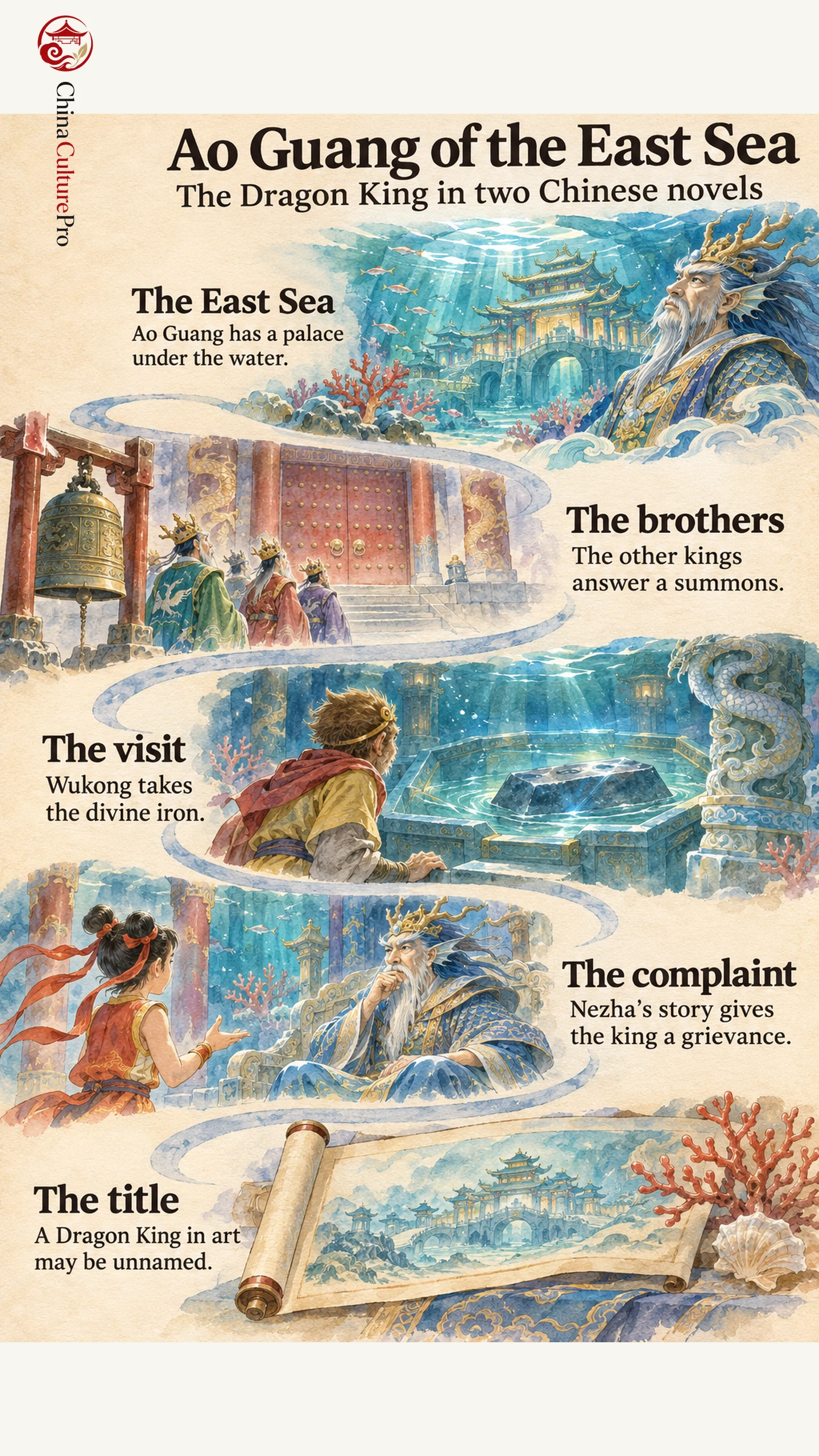
Two celebrated novels bring a visitor into conflict with the East Sea ruler. One story turns on a treasure in his palace. The other turns on what happens to his son.
The East Sea Ruler and His Brothers
In chapter three of Journey to the West, Sun Wukong enters the East Sea Dragon King’s palace. The king names three younger brothers: Ao Qin of the South Sea, Ao Run of the West Sea and Ao Shun of the North Sea. The east and the other three directions define the kings’ respective realms in this chapter.[1]
The others come when a bell and drum are sounded. The scene shows a group able to respond together to a problem in one palace. The king’s title identifies his own realm even when the other kings are present.[1]
How Sun Wukong Gets the Staff
Wukong comes looking for something suited to him and rejects several objects. His attention then turns to a piece of divine iron in the palace’s waters. It changes size when he asks it to. He takes it as the staff associated with him throughout the novel.[1]
Ao Guang also calls his brothers because Wukong demands equipment to go with it. After Wukong leaves, the kings discuss making a report to the celestial court. The planned report shows that the kings regard the visit as a dispute.[1]
The East Sea King in Nezha’s Story
In chapter twelve of Investiture of the Gods, the East Sea king is written 敖光. The episode concerns Nezha and the king’s third son, Ao Bing. After Ao Bing dies, the king goes to make a complaint. His complaint takes a family grievance to the celestial court.[2]
Both names are often written Ao Guang in English. In the Chinese forms given in these editions, the final character and tone differ. A citation of the novel and chapter is more precise than silently using the same Chinese spelling for both figures.[1][2]
Dragon King as Title and Image
A late Ming painting in the Metropolitan Museum of Art depicts Buddhist luohans crossing the sea to the palace of a Dragon King. The museum’s title identifies a palace setting without assigning the king the name Ao Guang. That is a reminder that the title can appear outside the two novels.[3]
A named Sea Dragon King in fiction has a realm, attendants and a position in a court. The word jiaolong describes a dragonlike water creature in other sources. A watery setting alone gives too little information to call a figure the East Sea king.
FAQs About Ao Guang
Which sea does Ao Guang rule?
In Journey to the West, Ao Guang rules the East Sea. Chapter three names three other kings for the south, west and north.[1]
Does Ao Guang give Sun Wukong his staff?
Wukong takes the divine iron from the king’s waters and uses it as his staff. The kings’ response afterward shows that the encounter is a dispute.[1]
Why is the king also written 敖光?
The East Sea king is 敖廣 in the cited Journey to the West text and 敖光 in the cited Investiture of the Gods chapter. Both can be romanized Ao Guang when tones are omitted.[1][2]
Sources
[1] Shidian Classics. Journey to the West, chapter three
[2] Chinese Wikisource. Investiture of the Gods, chapter twelve
[3] The Metropolitan Museum of Art. Buddhist Luohans Crossing the Sea to the Palace of the Dragon King