
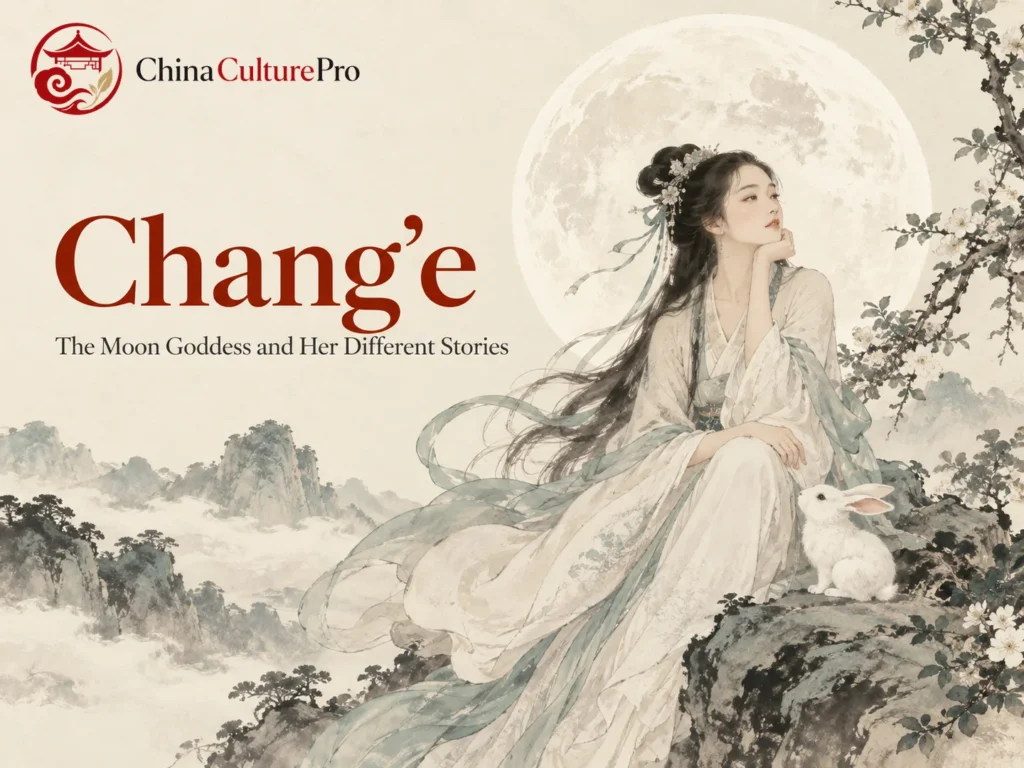

Quick Answer: Who Is Chang’e?
Chang’e (嫦娥, Cháng’é) is the moon goddess of Chinese storytelling, closely associated with an immortality elixir and the Mid-Autumn Festival (中秋节, Zhōngqiū Jié). Her flight to the moon appears in different accounts with different motives and consequences.
- Recurring story: An extraordinary medicine separates her from the earthly world.
- Changing motives: Theft, a desire to regain immortality and resistance to a would-be thief appear in different versions.
- Lunar imagery: A goddess, a medicine-pounding rabbit and a toad belong to a varied visual tradition.
These details should not all be combined into one supposedly original plot. A named text or retelling gives each version its context.
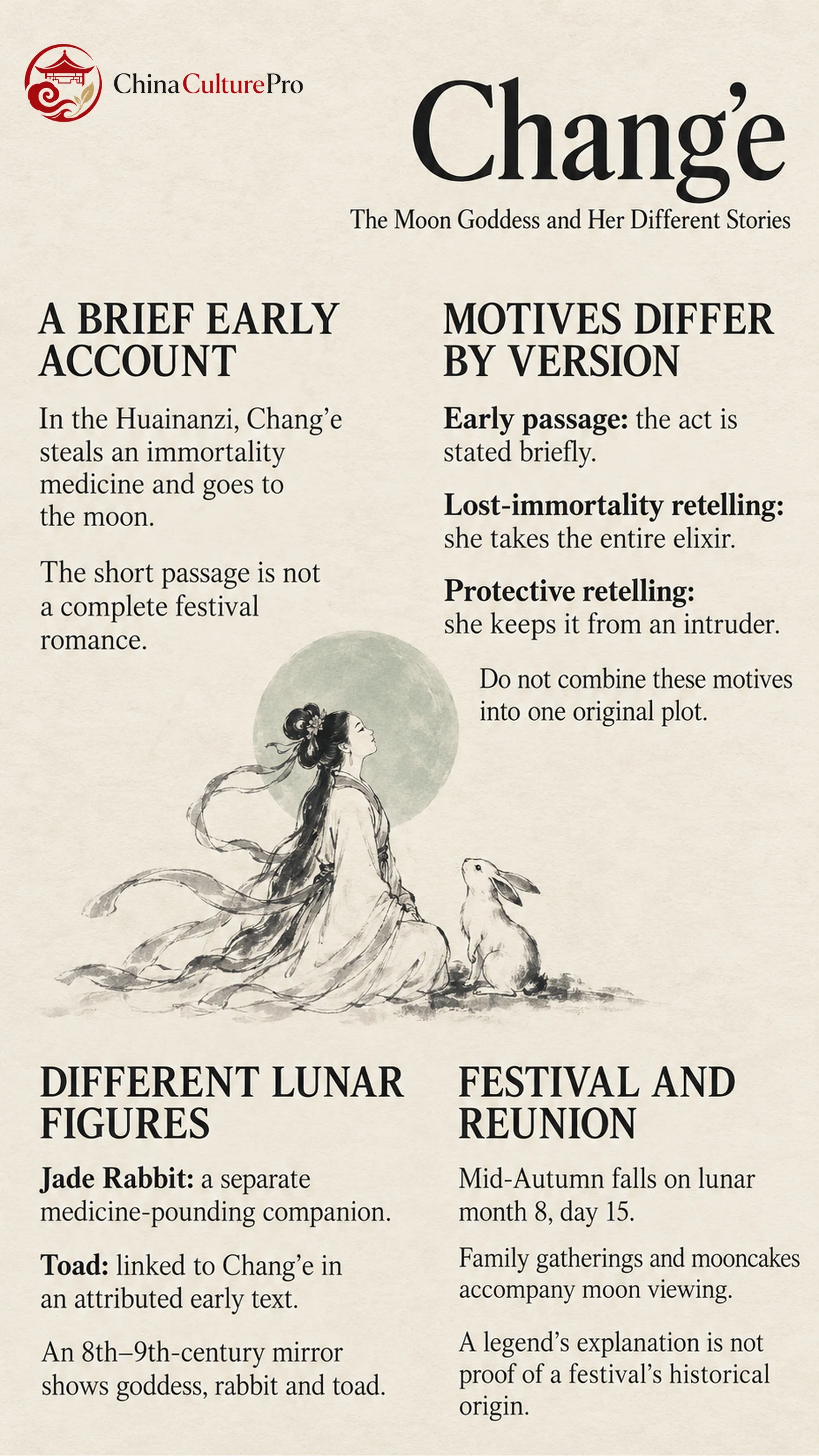
A woman rising toward the moon can suggest longing, immortality or separation. But why does she leave Earth, and does she choose to go? Chang’e’s place in Chinese mythology becomes clearer when the brief early account, later festival stories and surviving images are read alongside one another.
An Early Elixir Story
The Huainanzi (淮南子, Huáinánzǐ), a Han-dynasty text, preserves a compact account. An archer obtains an immortality medicine from the Queen Mother of the West (西王母, Xīwángmǔ); Chang’e steals it and goes to the moon. The episode appears within a broader discussion, not as a complete, self-contained romance.[1]
Its brevity matters. The passage does not supply the elaborate confrontation with a would-be thief familiar from some modern retellings. Nor does it describe a full set of annual festival customs. Reading those details into it would turn a later narrative expansion into something the early passage actually says.
The account establishes an important recurring connection: a coveted escape from mortality leads to a move away from ordinary human life. Later storytellers expand her emotions, motives and relationship with the archer.
Why Does Chang’e Drink the Elixir?
The archer is commonly called Hou Yi (后羿, Hòu Yì) in later retellings. Later accounts identify him as Chang’e’s husband; her reason for taking the medicine changes the story’s moral emphasis.
| Account | What happens with the elixir? | How the version frames her action |
|---|---|---|
| The brief Huainanzi passage | She steals the medicine obtained from the Queen Mother and goes to the moon. | The text states the act without supplying the full motives of a later romance.[1] |
| A popular lost-immortality retelling | After the couple lose their heavenly status, she takes the entire elixir intended to restore them. | Her desire to regain immortality produces separation from her husband.[2] |
| A protective festival retelling | A man demands the elixir while Hou Yi is away; Chang’e drinks it rather than surrender it. | The same ascent becomes a response to danger rather than a simple act of selfishness.[3] |
In the protective version, the demand forces the decisive choice. In the lost-immortality version, the couple’s earlier fall from heaven gives that choice a different setting. One cannot insert both motivations into the short early account and still call it a faithful summary of that passage.
A useful retelling can choose one version and tell it clearly. It need not decide that every other version is a corrupted copy.
The Moon Goddess, Rabbit and Toad in Art
The Jade Rabbit (玉兔, Yùtù) is a lunar companion, not another name for Chang’e. Its pestle and mortar connect the image with the preparation of immortality medicine.[2]
An eighth- to ninth-century bronze mirror depicts the goddess on its decorated back alongside a rabbit and a toad. This dated object shows that the combination belongs to a visual tradition much older than modern illustrated festival books.[4]
The toad has a particularly important textual connection. An excerpt attributed to Zhang Heng (张衡, Zhāng Héng) in the Lingxian (灵宪, Língxiàn), quoted in the later encyclopedia Taiping Yulan (太平御览, Tàipíng Yùlǎn), identifies the moon-bound woman with a toad. That is different from simply showing a separate toad beside a human-shaped goddess.[5]
Chinese painting also presents her as an elegant female figure. One Ming-dynasty painting carries a cassia branch. Its current catalogue attribution is to an unidentified artist after Tang Yin, rather than an unqualified original by Tang Yin. An image’s subject, date and attribution each tell us something different; none establishes one exclusive appearance for the goddess.[6]
Chang’e and the Mid-Autumn Festival
The Mid-Autumn Festival falls on the fifteenth day of the eighth month of the traditional Chinese calendar. Chang’e’s story is one of its familiar legends. Moon viewing, family gatherings and mooncakes provide a setting in which the story is retold.[3]
There is a striking emotional contrast: people gather with family while the goddess’s ascent separates her from the human world. That contrast helps explain why longing and reunion are useful ways to read the tale. It does not require every family to tell the same version or regard the goddess in exactly the same way.
Some festival retellings explain offerings as Hou Yi’s response to losing his wife. That is a narrative explanation within the legend, not documentary proof of the historical beginning of the festival.[3] Likewise, accounts of an annual reunion belong to particular versions; they should not be supplied automatically as the ending of every Chang’e story.[2]
FAQs About Chang’e
Is Chang’e always portrayed as selfish?
No. Some accounts emphasize taking the elixir for herself; others make drinking it a way to keep it from a threatening intruder. The motive depends on the version.
Who is Chang’e’s husband?
Later familiar retellings identify the archer Hou Yi as her husband. Their relationship and the circumstances of separation are developed differently across accounts.
Is the Jade Rabbit the same as Chang’e?
No. The rabbit is a separate lunar figure, often shown preparing medicine with a pestle and mortar. A goddess and rabbit can appear together in the same image.
Did Chang’e’s story historically begin the Mid-Autumn Festival?
A legend can explain a custom within its own narrative. That explanation is different from evidence establishing when a festival began or how its practices developed.
Sources
[1] Huainanzi, Chinese text via Wikisource. Lanming Xun
[2] British Library, International Dunhuang Programme. Chang-E, or the Archer and the Moon Goddess
[3] Hong Kong Education Bureau. Mid-Autumn Festival, Part A
[4] The Metropolitan Museum of Art. Mirror with Moon Goddess and Rabbit
[5] Taiping Yulan, Chinese text via Wikisource. Volume 949: Toads
[6] The Metropolitan Museum of Art. The Moon Goddess Chang E