

Quick Answer: What Are Good Chinese New Year Gifts?
Good gifts for Chinese New Year (春节, Chūnjié) suit the recipient and your relationship. Start with one of three choices:
- A shared household gift: Fruit, tea or a box of pastries can thank a host and give the family something to enjoy together.
- A personal gift: Choose a useful item connected to an elder’s, friend’s or child’s interests, rather than relying on age or gender alone.
- A red envelope: Hongbao (红包, hóngbāo) are cash gifts expressing good wishes; whether to give one depends on family and community practice.
These are practical options, not a fixed traditional classification. No gift suits everyone, and auspicious associations do not guarantee prosperity or good fortune.
Is a fruit basket enough for your first Chinese New Year (春节, Chūnjié) visit, and should you bring red envelopes too? The answer depends on whom you are visiting. Choose something they can enjoy, then check the household’s expectations before worrying about elaborate packaging or symbolic rules.
Chinese New Year Gift Ideas by Recipient
Start with the person or household, rather than a supposedly universal lucky object. A shared present is useful for a home visit; a personal present works better when you know the recipient’s tastes. Fruit baskets, packaged foods and non-food alternatives all appear in New Year gift guidance.[1]
Options for Hosts, Family and Friends
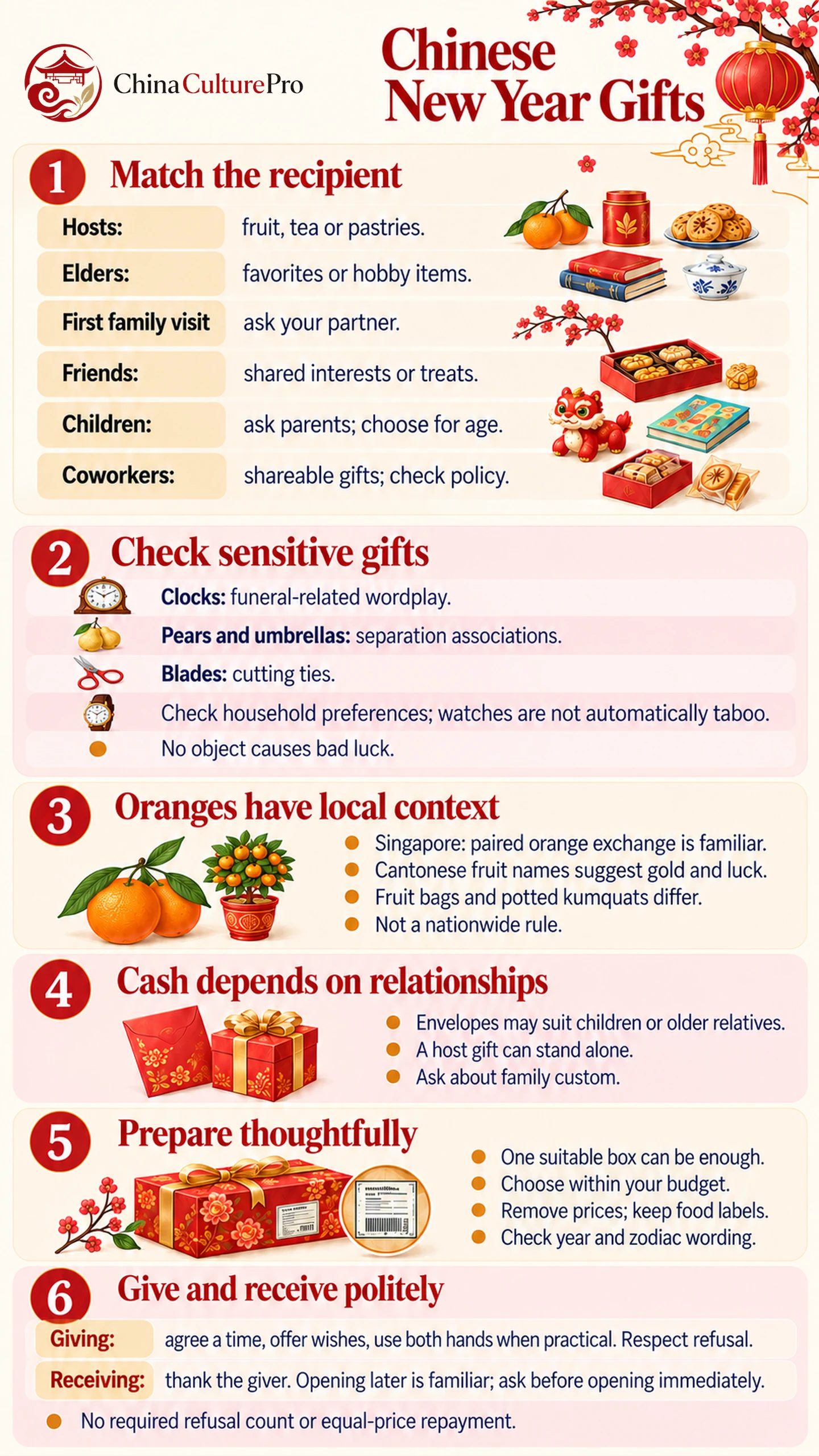
| Recipient | Gifts to consider | Why they may fit | Check before choosing |
|---|---|---|---|
| A host and their household | Mandarin oranges, a tin of tea or a pastry box | Something the household can share without choosing one person’s size or style | Food preferences, household size, ingredients and shelf life |
| Parents and other elders | Their favorite tea or snacks, a gardening plant or a useful hobby item | Familiar preferences make the gift personal without requiring an expensive purchase | What they actually enjoy, whether they want another plant, and any practical limitations |
| A partner’s family on a first visit | A fruit box or a modest selection of tea and treats | A household present avoids guessing about intimate personal items | Ask your partner about family expectations and anything already being brought |
| Friends | Regional snacks, a small craft item or something linked to a shared interest | A relaxed present can reflect the friendship | Whether it travels easily and suits their interests or diet |
| Children | Age-appropriate books, toys, stationery or a suitable red envelope | Offers choices beyond cash while respecting the family’s arrangements | Age, interests and parental preferences about gifts or money |
| Coworkers or an office team | Individually wrapped treats or another easily shared box | Makes sharing straightforward without singling out one person | Workplace gift policies, ingredients and team customs |
For tea, find out what the recipient drinks before choosing a set. Someone who already has teaware may prefer familiar leaves; someone who does not drink tea needs a different present. An introduction to Chinese tea culture can help you understand the context without making the choice about price.
Choose alcohol only when you know it is welcome. Likewise, an elder’s age is not a reason to select supplements or tonic products. A useful, wanted item is a better starting point than an assumed health need.
Gifts to Check Before You Choose
Some gifts have uncomfortable associations in particular households. The following are folk sensitivities, not evidence that an object causes harm:
- Clocks: Giving a clock, 送钟 (sòng zhōng), sounds exactly like 送终 (sòng zhōng), attending someone’s final moments and funeral arrangements. Some people extend the concern to watches, but the wordplay specifically involves 钟, clock; ask before treating every timepiece alike.[2][3]
- Pears: 梨 (lí), pear, sounds like 离 (lí), to part. That association can make a pear-only gift awkward for someone who observes it; it is not a rule against eating pears.[3]
- Umbrellas: 伞 (sǎn), umbrella, resembles 散 (sàn), to disperse or separate. The tones differ in Mandarin. Some recipients dislike the association; others may welcome a requested practical gift.[3]
- Knives and scissors: Sharp blades can suggest cutting a relationship. Check before choosing them as festive presents, particularly for someone whose preferences you do not know.[2]
Do not predict someone’s reaction from their age. If a proposed gift raises doubts, ask a family member or choose another item rather than trying to explain away the recipient’s discomfort.
Why Are Oranges a Common Chinese New Year Gift?
Mandarin oranges are especially familiar during New Year visits (拜年, bàinián) in southern Chinese and overseas Chinese communities. Their associations are connected to particular languages and customs. In Cantonese, 柑 (gam1) sounds like 金 (gam1), gold; exchanging fruit and greetings can therefore express good wishes.[4][8] The orange-exchange custom in Singapore has ties to the Teochew community and the Chaoshan region.[4]
A related Cantonese connection is 桔 (gat1) with 吉 (gat1), auspiciousness. Kumquats are particularly associated with the language of gold and luck. These are Cantonese readings in Jyutping, not Mandarin pinyin; Mandarin 橘 (jú) and 吉 (jí) are not identical sounds.[5][8]
In Singapore, visits commonly include pairs of mandarins, and hosts may exchange fruit with guests. This does not mean every Chinese household follows the same exchange.[4][7] Also distinguish a bag of edible fruit from a potted kumquat: the latter is a living display that needs space and care. Confirm that a host wants a plant before bringing one.
Red Envelopes or a Physical Gift: Which Is Appropriate?
A household gift thanks the people hosting you; a red envelope usually addresses a particular relationship. In Singapore, familiar recipients include children and younger unmarried relatives, while adults with an income may also give packets to parents or grandparents. Marriage and employment can influence expectations, but there is no single starting rule.[6][7]
You do not automatically need both a gift box and envelopes for every person present. If children will attend, ask someone familiar with the family whether a small present, an envelope or simply joining the celebration is appropriate. For a visit to a friend of your own generation, a shared gift may be sufficient.
Avoid offering cash to an unfamiliar host merely because you cannot decide what to buy. Confirm what is welcome; the relationship matters more than treating money as a universal substitute.
Budget, Quantity and Wrapping: How to Prepare the Gift
Budget and Quantity: Preferences, Not Fixed Rules
There is no nationwide spending requirement. Set an amount you can comfortably afford, then consider the relationship and the occasion. A first visit does not require a luxury hamper, and an expensive present may be awkward if the recipient feels obliged to reciprocate. Ask a trusted relative about an established family exchange rather than copying a price list from another country.
Pairs and even quantities are familiar preferences, but one well-chosen gift is also acceptable.[2] You do not need to buy a second large box simply to make the count even. Some people avoid four because 四 (sì) resembles 死 (sǐ), death; the Mandarin tones differ. These number associations are cultural preferences, not a formula for whether a gift will be appreciated.
Wrapping and Labels: Make the Occasion Clear
Red and gold are common festive choices. Some recipients associate predominantly black or white wrapping with mourning; consider a cheerful alternative when you are unsure, without treating every pale-colored product as inappropriate.[2]
Before packing, check the details that affect the recipient:
- Price stickers: Remove visible prices where practical, while preserving useful product information and any separate exchange receipt.
- Food labels: Keep ingredient, allergen, storage and date information intact. Choose an amount the household can reasonably enjoy.
- Seasonal wording: If the packaging names a zodiac animal or year, check it matches the intended celebration. A year-free box is easier to reuse.
- Condition: Make sure the packaging is clean, intact and easy to carry. More layers do not necessarily make a more considerate gift.
When and How to Give and Receive New Year Gifts
Giving: Arrange the Visit and Offer a Greeting
New Year visits are an opportunity to exchange good wishes. Arrange a convenient time rather than appearing unannounced. Giving a present before the holiday is fine when agreed; family visits during the festival also work. Do not assume an invitation includes the household’s private New Year’s Eve dinner.
Offer the gift after greeting the host, using both hands when practical.[2] A brief wish is enough: 新春大吉 (Xīn chūn dà jí), “Wishing you good luck in the new year.” You can explain a thoughtful choice simply: “I remembered you enjoy this tea.”
If someone clearly cannot accept the gift, respect the answer. Courtesy does not require repeated persuasion. For delivery rather than a visit, check when someone will be available to receive it, particularly if the contents need prompt storage.
Receiving: Thank the Giver and Follow the Household
Thank the giver warmly before worrying about what is inside. Opening a present later, away from the giver, is a familiar practice; if you would like to open it immediately, ask rather than assume.[2] Receiving customs vary, so follow the actual situation instead of staging a fixed number of refusals.
A simple response is 谢谢你,太客气了 (Xièxie nǐ, tài kèqi le), “Thank you, that’s very kind.” If you set the gift aside, do so carefully and keep enjoying the visit. It is not necessary to announce its price or compare it with another person’s present.
If you choose to reciprocate, base it on the relationship and what you would enjoy giving. A return invitation or thoughtful future present need not become an equal-price repayment.
FAQs About Chinese New Year Gifts
What Should I Bring to a Chinese New Year Dinner?
Consider a shareable fruit, tea or food gift suited to the host’s household. Check preferences first, and ask before bringing something that needs to be served immediately or changes the planned meal.
Do I Need to Give Red Envelopes as Well as a Gift?
Not automatically. Envelopes depend on relationships and household customs, while a host gift can stand on its own. Ask about expectations for children rather than assuming every guest must give them cash.
Is One Gift Box Enough for Chinese New Year?
Yes, one suitable box can be enough. Pairing is a familiar preference, not a nationwide requirement to double every present. Match the gift to the household and your budget rather than counting boxes alone.
Can I Give a Chinese New Year Gift Before the Holiday?
Yes. Arrange a convenient visit or delivery before the celebration if that suits the recipient. There is no universal deadline; agreed timing and the gift’s storage needs matter more than a prescribed day.
Can Non-Chinese People Give Chinese New Year Gifts?
Yes. A considerate gift can accompany an invitation to celebrate. Learn the host’s preferences, ask about unfamiliar customs and offer warm wishes; you do not need to reproduce every regional practice to participate respectfully.
Sources
[1] Hong Kong Department of Health. Happy Chinese New Year for Kids
[2] Beijing Tourism. Giving and Receiving Gifts in China
[3] People’s Daily Online. 春节送礼让人焦虑?
[4] Singapore Chinese Cultural Centre. Find Out What’s Distinct About Chinese New Year in Singapore
[5] National Parks Board, Singapore. Citrus japonica ‘Fukushu’
[6] Sun Yat Sen Nanyang Memorial Hall, Culturepaedia. Red packets (Hongbao)
[7] Lee Kok Leong, Culturepaedia. Chinese New Year
[8] Chinese University of Hong Kong. 粵語審音配詞字庫