
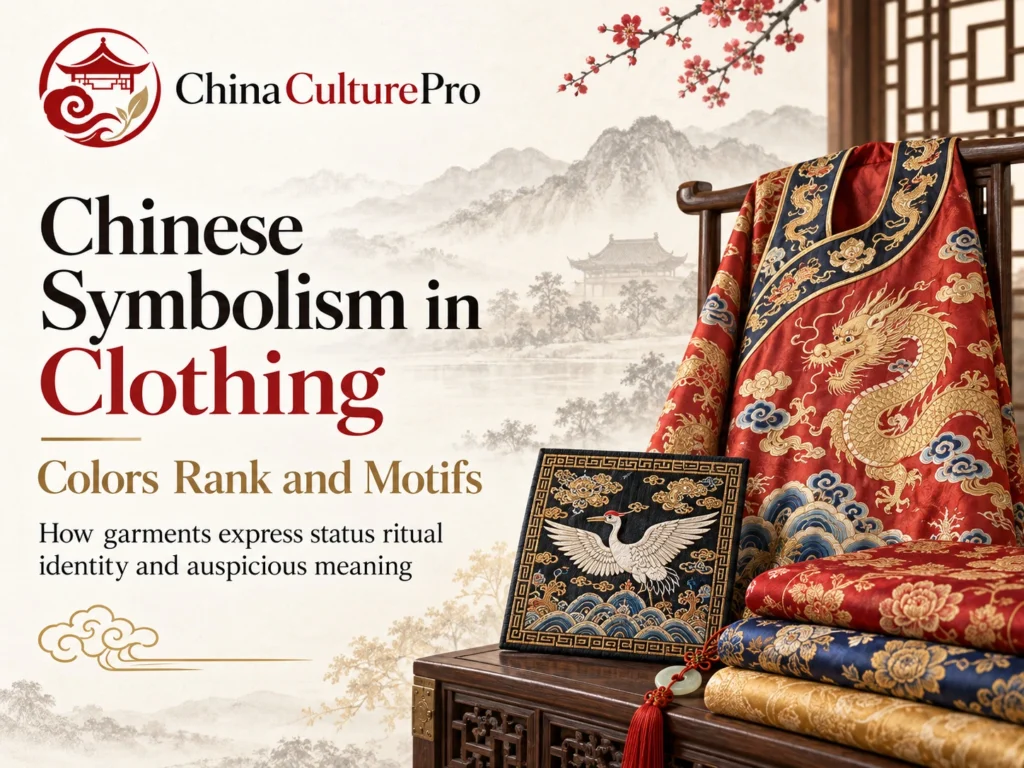

Quick Answer: What Does Symbolism Mean in Chinese Clothing?
Chinese clothing can express rank, ritual obligations, auspicious wishes, community identity and personal taste through its construction, colors, materials and decoration.
- Rank: Court garments and official badges identified status under particular dynastic rules.
- Occasion: Ceremonial, wedding, mourning and religious garments served different purposes.
- Wishes: Embroidered animals, plants and characters could convey blessings through wordplay or cultural associations.
- Community: Regional textile traditions preserve shared stories, skills and identities.
- Modern expression: Chinese-inspired dress can communicate heritage, aesthetics or individual choice.
Meaning depends on the garment’s period, wearer, complete design and use. A dragon, red fabric or elaborate fastening alone cannot explain an entire outfit, and some details are primarily practical or decorative.
Chinese symbolism in clothing becomes clearer when you ask what a garment was made to do. A crane on an official badge identifies rank; the same bird on a birthday garment may express longevity. A dress can also combine several messages: its cut establishes a clothing tradition, its materials display craftsmanship, and its embroidery adds a family wish. Clothing provides a specific setting for the broader system of Chinese symbols and meanings.
Start with the Garment: Hanfu, Qing Robes and Qipao
“Traditional Chinese clothing” covers different histories. Identify the garment family before applying a color or motif dictionary; similar decoration does not make two clothing systems interchangeable.
| Garment family | Historical context | What to examine | Interpretive limit |
|---|---|---|---|
| Hanfu (汉服, hànfú) | Historical Han Chinese dress and its modern revival | Period-specific layers, collars, sleeves and silhouettes | Neither all historical styles nor modern designs follow one standard shape |
| Qing court robes | Manchu court and official dress under the Qing dynasty, 1644–1911 | Garment category, prescribed color, insignia and accessories | Qing rules cannot decode every earlier dynasty |
| Qipao (旗袍, qípáo), also called cheongsam | Modern dress shaped by Banner clothing and twentieth-century fashion | Tailoring, fabric, changing length and ornament | A fitted modern qipao is not an unchanged ancient costume |
| Regional and community dress | Local traditions with their own histories | Maker, community, technique and occasion | Imperial dress rules cannot replace community knowledge |
Modern Hanfu practice includes researched reconstructions and creative adaptations. The qipao’s development incorporated Western tailoring and new materials, particularly in urban settings.[1][2]
Tangzhuang (唐装, tángzhuāng), a name used for modern Chinese-style outfits, also requires context. The name alone does not establish that a jacket reproduces Tang-dynasty clothing.
What Can Cut, Collars and Fastenings Tell You?
Crossed Collars and the Shenyi: Convention vs. Textual Symbolism
Youren (右衽, yòurèn) means closure toward the wearer’s right: on a crossed-collar garment, the wearer’s left lapel overlaps the right. This is a common historical convention, visible in surviving garments, rather than a rule covering every Chinese community or garment type. Left-closing clothing has other historical contexts; it cannot automatically be labeled funerary dress.[3]
Shenyi (深衣, shēnyī), a robe described in the Book of Rites, has a more explicit textual interpretation. Its twelve cloth sections correspond to twelve months. Rounded and square features, the straight back seam and the level lower edge are connected with disciplined conduct, correctness and impartiality.[4]
These associations belong to a particular classical description. They do not establish that every crossed collar represents cosmic order, or that all modern Hanfu follows the text’s construction.
Pankou and Fine Textiles: Function, Craft and Added Meaning
Pankou (盘扣, pánkòu) are knotted or shaped fastenings that secure clothing. Their practical role comes first. Decorative versions can add meaning: butterfly forms suggest a couple together, while named ruyi designs convey wishes for things to go well. Such readings depend on the identifiable form, rather than every loop carrying the same blessing.[5]
Textile technique supplies another kind of information. Kesi (缂丝, kèsī) is silk tapestry weaving, with designs created during weaving; it is distinct from embroidery applied to an existing fabric.[6] Fine silk, intricate weaving and metallic-thread embroidery demonstrate materials and skilled work. In a court setting, they can contribute to prestige, but expensive workmanship alone does not establish an exact office or rank. Neither fabric nor fastening has a proven power to protect its wearer.
How Did Court Dress Communicate Rank?
Dragons, Imperial Emblems and the Whole Outfit
A dragon on a historical garment does not always identify an emperor. In Qing dress, garment terminology, approved colors, decoration and the wearer’s position worked together. Longpao (龙袍, lóngpáo), commonly translated as “dragon robe,” and mangpao (蟒袍, mǎngpáo), often called a “python robe,” cannot be distinguished reliably by claw count alone.
A Jiaqing-period child’s mangpao in the Palace Museum is an instructive exception. It belongs to princely festive dress and carries five-clawed dragons on an apricot-yellow ground. Its designation follows court status even though the dragon has the claw count often described as imperial.[8]
Imperial garments could employ a fuller scheme. A late-eighteenth-century festival robe in the Metropolitan Museum of Art, accession 35.84.8, combines bright yellow, dragons and the twelve imperial emblems, including the sun, moon, mountain and grain. Together, these signs communicate sovereign authority.[7]
Check the garment category and complete arrangement before assigning ownership. Count dragons across the whole garment, including concealed panels when documented, and check for the twelve emblems separately. These are distinct features, not a universal package carried by every dragon robe. Hats, belts and other surviving accessories can supply context that an isolated sleeve or cropped photograph cannot.
Rank Badges: Birds, Beasts and Changing Rules
Buzi (补子, bǔzi) are rank badges associated with Ming and Qing official dress. Birds generally marked civil ranks, while beasts marked military ranks. The animal’s identity therefore has an institutional role beyond its broader cultural associations.[9]
The mapping changed with time. A tiger indicated the third military rank in the Ming system but the fourth in the Qing system. In Qing civil dress, a crane marked the first rank.[9][16] A chart without a dynasty attached can therefore give the wrong answer even when the animal has been identified correctly.
Rank insignia describes a recognized position within a dress system. It does not prove the wearer’s competence, virtue or achievements, and an unidentified detached badge cannot supply a personal biography.
What Do Colors Mean in Chinese Clothing?
Colors acquire meaning through a dated dress rule or social occasion. Distinguish a regulated shade from a broad color family, and distinguish official robes from ordinary clothing.
| Color | Relevant context | Likely reading | Interpretive limit |
|---|---|---|---|
| Bright yellow | Particular Qing imperial garments | High imperial status under court regulations | Several imperial categories used it; not every yellow garment belonged to the emperor |
| Red | Many wedding and festive settings | Celebration and auspicious wishes | Red was not the universal wedding color across periods and communities |
| White or undyed hemp | Traditional mourning dress | Bereavement and specified mourning obligations | Everyday white clothing and modern bridal white require different readings |
| Stone blue, a deep blue shade | Prescribed Qing court garments and surcoats | Formal dress within the relevant clothing category | Darkness alone does not identify office, rank or mourning |
Qing regulations distinguished bright yellow, apricot yellow and golden yellow, as well as the permitted colors of different garment categories. These distinctions were more specific than “yellow means royalty.”[10] The wider background of Chinese imperial colors helps explain why shade and dress category matter.
A faded photograph or changed lighting can also distort color. Treat an object record’s fabric description as stronger evidence than a screen’s apparent hue.
How Do Embroidered Motifs Convey Wishes?
Auspicious embroidery can communicate through sound, stories or written characters. The following readings are useful in identified festive or decorative contexts, rather than automatic meanings for every image.
| Motif | Meaning mechanism | Common wish or association | Interpretive limit |
|---|---|---|---|
| Bat | 蝠 and 福 both read fú | Blessings or good fortune | One bat does not establish a complete five-blessing composition.[17] |
| Peach | Traditional longevity and immortal imagery | Long life | A cultural wish, not a promise of immortality.[11] |
| Fish | 鱼 and 余 both read yú | Surplus and abundance | Identify companion motifs before claiming a longer rebus.[18] |
| Peony | Established cultural association | Wealth, honor and flourishing | “Wealth and honor” is broader than money alone.[11] |
| Dragon and phoenix | Courtly and wedding associations | Imperial identity or marital harmony | The garment’s use determines which reading fits.[12] |
| Double Happiness (囍, xǐ) | Two 喜 characters combined into a wedding emblem | Wedding joy and a couple’s union | It is a decorative ligature, not the traditional form of 喜 |
Examine the complete arrangement, including the back and lining where relevant. Numbers, inscriptions and neighboring motifs can turn a general association into a more specific message. The organization of these elements is the subject of Chinese patterns and motifs. These designs express wishes; they cannot guarantee wealth, health or longer life.
How Do Weddings, Mourning and Religious Dress Change the Reading?
Weddings, Festivals and Family Wishes
Wedding imagery often emphasizes a couple’s union. Dragons, phoenixes and Double Happiness can make that message explicit, while festive red reinforces celebration. Yet the occasion should be established from the garment’s documented use, rather than inferred from one familiar color.
The Palace Museum preserves a stone-blue embroidered surcoat from the Guangxu period, decorated with eight dragon-and-phoenix roundels and Double Happiness characters. It is identified as an empress’s wedding garment, worn during a specific wedding ceremony. Its blue exterior demonstrates that even a court wedding outfit cannot be reduced to “red means marriage.”[12]
For New Year and longevity celebrations, blessings and long-life motifs may be more prominent. Such imagery supports an auspicious reading without necessarily identifying the exact celebration or recipient.
Mourning and Religious Garments
Traditional mourning dress communicated relationships and obligations through fabric and construction as well as color. The Yili’s mourning chapter distinguishes attire according to kinship and prescribed observance. Plain hemp in that setting belongs to a ritual system, rather than a general statement about white clothing.[13]
Religious dress also needs its own evidence. Jiasha (袈裟, jiāshā), the Chinese term for a Buddhist kasaya, is a vestment worn over an inner robe. A late-eighteenth- to nineteenth-century Chinese example in the Metropolitan Museum of Art, accession 2021.178, has nineteen patchwork columns and is classified as ceremonial dress; its arrangement relates to religious function.[14] The vestment’s construction and documented use establish the religious reading; lotus embroidery alone would provide much weaker identification. Daoist garments likewise require their own ritual and community context.
Why Do Regional and Community Traditions Matter?
Court regulations explain only one part of Chinese clothing. A local textile can convey family knowledge, community memory and identity without using an imperial color hierarchy or an official rank badge.
In Hainan, traditional Li textile techniques include spinning, dyeing, weaving and embroidery using cotton, hemp and other fibers. Textile patterns record stories, beliefs, traditions and shared historical memory. Skills have traditionally passed through instruction and demonstration within families. The tradition is recognized on UNESCO’s Representative List of the Intangible Cultural Heritage of Humanity.[15]
This example changes the questions worth asking: which community made the cloth, who taught the maker, and what do knowledgeable practitioners say about the design? A visual resemblance to a court motif does not establish the same meaning. Community traditions also change, so a contemporary textile should not automatically be treated as a fixed survival from an unspecified ancient period. Its makers’ explanations can clarify meanings that a generic symbol chart misses.
How Is Clothing Symbolism Reinterpreted Today?
Modern clothing can preserve a historical reference while changing its purpose. A reconstructed outfit may seek accuracy to a particular period; an adapted design may use a collar, fastening or embroidered panel for contemporary fashion. Both need to be described on their own terms.
Modern Hanfu practice combines research, craft transmission and design experimentation. The China National Silk Museum’s 2025 Hanfu program, for example, included reconstructed garments and discussion of traditional techniques in contemporary design.[1] A wearer may be interested in history, cultural belonging, photography or simply the garment’s appearance. The outfit alone cannot establish one shared political message or personal belief.
The qipao offers an earlier example of change. A Victoria and Albert Museum dress dated 1920–1939 combines a Chinese clothing form with synthetic velvet and crepe, Western tailoring influences and Art Deco detail.[2] Its meaning belongs partly to modern fashion and urban life. Describing every qipao as ancient dress would miss that history, just as applying Qing prohibitions to a modern printed dragon jacket would confuse historical regulation with current design.
Two Worked Examples: Reading Rank and Auspicious Wishes
A Qing Crane Rank Badge
The Metropolitan Museum of Art’s nineteenth-century crane badge, accession 30.75.980, offers a clear distinction between observation and interpretation.[16]
- Visible facts: Silk embroidery and pearls, coral and glass beads form a crane, flowers and a sun disk. Coral marks the bird’s red head and the sun; pearls form its body and some flowers.
- Context: In the Qing civil badge system, the crane corresponds to the first rank.
- Supported reading: This is rank insignia with elaborate workmanship. The crane’s broader cultural symbolism does not replace its official function here.
- Limit: The badge does not identify an individual wearer, prove moral character or document a successful career. A detached object also cannot show the complete outfit in which it was used.
A Woman’s Robe with Five-Bat Longevity Roundels
The same museum’s woman’s ceremonial robe, accession 43.119, dates to the first half of the eighteenth century. It provides a different kind of message.[17]
- Visible facts: Silk and metallic-thread embroidery decorate satin. Roundels contain five interlocking bats surrounding a longevity character, 壽.
- Context: The bat-and-blessing sound connection supports the reading of Five Blessings (五福, wǔfú), while the central character emphasizes longevity.
- Supported reading: The composition expresses blessings and long life. The classical Five Blessings include ethical conduct and a natural completion of life, beyond material prosperity.
- Limit: The motifs do not establish the wearer’s age, name or a specific birthday or wedding. Ceremonial classification and auspicious decoration support a broad ceremonial reading without proving one occasion.
How to Interpret Chinese Clothing Without Overreading It
Use this sequence when reading a museum label, studying an old photograph or explaining a garment design:
- Identify the period and garment family: Establish whether the object is historical court dress, community clothing, modern fashion or a reconstruction. A reconstruction’s production date differs from the period it represents.
- Establish purpose and wearer: Look for evidence of official, ceremonial, everyday, wedding, mourning or religious use. Record a known wearer separately from an assumed one.
- Examine construction, material and color: Check the collar, closure, fabric and craftsmanship before applying a symbolic explanation. Note the difference between practical construction and regulated details.
- Read the complete decoration: Include motif identity, counts, position and writing. Check front, back and hidden panels where documentation permits; photographs may be mirrored.
- Compare reliable documentation: Use collection records, dated regulations and community knowledge. Separate documented facts from plausible interpretation, and leave unsupported ownership or occasion claims unresolved.
FAQs About Chinese Symbolism in Clothing
Does a Dragon on Clothing Always Mean the Emperor?
No. Qing princely garments could carry five-clawed dragons. Identify the robe category, period, color and complete insignia before assigning imperial ownership; a modern dragon design does not follow the same historical dress rules.
Must Chinese Wedding Clothes Be Red?
No. Red is widely associated with celebration, but wedding dress varies by period and community. A documented Qing empress’s wedding surcoat has a stone-blue exterior. Ask about the specific tradition and ceremony.
Does White Clothing Always Mean Mourning?
No. White or undyed hemp has a mourning meaning within particular funeral traditions. Everyday white garments and modern white bridal dresses have other uses. Fabric, construction and occasion are essential clues.
Is the Qipao an Ancient Chinese Garment?
The familiar modern qipao developed through twentieth-century fashion, with connections to earlier Banner dress and Western tailoring. It is historically significant, but its fitted silhouette should not be described as an unchanged costume from ancient China.
Can Foreigners Wear Chinese-Inspired Clothing?
Generally, yes. Learn what the garment represents and follow the host’s expectations for the occasion. Religious vestments and community-specific ceremonial clothing require more context than everyday fashion; wearing a design does not confer a historical rank.
Sources
[1] China National Silk Museum. 共同领略非遗之美,2025“国丝汉服月·天工霓裳”举办
[2] Victoria and Albert Museum, via Google Arts & Culture. Qipao
[3] China National Silk Museum. 绢衫
[4] Chinese Text Project. Liji: Shen Yi
[5] Beijing Municipal Government, Haidian heritage information. 盘扣
[6] Tokyo National Museum. Chinese Textiles: Tapestry Weave (Kesi)
[7] The Metropolitan Museum of Art. Festival Robe
[8] Palace Museum. 杏黄色缂丝彩云蝠八宝金龙纹小男夹蟒袍
[9] The Metropolitan Museum of Art. Rank badge with tiger
[10] Palace Museum. 清代宫廷服饰制度及其文化内涵——“故宫学人讲故宫”系列讲座第五期第四讲
[11] SFO Museum, with the Asian Art Museum of San Francisco. Hidden Meanings
[12] Palace Museum. 石青色绸绣八团龙凤双喜棉褂
[13] Chinese Text Project. Yili: Mourning Attire
[14] The Metropolitan Museum of Art. Buddhist vestment (kasaya)
[15] UNESCO. Traditional Li textile techniques: spinning, dyeing, weaving and embroidering
[16] The Metropolitan Museum of Art. Rank badge with crane
[17] The Metropolitan Museum of Art. Woman’s ceremonial robe
[18] Asian Art Museum of San Francisco. Wine cooler