
Quick Answer: What Do Carp and Koi Symbolize in Chinese Culture?
In Chinese culture culture, carp can symbolize advancement, transformation, perseverance, or general abundance, but the image has no single meaning in every context.
- Advancement and transformation: A carp confronting the Dragon Gate can evoke examination success, rising reputation, official appointment, or a difficult transition.
- Perseverance and strength: Waves, upward movement, and the struggle to cross a barrier can make the fish an image of sustained effort.
- Abundance: As a fish, carp can participate in the fish 鱼/魚 (yú) and surplus 余/餘 (yú) rebus. This is a general fish association, not a meaning unique to carp.
- Modern luck: In contemporary Chinese internet language, 锦鲤/錦鯉 (jǐnlǐ) can mean an exceptionally lucky person or an image shared in hopes of good fortune.
Modern koi colors, counts, pairings, and swimming directions do not form one inherited Chinese code. These meanings are cultural expressions and personal wishes, not mechanisms that alter exams, wealth, relationships, or fate.
Chinese carp and the colorful fish called koi in modern English are related animals, but they are not interchangeable cultural labels. A Ming painting of a carp rising through waves can invoke the Dragon Gate and scholarly advancement. A multicolored koi in a contemporary tattoo may instead draw on modern Japanese breeding culture, global design, or a personal story.
That distinction is the key to reading the image carefully. Chinese carp symbolism changes with the period, medium, posture, inscription, and companion motifs. Color charts and numerical rules circulating online should not be projected backward onto historical Chinese art.
Are Carp and Koi the Same Thing?
Biologically, ornamental koi are varieties of the common carp, Cyprinus carpio. Culturally, however, “carp” and “koi” often point readers toward different histories. Japanese koi simply means carp, while nishikigoi identifies the ornamental “brocaded carp” selectively bred for color and pattern. Modern English commonly shortens that category to “koi.” The Smithsonian dates modern Japanese ornamental koi to the early nineteenth century, when rice farmers bred colorful carp in Japan.[6]
China has a much older history of raising and representing carp. That does not mean every premodern Chinese carp was visually identical or colorless. It means that the standardized ornamental varieties now recognized internationally as Japanese koi should not be used to identify fish in ancient Chinese paintings, porcelain, or prints.
| Category | Name | Identity and chronology | Common cultural context | Interpretation limit |
|---|---|---|---|---|
| Chinese carp | 鲤鱼/鯉魚, lǐyú | Common carp with a long history in Chinese food, aquaculture, literature, and art | Dragon Gate, examination advancement, popular prints, natural observation | Do not call every historical carp a modern Japanese koi. |
| Japanese ornamental koi | 锦鲤/錦鯉, jǐnlǐ; Japanese koi or nishikigoi | Color-selected common carp standardized in modern Japan | Ponds, shows, tattoos, international design | Modern variety names and color lore do not decode ancient Chinese objects. |
| Goldfish | 金鱼/金魚, jīnyú | A separate domesticated lineage within Carassius auratus, developed in China | Ornamental display and auspicious art | A goldfish is not a small koi or a type of common carp.[8] |
The Mandarin syllables 鲤 (lǐ) and 利 (lì, profit or benefit) differ in tone, so “carp equals profit” is not a strict homophone. The broader fish-surplus pun is explained in the fish symbolism guide.
How the Dragon Gate Made Carp a Symbol of Advancement
The Carp-Leaping-the-Dragon-Gate Story
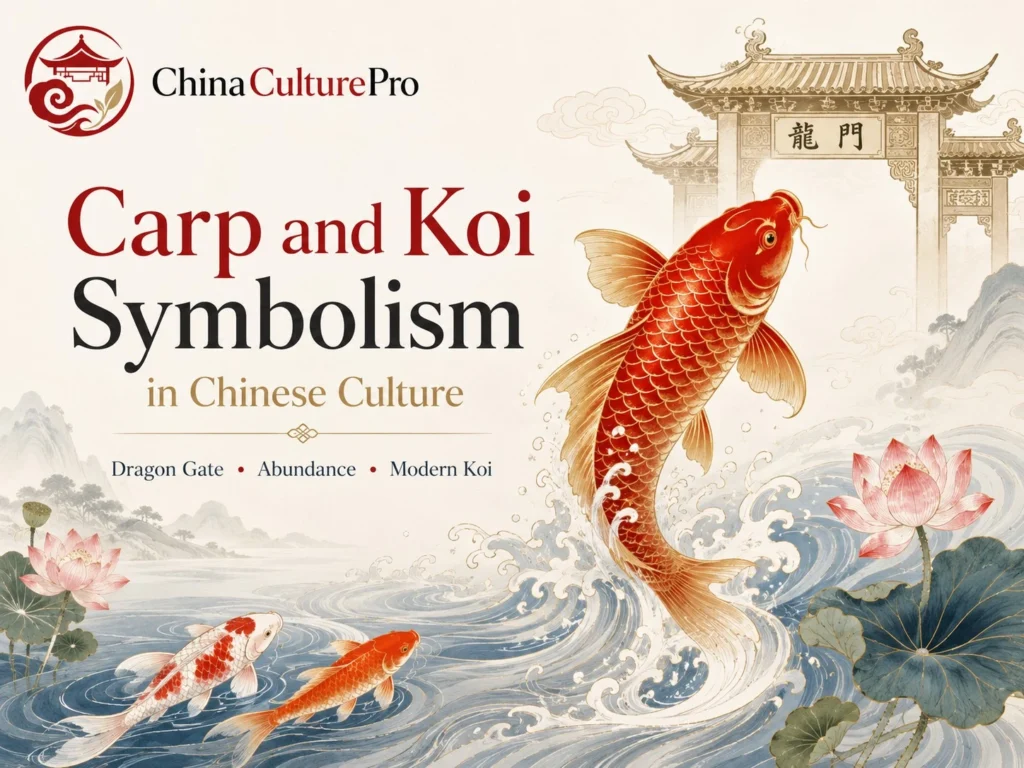
The Dragon Gate is the most distinctive carp-specific tradition in Chinese symbolism. Its core narrative places carp below a formidable river passage. A fish capable of crossing the gate becomes a dragon. The image turns an ordinary creature into a transformed being through effort, danger, and selection.
The textual history needs care. The best-known surviving wording is preserved in later quotations attributed to the lost Sanqin Ji (Record of the Three Qin Regions), traditionally associated with an author called Xin Shi. A passage transmitted in the Taiping Guangji describes yellow carp converging on the gate, a small number passing it, clouds and rain accompanying them, and heavenly fire burning their tails before they become dragons.[1] Those dramatic details belong to the transmitted textual tradition; they should not be presented as a securely preserved Eastern Han autograph.
The Royal Ontario Museum’s nineteenth- to mid-twentieth-century Sichuan woodblock print makes the story visually explicit. A plaque labels the archway “Dragon Gate,” a giant carp rolls in high waves beneath it, and inscriptions invoke thunder, favorable wind, and rain. The museum explains that such prints were pasted up at New Year to express hopes of making a major step forward.[3] Here the gate, waves, text, and leaping fish work together. A carp merely swimming in a pond does not activate the same narrative.
Civil Examinations, Reputation, and Social Mobility
“Ascending the Dragon Gate” acquired a human meaning before it became a standard examination picture. The Hou Hanshu records that scholars received by the eminent official Li Ying were said to have “ascended the Dragon Gate,” a metaphor for enhanced reputation and entry into an elite circle.[2] Later usage increasingly connected the phrase with passing the civil examinations and gaining office.
That analogy was powerful because examination success could change a scholar’s recognized status: the carp’s transformation into a Chinese dragon provided a visual model for intellectual achievement becoming public rank. In later paintings, prints, and ceramics, the theme could congratulate a candidate, encourage study, or express a household’s hopes for advancement. It therefore belongs naturally among Chinese symbols for success, while its struggle against the current can also support a context-specific reading of strength and perseverance.
The symbol remains a wish and metaphor. A Dragon Gate design cannot improve an examination result or secure a promotion. Its historical value lies in how it visualizes difficult passage, recognition, and change.
How Carp Motifs Work in Chinese Art
Leaping Carp, Waves, and the Dragon Gate
A strong Dragon Gate identification normally depends on a group of clues: an architectural gate or named plaque, steep waves, an upward-moving carp, clouds or thunder, a developing dragon form, and an inscription concerning advancement. These elements function as visual grammar rather than as independent lucky objects.
The ROM print supplies nearly the complete set. Yet Liu Jie’s Ming-dynasty Leaping Carp at the Cleveland Museum of Art shows why posture alone is insufficient. The museum notes two readings: the large carp may recall the Dragon Gate and a scholar passing the civil examinations, or it may be guiding its offspring in worshipping heaven.[4] The painting contains a large rising fish and smaller fish below but no labeled gate. Responsible interpretation therefore reports the alternatives instead of converting “leaping” into an automatic formula.
This context-first approach applies across Chinese symbolism in art. Museum title, inscription, object type, date, and composition carry more evidential weight than a generic symbol dictionary.
Carp Transforming into a Dragon and Kui Xing
A fish with emerging dragon features makes the transformation more explicit. Adding Kui Xing narrows the message further toward literature, degrees, and official appointment. On a Chinese porcelain vase dated about 1650 at the Metropolitan Museum of Art, Kui Xing stands on the head of a carp changing into a dragon. He holds a writing brush and a bushel; the museum identifies him as a popular deity associated with the Lord of Literature who oversees the conferring of degrees.[5]
The scene connects three components: carp below the threshold, dragon as the transformed state, and Kui Xing as the literary-examination figure. It does not need a modern color chart to communicate its subject. Nor should every fish-and-dragon design be assigned exactly the same meaning. Without Kui Xing, a brush, an inscription, or an examination context, the composition may express transformation more broadly.
This vase also demonstrates how Chinese porcelain patterns can carry a narrative rather than a single emblem. The viewer reads the relationship among the figures, not merely the species painted on the surface.
Swimming Carp, Children, Lotus, and Other Contexts
Carp outside the Dragon Gate story enter other visual systems. The following meanings are possibilities, not universal translations.
| Composition | Possible reading | Evidence to look for | Boundary |
|---|---|---|---|
| Carp swimming in calm water | Natural observation, leisure, or aquatic life | Painter’s title, inscription, and setting | Still water does not automatically mean wealth, peace, or “success achieved.” |
| Carp with lotus | Continuing surplus through the lotus/continuous and fish/surplus rebuses | Decorative object, auspicious inscription, New Year or gift context | The abundance mechanism belongs to generic fish symbolism; a natural pond scene may remain descriptive. |
| Child holding a carp | Family abundance, offspring, or a New Year wish | Popular-print convention, caption, festival use | It is a secular popular motif, not automatically an examination image. |
| Two carp | Symmetry, paired abundance, religious or personal meaning | Wedding setting, Buddhist emblems, text, or design brief | A pair alone does not prove romance, marriage, or yin-yang. |
Research on carp and goldfish in Chinese popular prints shows that auspicious fish imagery took several forms rather than following one code.[7] A lotus can contribute its own established associations, explained in the planned lotus meaning guide, while a New Year setting can shift the emphasis toward household hopes; see the planned guide to Chinese New Year symbols. The more specific the claim, the more important the inscription and object history become.
Chinese Carp and Japanese Koi: What Is Different?
Chinese carp culture and Japanese koi culture overlap biologically and have influenced one another, but they are not the same historical package.
| Dimension | Chinese carp traditions | Modern Japanese koi traditions |
|---|---|---|
| Primary term | 鲤鱼/鯉魚, lǐyú | koi means carp; nishikigoi specifies ornamental brocaded carp |
| Historical focus | Literature, foodways, aquaculture, Dragon Gate transformation, examination advancement, popular auspice | Selective breeding, named color and pattern varieties, pond display, judging, modern visual culture |
| Key chronology | Ancient and imperial Chinese traditions with meanings that changed over time | Modern ornamental forms developed in early nineteenth-century Japan and spread internationally.[6] |
| Common modern image | Naturalistic or stylized carp, sometimes at a gate or transforming into a dragon | Brightly patterned red, white, black, yellow, or mixed ornamental fish |
| Interpretation rule | Read text, period, object, and companion motifs | Separate documented Japanese variety culture from global tattoo and commercial symbolism |
This distinction does not make one form more authentic than the other. It prevents a modern Japanese variety label from being attached to a Ming painting and prevents a Chinese examination metaphor from being treated as the sole meaning of every contemporary koi design.
Japanese koinobori carp streamers, koi shows, and named nishikigoi varieties belong to Japanese histories beyond this article’s scope. Conversely, the Chinese Dragon Gate story traveled across borders and could be adapted locally. Cultural transmission does not create a universal East Asian definition; each object still needs a country, date, medium, and audience.
Do Koi Colors, Numbers, and Directions Have Fixed Chinese Meanings?
No single documented ancient Chinese system assigns fixed meanings to every koi color, count, pairing, and swimming direction. Modern charts often combine broad Chinese symbols for wealth, Japanese ornamental-fish culture, global tattoo conventions, and commercial feng-shui claims, then present the mixture as one timeless code.
| Popular claim | More accurate reading |
|---|---|
| Red koi always means love or courage | Red has broad festive and auspicious associations in Chinese culture, but no universal historical rule makes every red carp a love symbol. |
| Black koi means overcoming adversity or absorbing harm | This may be used in modern Japanese or tattoo narratives; it is not a general key for premodern Chinese art. |
| Blue koi means peace | Blue is a modern design choice in many works. An inscription or artist’s statement is needed before assigning a precise meaning. |
| Gold koi guarantees wealth | Gold can evoke value or splendor, but that wider color association does not give a fish real wealth-producing power. |
| Upstream means struggle and downstream means completed success | An upward carp at a clearly identified Dragon Gate supports a struggle-and-transformation reading. Direction alone does not establish this two-part rule. |
| Two koi always means love or marriage | A pair may be decorative, religious, narrative, or personal. A wedding context or inscription is needed for a marital reading. |
| Eight or nine koi has a fixed fortune formula | Numbers can matter in specific Chinese compositions, but there is no universal ancient koi chart that overrides the object’s own context. |
| Black-and-white koi form a traditional taijitu | This is a modern figurative adaptation. The historical yin-yang diagram does not require fish. |
Modern artists may intentionally use any of these conventions. The error is not personal symbolism; it is presenting a recent design choice as an unchanged ancient rule. For a commission or purchase, ask where the claimed meaning is documented and whether it comes from Chinese art history, Japanese koi culture, a tattoo tradition, or the seller’s own system.
How Koi Became a Modern Chinese Internet Luck Symbol
In present-day Mandarin, 锦鲤/錦鯉 (jǐnlǐ) can describe more than an ornamental fish. It can refer to an unusually lucky person, a prize winner, or a meme circulated before an exam, interview, drawing, or other uncertain event. The image may be a koi, a celebrity, a deity, or simply a post labeled “koi.”
This usage was already circulating before Alipay’s widely publicized 2018 “Chinese Koi” giveaway, but the campaign made the expression exceptionally visible by selecting one winner for an enormous package of prizes. Contemporary reporting treated the event as a prominent example within a broader culture of sharing “koi” for luck, not as the creation of carp symbolism from nothing.[9]
The internet meaning is best understood as a modern semantic extension. It draws loosely on older auspicious fish and carp imagery, the modern word jǐnlǐ, promotional culture, and platform behavior. It is neither an unchanged ancient belief nor completely disconnected from the past. Reposting a koi can express hope, humor, community, or anxiety, but it cannot alter probability or guarantee an outcome.
How to Interpret or Use a Carp or Koi Symbol Correctly
Use this sequence for museum objects, antiques, tattoos, logos, and contemporary art:
- Identify the fish: Decide whether the work shows a Chinese carp, modern ornamental koi, goldfish, a generic fish, or an uncertain stylized creature. Do not let bright color alone settle the identification.
- Establish place and date: A Ming hanging scroll, a Qing porcelain vase, a Japanese pond fish, and a twenty-first-century tattoo follow different conventions.
- Read the complete composition: Look for a named Dragon Gate, waves, clouds, a dragon body, Kui Xing, a writing brush, lotus, children, inscriptions, or festival use.
- Match the cultural system: Separate examination imagery, popular auspice, natural observation, Japanese nishikigoi culture, Buddhist paired fish, and modern internet language.
- Test specific claims: Treat colors, counts, direction, and pairing as evidence only when the object, artist, community, or reliable source defines them. Avoid universal internet charts.
- State the boundary: Say that a motif “can symbolize” perseverance, advancement, abundance, or luck in a named context. Distinguish historical meaning from personal adaptation and never promise supernatural results.
For a culturally grounded design, a brief such as “a Chinese carp approaching an inscribed Dragon Gate to express difficult advancement” is more precise than “a lucky koi.” A modern tattoo can combine personal meanings, but the planned guide to Chinese tattoo symbols and meanings should be used to label adaptation honestly. The broader Chinese animal symbolism guide and complete guide to Chinese symbols and meanings provide the same context-first method for other motifs.
FAQs About Carp and Koi Symbolism
Is Koi a Chinese or Japanese Symbol?
Both cultures use related carp imagery, but the histories are different. China developed the ancient Dragon Gate narrative and other carp motifs. Modern ornamental nishikigoi varieties were developed in Japan, while contemporary Chinese internet culture later turned 锦鲤/錦鯉 (jǐnlǐ) into a term for an exceptionally lucky person. The country, period, and medium determine which tradition applies.
What Does a Chinese Koi Tattoo Mean?
A Chinese-inspired carp or koi tattoo can express perseverance, transformation, advancement, abundance, or personal hopes for good fortune. A clearly depicted Dragon Gate supports the strongest traditional Chinese connection to difficult advancement. Bright ornamental varieties, fixed color meanings, and upstream-versus-downstream rules usually belong to modern Japanese, global tattoo, or personal design conventions rather than one ancient Chinese code.
Do Two Koi Symbolize Yin and Yang in Chinese Culture?
Not automatically. Two fish can form a symmetrical decoration, participate in Buddhist imagery, or carry a meaning defined by a particular artist or occasion. The familiar black-and-white koi arranged like a taijitu is primarily a modern cross-cultural design. A pair of fish alone does not establish either yin-yang or romantic symbolism.
Sources
[1] Chinese Text Project. Taiping Guangji: Longmen
[2] Chinese Text Project. Hou Hanshu: Biographies of Those Affected by Party Prohibitions
[3] Royal Ontario Museum. Carp Leaping over the Dragon’s Gate, object 969.168.24
[4] Cleveland Museum of Art. Leaping Carp, object 1977.55
[5] The Metropolitan Museum of Art. Vase with the Pole Star deity (Kui Xing), object L.2017.53.2
[6] Smithsonian’s National Zoo and Conservation Biology Institute. Japanese Koi
[7] Ellen Johnston Laing. Carp and Goldfish as Auspicious Symbols and their Representation in Chinese Popular Prints, Arts Asiatiques 72 (2017), 97–109
[8] Chen et al. The Evolutionary Origin and Domestication History of Goldfish, PNAS 117.47 (2020)
[9] Sixth Tone. Why Down on Their Luck Netizens Like to Play ‘Koi’ (2018)