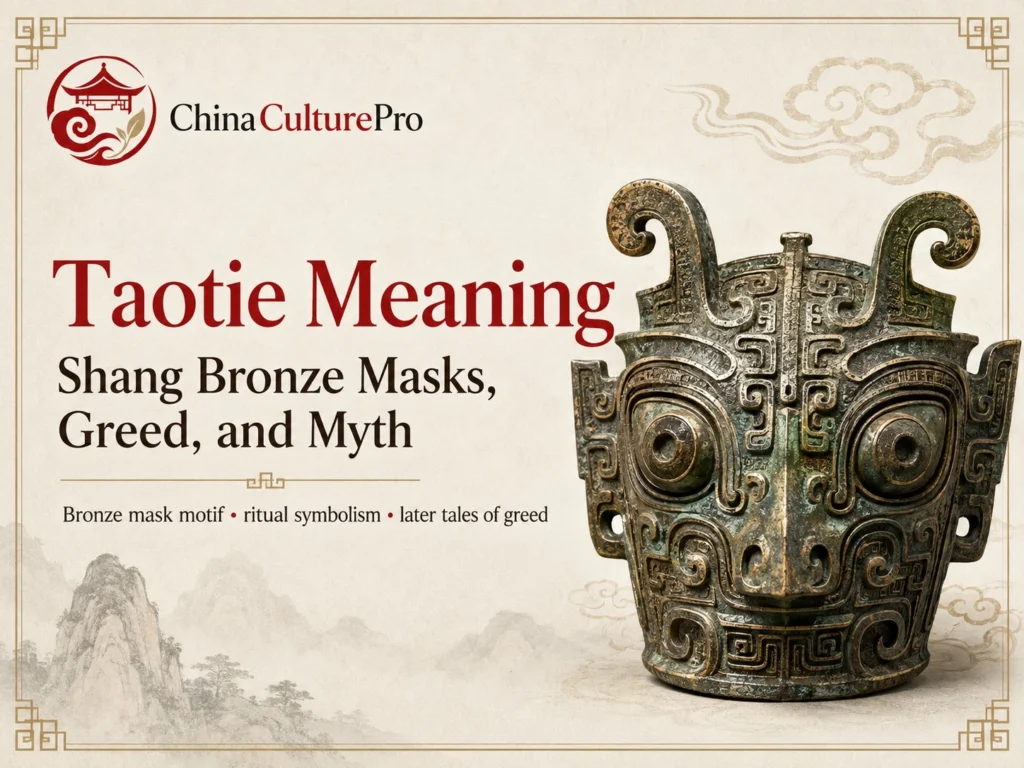

Quick Answer: What Does Taotie Symbolize?
Taotie (饕餮, Tāotiè) is a layered Chinese symbol. The word can mean the greedy figure described in later literature, while taotie mask is the conventional art-historical name for a frontal animal-mask motif on Shang and Zhou bronzes. These meanings developed at different times and should not be collapsed into one origin story.
- Ritual awe and authority: On early bronzes, the mask belonged to elite sacrificial culture and helped give ritual vessels an imposing presence.
- Later gluttony and greed: Late pre-imperial texts made Taotie a negative model of uncontrolled appetite and acquisitiveness.
- Archaistic cultural identity: Song antiquarians and later craftspeople treated the motif as an emblem of the ancient ritual past.
- Modern fantasy: Films, games, tattoos, and illustrations often turn it into a complete devouring monster with invented powers.
The original Shang meaning has not been conclusively decoded. “A warning against greed” is an important later interpretation, not a proven explanation of why Shang artisans created the motif.
A familiar explanation says that Shang bronze workers cast the Taotie as a gluttonous monster to warn people against greed. The chronology does not support that simple story. Animal-mask images on Shang ritual bronzes are centuries older than the surviving texts that call a figure Taotie and condemn its appetite. No known Shang inscription securely gives these masks that name or explains them as warnings against excess.
The Metropolitan Museum of Art’s late Shang Ritual Water Container (Yu), made in the thirteenth–twelfth century BCE, makes the distinction visible. Its four imposing masks—now conventionally called Taotie—help create deference and awe on a bronze used in sacrificial ablutions. Yet the original identity and meaning of Shang animal masks remain debated.[1]
What Is Taotie?
Taotie is written 饕餮 and pronounced Tāotiè. Older Western museum publications may use the Wade–Giles spelling t’ao-t’ieh. The term now has two main uses. In received literature, it identifies an exemplary figure of greed or gluttony. In art history, taotie motif or taotie mask labels a frontal, usually bilaterally organized fantasy animal face found especially on Shang and early Zhou ritual bronzes.
The bronze image is not a portrait of one real species. It combines mutable horns, ears, brows, fangs, jaws, claws, and bodies around a remarkably stable pair of eyes. In many examples, a central ridge functions like a nose while the creature’s body unfolds in profile on either side. Some masks lack a lower jaw; some seem almost bodiless.[2]
This modern label does not prove what Shang people called the image. Texts found at Anyang do not supply the original names of these fantastic animals, even though vessel inscriptions can identify ancestors for whom offerings were intended.[3] Taotie is therefore not best understood as a god with one biography, sex, body plan, or universal cult. For the bronze design, neutral phrases such as “animal-mask motif” are more precise than “demon face.”
What Taotie Means in Different Contexts
The safest rule is to identify the historical layer before assigning a meaning. A Shang bronze, a Warring States moral text, a Song imitation vessel, and a contemporary game character may all be called Taotie, but they are not making the same claim.
| Context | Primary meaning | Typical carrier | Interpretation limit |
|---|---|---|---|
| Shang and early Zhou ritual bronzes | Imposing ritual imagery within elite sacrificial culture; exact identity debated | Ding, zun, yu, you, fangyi, gu, and jue | No contemporary inscription proves the name Taotie or a warning against greed |
| Late pre-imperial moral literature | Gluttony, greed, and self-destructive excess | Zuo Zhuan and Lüshi Chunqiu | These texts postdate the height of Shang bronze production by centuries |
| Song antiquarian catalogues and archaistic art | A named ancient motif and a visual connection to idealized ritual antiquity | Illustrated catalogues and revival bronzes | Retrospective classification is not Shang terminology |
| Ming Nine Sons variant | A creature fond of food, placed on a ding lid | Yang Shen-associated alternative list | Taotie is absent from the better-known Li Dongyang-associated list |
| Later language and food culture | Voracious appetite; later, a lavish feast or enthusiastic gourmet | Expressions such as taotie shengyan and laotao | Linguistic development does not decode Shang bronze art |
| Modern media and design | Devouring monster or archaic Chinese visual identity | Film, games, logos, jewelry, and tattoos | Full bodies, powers, colors, and personalities are usually modern inventions |
These layers can interact. A modern designer may deliberately combine the bronze mask with the later idea of appetite. Accuracy depends on labeling that combination as an interpretation rather than presenting it as uninterrupted Shang belief.
What Did the Taotie Motif Mean on Shang Bronzes?
No excavated text currently gives a single answer. Scholars therefore build interpretations from object type, archaeological setting, casting structure, visual form, and comparison with later evidence. Several hypotheses remain influential:
| Interpretation | Supporting clue | Certainty limit |
|---|---|---|
| Ritual awe and elite authority | Masks dominate expensive bronzes used in aristocratic ancestral rites; their scale and eyes create a commanding presence | Strong as a social-context reading, but it does not identify the depicted being |
| Ancestral spirit or ritual intermediary | Bronzes served offerings to ancestors; some scholars read the animal image as mediating between living and spirit worlds | A serious scholarly proposal, not a consensus supported by a direct Shang explanation |
| Predator, devouring, or life–death boundary | Fangs and powerful jaws can suggest dangerous consumption in a sacrificial environment | The visual association is plausible but cannot establish the artisan’s intention |
| Protective or apotropaic power | Formidable animals can mark and guard ritually charged spaces | Largely inferential; no Shang text explicitly assigns the mask this function |
| Formal decorative organization | Symmetry, eyes, and modular animal parts efficiently structure a vessel’s surface | Explains design logic without proving that the image lacked ritual significance |
The first view is especially useful when carefully phrased. The Met interprets the four masks on its water vessel as generating deference and awe, while its wider bronze survey states that the motif’s meaning in Shang society is unknown.[1][2] Sarah Allan’s work offers a more specific ritual reading and traces a two-eyed visual sequence from Erlitou through early and late Shang forms, but it remains an interpretation rather than a deciphered Shang statement.[5]
The popular “warning against greed” explanation comes from later textual memory. It can illuminate how later Chinese readers understood old bronzes, but it cannot serve as contemporary testimony for thirteenth-century BCE workshops.
How Taotie Symbolism Developed Through History
Taotie developed through a sequence in which an image came first, names and moral stories accumulated later, and each period reshaped the previous one.
Animal Masks Before the Name
Two-eyed designs appear before the mature Anyang bronze style. Some studies trace a formal sequence from eye motifs associated with Erlitou, through simpler masks in early Shang Erligang culture, to the dense, high-relief compositions of late Shang Anyang. At Anyang, projecting eyes, a central ridge, variable horns and ears, and fine spiraling ground patterns could transform a vessel into a tightly organized field of animal forms.[5]
Liangzhu jade “spirit-and-animal” faces are sometimes proposed as an earlier visual ancestor. The resemblance is intriguing, but the British Museum notes that a large chronological gap prevents this continuity from being demonstrated.[4] It is safer to call the Liangzhu image a possible visual precedent, not an early Taotie.
Most importantly, image and name should remain separate. The Anyang evidence gives us objects, workshops, inscriptions, and ritual settings, but not a securely attested Shang label for this animal mask.[3]
Early Texts and the Gluttony Interpretation
The received Zuo Zhuan account associated with Duke Wen’s eighteenth year describes an unworthy descendant of the Jinyun clan as greedy for food and goods. People called him Taotie; the passage later became part of the tradition of the Four Perils.[6] Here Taotie is a morally corrupt figure or lineage designation. The passage does not describe a Shang bronze mask.
The Lüshi Chunqiu, compiled in the late third century BCE, makes the decisive textual connection to a vessel. It says a Zhou ding bore Taotie with a head but no body: the creature tried to eat a person before swallowing and harmed itself, illustrating the consequences of appetite.[7] This is the classic source for reading the image as an admonition against greed.
Both texts matter for the history of interpretation. Neither is contemporary evidence for the makers of late Shang bronzes. The correct conclusion is not that the moral story is “false,” but that it belongs to a later layer.
Antiquarian Naming and Archaistic Revival
During the Northern Song, scholars built jinshixue, the “study of bronze and stone.” They collected ancient vessels, copied inscriptions, prepared illustrated catalogues, and used received classical texts to classify objects whose original names and imagery were uncertain. The movement fundamentally shaped later Chinese archaeology and the vocabulary still used for old bronzes.[9]
In this environment, antiquarians such as Li Gonglin applied the literary name Taotie to ancient mask decoration by drawing on passages such as the one in the Lüshi Chunqiu. Later catalogues, including Kaogu Tu and Xuanhe Bogu Tu, helped stabilize this retrospective terminology. Song scholars did not invent the word Taotie; they made it a durable category for a broad family of ancient images.
Song and later makers also produced archaistic bronzes and other objects that quoted ancient forms. In those works, the mask could signal cultivated knowledge of high antiquity and a claim to ritual or cultural continuity, even when the object’s design was not an exact archaeological copy.
From the Nine Sons Tradition to Modern Pop Culture
Ming sources offered more than one list of the Nine Sons of the Dragon. The widely circulated Li Dongyang-associated list does not include Taotie. An alternative list associated with Yang Shen does: it says Taotie likes food and therefore appears on ding lids.[10] This classification is a Ming antiquarian-folkloric layer, not evidence that Shang patrons regarded the bronze mask as a dragon’s child.
Modern media extend the process. A frontal mask can become a full-bodied monster, species, villain, or weapon with limitless swallowing power. Such versions may creatively echo the later appetite story and the bronze aesthetic, but their anatomy, colors, magic, and power rankings are not fixed by early texts. They are modern fantasy adaptations.
How to Recognize Taotie in Chinese Art
Identification should begin with the object, date, and overall composition—not with a generic impression of a frightening face.
- Check the carrier and date: The motif is especially associated with Shang and early Western Zhou ritual bronzes, including ding, zun, yu, you, fangyi, gu, and jue. Later archaistic works deliberately revive it.
- Look for bilateral organization: The face is normally arranged around a vertical center. A flange may operate as the nose and divide the two halves.
- Find the paired eyes: Large, projecting eyes are the most stable identifying feature. They often remain legible even when other anatomy dissolves into ornament.[2]
- Treat horns and jaws as variables: Horns, ears, brows, fangs, and a lower jaw change from object to object. No single horn type defines Taotie.
- Trace the split body: What first appears to be a head alone may have a body and legs extending in profile along both sides of the face.
- Inspect the ground pattern: Dense spirals often called leiwen or thunder pattern fill the surrounding surface and separate raised animal elements.
- Read the label: Not every symmetrical ancient animal face is Taotie. Museum cataloguing, provenance, object type, and related motifs should confirm the identification.
A Western Zhou fangyi in the National Museum of Asian Art illustrates the split-body principle: a frontal head sits at the center while paired body parts, feet, and tails unfold to either side. This visual grammar is more reliable than looking only for a huge mouth.
Taotie, Paoxiao, the Four Perils, and the Nine Sons
Later commentaries often equated creatures from different texts. Those equations are historically important, but they do not make every source describe one original, stable species.
| Identity | Earliest relevant layer | Core description | What it does not prove |
|---|---|---|---|
| Bronze Taotie mask | Shang ritual bronzes; name applied retrospectively | Symmetrical fantastic animal mask, often with split body | That Shang artisans called it Taotie or intended a greed lesson |
| Taotie in the Zuo Zhuan | Received late pre-imperial historical narrative | Jinyun’s greedy, unworthy descendant in the Four Perils tradition | That the figure is a bronze mask |
| Paoxiao in the Shanhaijing | Classic of Mountains and Seas, Northern Mountains | Sheep-like body, human face, eyes under the armpits, tiger teeth, human hands, and a taste for people | The base text does not call it Taotie; the identification comes from later commentary |
| Taotie in Yang Shen’s Nine Sons list | Ming alternative catalogue | Food-loving creature placed on a ding lid | That Taotie belongs to every Nine Sons list or to Shang dragon lore |
The Shanhaijing itself names Paoxiao (狍鸮), not Taotie, in the relevant passage.[8] Guo Pu’s later commentary connected Paoxiao with the self-harming glutton and with Taotie. Accordingly, “Paoxiao was later identified with Taotie” is more accurate than “the Shanhaijing describes Taotie.”
Likewise, calling Taotie one of the Four Perils reflects the received moral-political tradition built around the Zuo Zhuan passage. Calling it a dragon son reflects only one Ming variant. These are different genealogies of interpretation, not interchangeable facts.
How to Interpret or Use a Taotie Design Correctly
For museum interpretation, tattoos, logos, jewelry, clothing, architecture, and game art, use this short review process:
- Choose the source layer: Decide whether the design quotes a Shang–Zhou bronze mask or depicts the later gluttonous creature. State the choice clearly.
- Preserve the visual grammar: For a bronze-inspired motif, retain bilateral symmetry and prominent paired eyes. Secondary horns, jaws, and limbs can vary.
- Qualify the moral meaning: “A warning against greed” is supported as a later interpretation, not as a proven Shang intention.
- Do not assume dragon ancestry: Mention the Nine Sons only when deliberately using the Yang Shen-associated Ming variant.
- Label invention: A complete body, elemental power, appetite-based magic, and fixed personality usually belong to modern creative work.
- Avoid efficacy claims: Taotie imagery has no verified power to repel evil, attract wealth, restrain desire, or protect a building.
- Verify permanent or commercial work: Compare the design with a documented museum object and confirm the Chinese characters before finalizing a tattoo, public sculpture, or brand mark.
For broader context, see Chinese Symbols and Meanings and the guide to Chinese Mythical Creatures. Modern adaptation is legitimate; the key is to distinguish an adaptation from an archaeological reconstruction.
Final Takeaway
Taotie is best understood as an image first and a named monster later. Shang artisans created powerful animal masks for ritual bronzes, but their original name and precise meaning remain unknown. Late pre-imperial moral texts, Song antiquarian scholarship, a Ming Nine Sons variant, and modern fantasy each added a new layer. Separating those layers preserves both the mystery of the early bronzes and the genuine historical importance of later interpretations.
FAQs About Taotie Meaning and Symbolism
How Do You Pronounce Taotie?
The standard Mandarin pronunciation is Tāotiè: tāo has the first tone and tiè the fourth. “Dow-tyeh” is only a rough English approximation. Formal writing should use the pinyin spelling Taotie; older catalogues may use the Wade–Giles form t’ao-t’ieh.
Is Taotie a God?
Not in the sense of a single deity with a standardized temple cult, priesthood, and biography. Taotie can refer to a bronze motif, a morally corrupt figure in received literature, or a later classified beast. Shang elites may have treated animal-mask imagery with profound ritual seriousness, but that does not demonstrate one nationwide “Taotie god” worshipped across Chinese history.
Is Taotie Part of the Chinese Zodiac?
No. The Chinese zodiac is a twelve-animal calendrical cycle. Taotie belongs to histories of bronze ornament, moral literature, antiquarian classification, and later mythology. It is not a zodiac sign in any traditional cycle.
Why Can Taotie Also Describe a Feast or Food Lover?
Later Chinese language developed from the literary association between Taotie and voracious appetite. Taotie shengyan (饕餮盛宴) can describe a sumptuous feast, while laotao (老饕) can mean an enthusiastic or discerning eater. In these uses, the older condemnation of gluttony is partly softened into appreciation of abundance or food. This linguistic development does not reveal the meaning of Shang bronze masks.
Does Taotie Have the Same Meaning Across East Asia?
No single interpretation applies everywhere. Chinese bronze forms and the written term circulated through East Asia, but Japanese, Korean, Vietnamese, and other local artistic traditions adapted them to different objects and narratives. A local museum label, historical period, and regional context should take priority over a generalized “East Asian Taotie” definition.
Sources
[1] The Metropolitan Museum of Art. Ritual Water Container (Yu), Object 61.117
[2] The Metropolitan Museum of Art. Shang and Zhou Dynasties: The Bronze Age of China
[3] National Museum of Asian Art. Anyang: China’s Ancient City of Kings
[4] British Museum. Taotie Collection Term
[5] Sarah Allan. The Taotie Motif on Early Chinese Ritual Bronzes
[6] Chinese Text Project. Zuo Zhuan, Duke Wen 18
[7] Chinese Text Project. Lüshi Chunqiu, Xianshi
[8] Wikisource. Shanhaijing: Northern Mountains
[9] Yunchiahn C. Sena. Bronze and Stone: The Cult of Antiquity in Song Dynasty China
[10] People’s Political Consultative Conference Network. The Nine Sons Tradition and Yang Shen’s List