

Quick Answer: What Does the Xiezhi Symbolize?
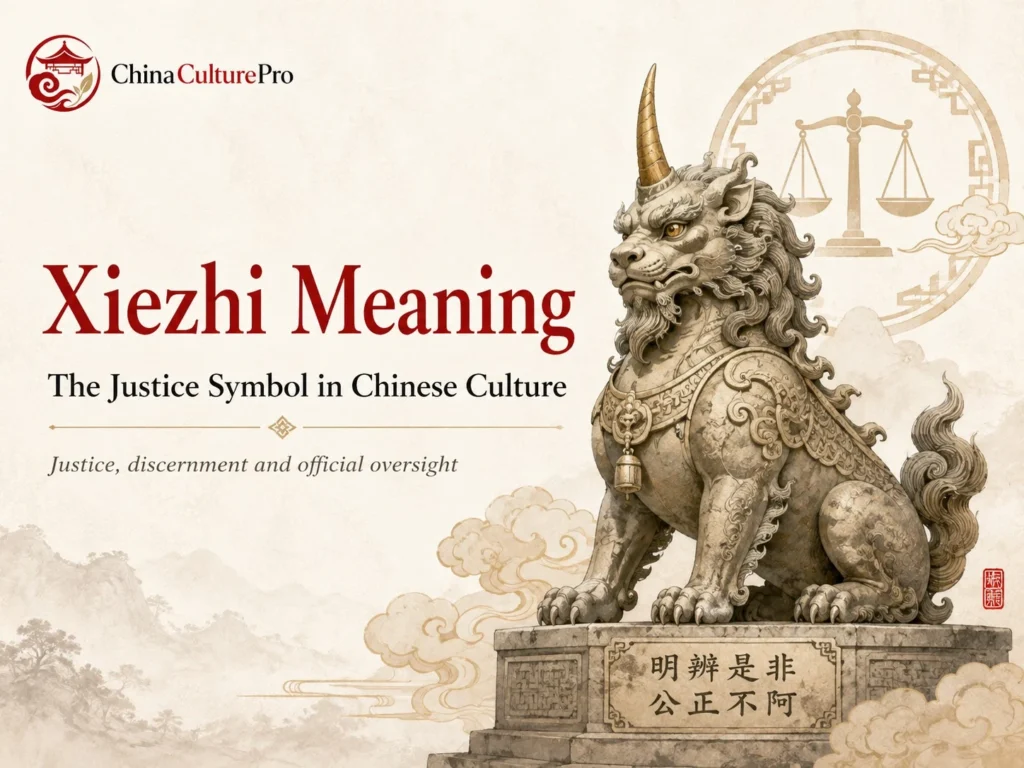
Xiezhi (獬豸, Xièzhì) is a Chinese mythical beast most closely associated with justice, moral judgment, and official oversight. Early transmitted texts describe a one-horned animal that could recognize guilt and strike the party in the wrong. Later governments turned that story into an institutional emblem on legal headgear and the rank badges of censors.
- Impartial judgment: Xiezhi represents deciding a dispute without favoritism.
- Moral discernment: Its legendary ability to recognize the wrongdoer expresses a clear distinction between right and wrong.
- Censorial integrity: On official dress, the animal identified officers responsible for scrutinizing government conduct.
- Modern legal identity: Its image still appears in Chinese legal education, court sculpture, publishing, and public culture.
These are cultural meanings, not supernatural functions. A Xiezhi image cannot detect lies, punish wrongdoing, or guarantee protection.
Calling Xiezhi a “Chinese unicorn” is convenient but misleading. The European unicorn is generally read through purity, wonder, and romance; Xiezhi belongs to a Chinese tradition of judgment, law, and official accountability. It is also not simply another Qilin. Chinese artists sometimes placed the two creatures together because they performed different symbolic jobs.
A Qing-dynasty rank badge dated 1736–95 makes that difference tangible. Its deerlike, single-horned Xiezhi stands amid rocks, waves, and clouds, facing a red sun that represented the emperor. The silk badge was made for a censor, turning a legendary judging beast into a visible statement of office, loyalty, and responsibility.[1]
What Is the Xiezhi?
Xiezhi is written 獬豸 and pronounced Xièzhì in standard Mandarin. Historical texts also preserve forms such as 解廌, 解豸, and 觟𧣾. “Justice beast” or “law beast” can explain its role in English, but neither is a fixed translation of its name.
The creature has no proven real-animal species or anatomy shared by every period. Eastern Han descriptions compare it with a one-horned sheep or a mountain ox. Later art can make it deerlike, bovine, caprine, scaled, or dragon-headed. The single horn is the most persistent clue, while body, coat, color, feet, and mane vary.
Xiezhi belongs to the broader tradition of Chinese mythical creatures, but its defining role is legal discernment. It is not a dragon or one of the Nine Sons. It also differs from auspicious animals whose main work is blessing a household or announcing a peaceful reign. This is why a context-first approach from the wider guide to Chinese symbols and meanings is more reliable than matching one horn to an online creature chart.
What Xiezhi Means in Different Contexts
Xiezhi did not carry one unchanged message on every object. Its role moved from transmitted legend into official dress, institutional art, and modern visual culture.
| Context | Primary meaning | Typical carrier | Interpretation limit |
|---|---|---|---|
| Early transmitted legend | Recognizing guilt and distinguishing the straight from the crooked | Lunheng, Shuowen Jiezi, and later collections of strange creatures | A literary tradition about legendary antiquity, not proof of an actual trial procedure |
| Legal crown and official dress | Authority to enforce law and examine misconduct | Xiezhi guan or “Xiezhi crown,” official portraits, dress regulations | Not a universal hat for every judge in every dynasty |
| Ming–Qing censor badges | Integrity, scrutiny of officials, and loyalty within the imperial system | Square embroidered rank badges and court textiles | Specific to censorial office rather than a general emblem for all civil officials |
| Architectural and decorative art | Public authority, judgment, and ordered government | Government compounds, legal-themed sculpture, textiles, and objects | A symbolic message, not a device with automatic protective power |
| Modern legal and civic use | Law, accountability, public responsibility, and cultural continuity | Courts, universities, legal publishing, public sculpture, and design | A modern adaptation, not China’s single national judicial emblem |
How Xiezhi Symbolism Developed Through History
The tradition did not begin as one complete origin myth. Surviving texts, court dress, and artworks record different stages in which the judging beast became an increasingly recognizable institutional sign.
Early Texts and the Gao Yao Legend
One of the clearest surviving accounts appears in the Eastern Han work Lunheng. It describes the beast as a one-horned sheep that knew guilt. When the legendary judge Gao Yao could not decide a case, the animal was said to butt the guilty party and spare the innocent.[3] The passage documents an Eastern Han understanding of a story set in legendary antiquity; it is not evidence that such animal judgment occurred in the age attributed to Gao Yao.
A related description preserved through Yiwu Zhi says that the one-horned animal would strike the unjust party in a fight and bite the dishonest party in an argument. This passage is often mislabeled online as a quotation from the Classic of Mountains and Seas. It should instead be identified through the later textual tradition in which it survives.[4] Together, these accounts establish the creature’s active role: it did not merely stand for virtue but exposed and confronted wrongdoing.
The Xiezhi Crown and Legal Office
The Book of Later Han describes the faguan, or law crown, as headgear worn by officers responsible for legal enforcement, including censors and senior judicial officials. It also records the alternative name “Xiezhi crown” and explains the animal as a divine sheep able to distinguish crooked from straight.[4]
The same passage connects the crown with a story that a king of Chu obtained the beast. That narrative explains the design within received tradition, but it should not be treated as an archaeologically confirmed event. The institutional point is firmer: the Xiezhi became a visual shorthand for an official expected to remain upright, investigate misconduct, and resist improper pressure. The exact form and users of the crown changed, so it was never a timeless uniform for everyone who worked with law.
Censor Badges and Modern Legal Emblems
During the Ming and Qing dynasties, rank badges made office visible on ceremonial clothing. Birds commonly marked civil ranks and beasts marked military ranks, while the Xiezhi identified a censor. The Qianlong-period example in Cleveland is silk satin embroidered with silk and metal thread, measuring 27.3 by 26 centimeters. Its central creature faces the imperial sun within a miniature landscape and cosmic setting.[1]
A seventeenth-century export textile places a white, single-horned Xiezhi in the same border as a blue Qilin. The museum identifies the Xiezhi through its power to distinguish virtue from evil and the Qilin through a separate auspicious tradition, showing that horned composite beasts were not interchangeable.[2]
Modern Chinese courts, law schools, publishers, and public spaces continue to use Xiezhi imagery. Its function has changed from marking a particular imperial office to expressing a broader ideal of justice and accountability. This use is widespread enough to make Xiezhi a recognizable legal-cultural emblem, but it does not make the beast an official logo used uniformly by every court or legal institution.[6]
Why Does the Xiezhi Have One Horn?
The single horn is the most consistent feature in classical descriptions because it performs the creature’s judgment. The beast identifies the party in the wrong and then butts or gores that person. The horn therefore makes an invisible moral decision visible as an immediate action.
Later interpretation connects that form with decisiveness, upright judgment, and refusal to bend under pressure. Those are reasonable readings of the story, not proof that the horn originally encoded a philosophical doctrine of “one absolute truth.” Classical sources do not prescribe one horn length, curve, direction, or color.
The horn is also a strong clue rather than a sufficient test. A Qilin can have one horn, and a damaged, stylized, or distant Xiezhi image may not display its horn clearly. Even the commentary preserved with the Book of Later Han notices tension between a one-horned animal and a crown then made with two projections.[4] Date, carrier, inscription, and institutional setting remain essential.
How to Recognize the Xiezhi in Chinese Art
Use several clues together instead of treating Xiezhi as a fixed fantasy species.
- Start with date and carrier: A censor’s badge, law crown, government setting, or legal-themed artwork gives the strongest initial context.
- Look for one horn: It is the most persistent textual and visual marker, but it does not identify the creature by itself.
- Allow body variation: Sheep-, ox-, goat-, and deerlike bodies occur, while later versions may add scales, a dragonlike head, a heavy mane, claws, or hooves.
- Read the composition: A creature confronting wrongdoing, standing with official insignia, or facing the sun on a rank badge supports a Xiezhi reading. Clouds and flames alone do not.
- Check inscriptions and catalogues: An object label, archaeological context, dress record, or written name carries more weight than a modern appearance chart.
- Compare the whole figure: A serene auspicious animal may be a Qilin; a lion at a gateway may be an architectural guardian; a feline beast on a prison door may belong to the Bi’an tradition.
The seventeenth-century textile is especially useful because it shows a white Xiezhi and blue Qilin within one composition. Color does not define either creature, and their coexistence confirms that Chinese visual culture could distinguish them even when both were horned, hoofed, and supernatural.[2]
Is the Xiezhi Connected to the Chinese Character for Law?
Yes, but the connection has two historical layers. The traditional explanation begins with the old graph 灋, an ancestor of 法 (fǎ, law). In Shuowen Jiezi, its water component is associated with level fairness, 廌 with the creature that strikes the unjust, and 去 with removing wrongdoing. This influential Eastern Han interpretation made Xiezhi part of the intellectual and visual language of Chinese law.
That traditional explanation should not be converted into the simple claim that “Xiezhi created the character for law.” Modern paleography studies much earlier oracle-bone and bronze forms that were unavailable to the compiler of Shuowen Jiezi. A 2025 analysis argues that the earliest sense of 灋 was closer to abolishing or doing away with something, while the judging power assigned to 廌 developed later. It also interprets early 廌 forms as sacrificial animals rather than an already complete mythical judge.[5]
The careful conclusion is that Xiezhi has a deep and historically important relationship with the traditional interpretation of law, but the creature is not an uncontested explanation for the graph’s first creation. Modern 法 no longer contains the 廌 component, although the older graphic story remains culturally influential.
Xiezhi vs. Similar Chinese Mythical Creatures
Horns, scales, imposing postures, and official settings can make several creatures look related. Their cultural systems and actions are more useful than anatomy alone.
| Creature | Core role | Recognition clues | What not to assume |
|---|---|---|---|
| Xiezhi | Discerns right from wrong; represents law and censorial integrity | Usually one horn; variable hoofed or scaled body; legal or official context | Not a generic luck beast or Chinese version of every unicorn |
| Qilin | Benevolence, worthy rule, peace, rank, and auspicious arrival | Hoofed composite; one or two horns; often calm or auspicious setting | A horn does not turn every Qilin into Xiezhi |
| Western unicorn | Purity, wonder, healing, or romance in European traditions | Commonly horse-shaped with one long horn | Visual similarity does not create a shared origin or legal meaning |
| Pixiu | Early martial or protective imagery; later wealth symbolism | Forceful hybrid, often horned or winged in later art | It has no classical role deciding lawsuits |
| Chinese guardian lion | Guards thresholds and expresses religious, civic, or imperial authority | Stylized lion, often placed at an entrance or as a later pair | It does not become Xiezhi because it stands near a courthouse |
| Bi’an | Litigation and prison-door imagery in some Nine Sons of the Dragon traditions | Often tiger- or feline-like and attached to judicial architecture | Its prison association does not make it the same judging beast as Xiezhi |
The fastest distinction is functional. Xiezhi actively identifies the wrongdoer; Qilin embodies benevolent order; guardian lions control a threshold; Bi’an marks punitive or prison space; and Pixiu follows a different guardian and later wealth-symbolism history.
How to Interpret or Use a Xiezhi Symbol Correctly
For a logo, tattoo, public sculpture, clothing motif, or legal-cultural design, use a context-first process:
- Define the message: Choose Xiezhi when the intended values are justice, ethical judgment, oversight, or public responsibility—not merely luck or visual prestige.
- Preserve identification: Retain a clear single horn and enough hoofed, beastlike, or official context to prevent the design from reading as a Western unicorn.
- Choose a documented historical layer: A sheep-like early concept, deerlike Qing badge, or later scaled form can all work if the reference is consistent.
- Avoid forced hybrids: Adding Qilin serenity, Pixiu wings and coins, or Bi’an prison imagery can erase the creature’s identity instead of enriching it.
- Describe symbolism, not effects: Say the design represents impartiality or integrity. Do not claim that it detects dishonesty, punishes enemies, prevents disasters, or changes legal outcomes.
- Review permanent uses: For a brand, institution, tattoo, or public installation, check the Chinese characters, period reference, and complete visual source with a museum catalogue or qualified cultural reviewer.
Modern adaptation is not inherently inaccurate. The essential step is to identify what was changed and avoid presenting a creative choice as an ancient rule.
Final Takeaway
Xiezhi is best understood as an evolving emblem of judgment rather than a Chinese unicorn with one fixed body. Legend gave it the power to identify wrongdoing; official dress turned that power into a sign of legal and censorial responsibility; modern culture broadened it into an image of justice. Context and institutional use therefore identify Xiezhi more reliably than color, scales, or any single anatomy chart.
FAQs About Xiezhi Meaning and Symbolism
How Do You Pronounce Xiezhi?
Xièzhì has two falling fourth tones in standard Mandarin. A rough English guide is “shyeh-jir,” but the initial consonants and tones do not map exactly into English. Standard pinyin with tone marks is the clearest written guide.
Is the Xiezhi Part of the Chinese Zodiac?
No. Xiezhi belongs to mythic, legal, and official symbolism. The Chinese zodiac is a separate twelve-animal calendrical cycle, and Xiezhi is not one of its members.
Is the Xiezhi Male or Female?
Classical texts and standard historical images do not give Xiezhi one fixed biological sex. Gender assigned in a modern animation, game, or design belongs to that adaptation rather than a general traditional rule.
Are Chinese Xiezhi and Korean Haechi the Same?
They share a historical source but are not interchangeable in every context. Korean Haechi or Haetae retained associations with justice and protection while developing local forms and meanings. Seoul’s modern Haechi character, for example, combines justice and safety with civic happiness, hope, a bell, wings, and a friendlier visual personality.[7] A Korean object should therefore be interpreted through Korean history and use, not treated as an unchanged Chinese Xiezhi.
Sources
[1] Cleveland Museum of Art. Rank Badge (buzi), 1736–95
[2] The Metropolitan Museum of Art. Panel with Flowers, Birds, and Animals
[3] Wang Chong. Lunheng
[4] Wikisource. Book of Later Han, Treatise on Carriages and Dress
[5] Zhiji Liu. An Investigation of Chinese Legal Concepts: Evidence from the Ancient Scripts ‘Fa’ and ‘Zui’
[6] Australian National University. The Unaesthetic Complexity of the Image of Xiezhi in Representing the Jurisprudence in Ancient and Modern China
[7] Seoul Metropolitan Government. Character Form: Haechi