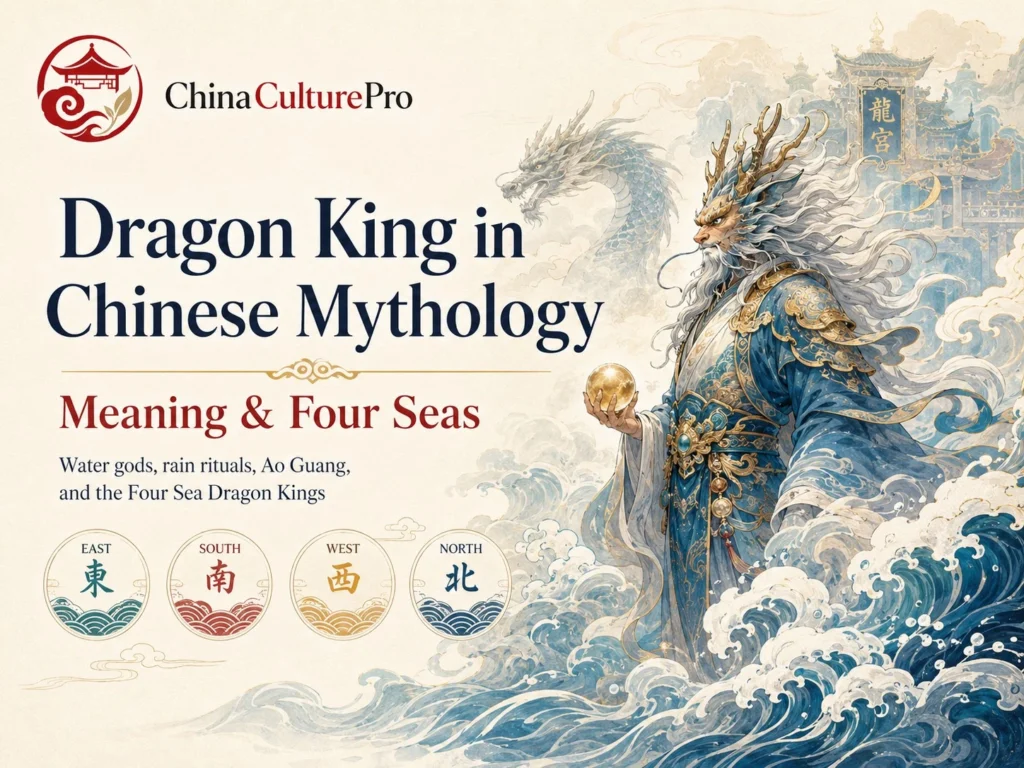

Quick Answer: Who Is the Dragon King in Chinese Mythology?
The Dragon King, or Longwang (龙王, Lóngwáng), is a title for divine authorities associated with bodies of water, rain, and water-related order in Chinese religion and mythology. It can refer to one of the Four Dragon Kings of the seas or to a local ruler of a river, lake, spring, well, or watershed. It does not name one universal god.
- Water and rain: Communities historically petitioned Dragon Kings for timely rain, safe waterways, and relief from drought or flood.
- Territorial water authority: Different Dragon Kings govern different waters; their names, ranks, and relationships vary by text and locality.
- Religious and ritual office: The tradition developed through interaction among earlier Chinese dragon–water beliefs, Buddhist nāga kings, Daoist systems, state ritual, and local worship.
- Literary and modern identity: Ao Guang became the best-known East Sea Dragon King through Ming novels and later screen adaptations, but a literary character cannot represent the entire religious tradition.
In short, Ao Guang is one famous version of one Dragon King—not the definition of every Longwang.
Many English introductions reduce the Chinese Dragon King to Ao Guang, a single monarch living beneath the East Sea. Chinese sources present a much larger system. Longwang is a divine office that may belong to a ruler of one of the Four Seas or to a local authority responsible for a river, lake, spring, well, or watershed.
That system changed whenever it entered a new setting. Buddhist scriptures, Daoist ritual, imperial rainmaking, village temples, Ming fiction, and modern animation created related but nonidentical Dragon Kings. A British Museum album leaf labeled “East Sea Dragon King” depicts him among Chinese deities, while a late Ming painting at The Met imagines a magnificent palace across the waves.[7][8] Neither image alone supplies one timeless biography.
What Is a Dragon King or Longwang?
Longwang is written 龙王 in simplified Chinese and 龍王 in traditional Chinese. The literal components are “dragon” and “king,” but the compound normally functions as a title or divine office rather than a personal name. English singular wording can therefore mislead: Chinese traditions recognize many Dragon Kings.
Several related terms should remain separate:
- Dragon deity (longshen): A broad category for divine dragons, especially those associated with water, clouds, and rain. Chinese dragon–water ideas predate the mature Longwang office.
- Dragon King (Longwang): A narrower title used for a ruler or administrator of a water domain. The category expanded through Buddhist translation, Daoist organization, state recognition, and local practice.
- Sea Dragon King: A Dragon King whose domain is a sea; this is only one branch of the larger category.
- Four Dragon Kings of the Four Seas: Four directional sea offices—east, south, west, and north—later given memorable personal names in fiction.
- Local Dragon King: A deity connected to a particular river, lake, spring, well, village, or irrigation landscape. Local cults need not share one name or centralized hierarchy.[1]
The distinction matters. An early dragon motif is not automatically a portrait of a Dragon King, and a local temple deity does not become Ao Guang merely because both are called Longwang. For the wider visual and mythic category, see Chinese dragon meaning and symbolism and Chinese mythical creatures.
What the Dragon King Means in Different Contexts
The Dragon King is not one unchanging myth. Agriculture, organized religion, state institutions, local custom, fiction, and modern media each assign the title a different role.
| Context | Primary meaning | Typical carrier | Interpretation limit |
|---|---|---|---|
| Water and agricultural life | A divine authority petitioned for rain, manageable water, and agricultural security | Dragon King temples, rain prayers, local ritual records | Describes historical belief and social practice, not verified control of weather |
| Four Seas and territorial order | Four directional offices representing the eastern, southern, western, and northern seas | Ritual texts, deity paintings, temples, and fiction | Directional offices are more stable than their personal names or family relationships |
| Buddhist nāga-king context | Chinese translation and adaptation of nāgarāja, a royal nāga associated with waters, treasures, and Buddhist protection | Translated sutras, Buddhist sculpture, murals | Indian nāgas and indigenous Chinese dragons began as different beings; neither Sāgara nor every nāga king is Ao Guang |
| Daoist and state ritual | A water deity organized through titles, jurisdictions, liturgy, and official recognition | Daoist texts, court ritual, stele inscriptions, officially recognized temples | Titles and ranks changed by dynasty and locality; there was no timeless universal bureaucracy |
| Local folk worship | A place-specific guardian of a river, lake, spring, well, or village water system | Local temples, festivals, oral traditions, drought rituals | Local names and stories vary greatly and cannot be standardized nationally |
| Classical literature | A narrative ruler with a palace, relatives, treasures, personality, and conflict | Journey to the West, Investiture of the Gods, drama, storytelling | Plot details are literary creations, not direct evidence for ritual belief |
| Modern popular culture | A redesigned character or cultural IP | Film, animation, games, comics, merchandise | Powers, rankings, appearances, and political backstories may be entirely modern |
A Dragon King can therefore symbolize water authority in one object, the territorial order of the Four Seas in another, or a recognizable fictional monarch in a third. Date, medium, inscription, and audience determine which reading is appropriate.
This context-first method also prevents a common error in Chinese symbols and their meanings: treating a historical ritual function as a permanent supernatural promise.
How Dragon King Belief Developed in China
Dragon King belief has no single birth date. It emerged from successive layers rather than one founding myth.
Early Dragons, Water, and Rain
Long before a standardized Dragon King office appeared, Chinese texts and art connected dragons with clouds, rainfall, rivers, seasonal change, and communication between heaven and earth. These associations made dragons natural figures through which agricultural communities interpreted water and weather.
The evidence does not justify calling every early dragon a Longwang. Neolithic jades, Shang and Zhou bronzes, and Han reliefs belong to different visual and ritual contexts. They show the deep history of Chinese dragon imagery, but usually lack the royal title, territorial jurisdiction, named court, and devotional identity that characterize later Dragon Kings.
It is safer to distinguish an early dragon–water complex from a mature office. The former provided indigenous concepts and imagery; the latter took shape through medieval religious translation and institutional development. This approach preserves continuity without claiming that the complete later system already existed in antiquity.
Buddhist Nāga Kings and the Term Longwang
Chinese Buddhist translators rendered Sanskrit nāgarāja, “nāga king,” as longwang. Nāgas in South Asian traditions are serpentine water beings associated with rivers, seas, rain, treasures, and protection of Buddhist teaching. Their bodies and narratives were not originally identical to the composite, horned Chinese dragon.
Translation brought the categories into sustained contact. The Lotus Sutra, for example, names Sāgara Dragon King and tells how his young daughter demonstrates enlightenment in the Devadatta chapter.[2] A 1641 Ming sculpture at The Met identifies Dragon Girl, Longnü, as the daughter of the Dragon King and an attendant of Guanyin.[9]
This history does not mean Buddhism single-handedly invented Chinese Dragon Kings. The Chinese tradition already connected dragons with water and rain, while later Daoist, state, and local systems transformed the imported royal title. Nor should Sāgara be renamed Ao Guang: they occupy different textual lineages despite sharing the Chinese translation “Dragon King.”
Daoist, State, and Local Water Bureaucracies
From the Tang and Song periods onward, Dragon Kings became increasingly organized like territorial officials. Daoist texts incorporated them into ritual hierarchies, while courts granted titles, repaired temples, and petitioned water deities during drought. Institutional forms expanded and changed through later dynasties rather than following one permanent chart.[3]
This bureaucratic imagination was practical as well as theological. A deity could be assigned to a particular sea, river, lake, or spring, just as a human official held a jurisdiction. Provincial and local communities could maintain distinct Dragon Kings whose biographies reflected their own landscapes and histories.[1]
Official recognition did not erase local variation. A court title, Daoist liturgical identity, and village oral story might coexist around the same temple without matching exactly. The result was a flexible network of water authorities, not one church with a universally enforced roster.
The Four Dragon Kings of the Four Seas
The Four Dragon Kings organize the seas by direction. The office framework is older and more stable than the familiar Ao-family names, which circulated most widely through Ming fiction.
| Direction | Chinese office | Common literary name | Primary domain | Source limit |
|---|---|---|---|---|
| East | 东海龙王 / 東海龍王 | Ao Guang (敖广 / 敖廣) | East Sea | Standard in Journey to the West; other ritual and literary sources vary |
| South | 南海龙王 / 南海龍王 | Ao Qin (敖钦 / 敖欽) | South Sea | Common Journey to the West name, not a universal religious name |
| West | 西海龙王 / 西海龍王 | Ao Run (敖闰 / 敖閏) | West Sea | Common Journey to the West name; historical “West Sea” geography was not always one modern body of water |
| North | 北海龙王 / 北海龍王 | Ao Shun (敖顺 / 敖順) | North Sea | Common Journey to the West name; historical “North Sea” geography also varied |
Chapter 3 of Journey to the West uses this set when Ao Guang summons the other three sea rulers to equip Sun Wukong.[4] Other novels, ritual texts, and local traditions replace names, omit them, or use titles alone.
The Four Seas should not be mapped onto the Four Symbols of Chinese mythology. The East Sea Dragon King is not the Azure Dragon; sea jurisdictions and celestial quadrants are separate cultural systems.
Why the Four Dragon Kings’ Names Vary by Source
Directional jurisdiction answers “which sea?” Personal names answer “which version?” The first is the organizing framework; the second depends on a particular scripture, novel, ritual manual, or local tradition.
Modern summaries often present Ao Guang, Ao Qin, Ao Run, and Ao Shun as an ancient canonical family. That overstates the evidence. Even influential Ming novels do not always preserve the same names and kinship details. For accurate interpretation, cite the source that supplies the name and avoid building a composite family tree from unrelated texts.
Ao Guang in Journey to the West and Investiture of the Gods
Ao Guang’s international fame owes more to Ming fiction and modern screen culture than to a single standardized religious biography.
Sun Wukong and the East Sea Palace
In chapter 3 of Journey to the West, Sun Wukong enters the East Sea palace seeking a weapon. Ao Guang offers several arms before the monkey chooses the iron pillar used in connection with Yu the Great’s regulation of the waters—the object later known as the Ruyi Jingu Bang. The text gives it a weight of 13,500 jin. The other Sea Dragon Kings then provide boots, armor, and a crown.[4]
The episode establishes a vivid underwater court filled with treasures and aquatic retainers. It also places Ao Guang in a difficult narrative position: he is a sea ruler, yet he cannot control his disruptive guest and later petitions the Jade Emperor.
That palace is a literary world, not a record of what every worshipper believed. Shrimp soldiers, crab generals, crystal halls, and treasure arsenals became durable images because fiction and theater made them memorable.
Nezha, Ao Bing, and the Dragon Court
Chapters 12–13 of Investiture of the Gods provide another influential Dragon King narrative. Nezha clashes with beings from the East Sea, kills the Dragon King’s third son Ao Bing, and brings Ao Guang into conflict with Nezha’s family and the celestial authorities.[5]
This plot shaped later opera, storytelling, animation, and film. Modern adaptations often give Ao Bing a new temperament, moral arc, appearance, or political role and may recast the dragon clan as an oppressed people. Those versions can be artistically meaningful, but they are not descriptions of a uniform ancient cult.
The two novels also serve different narrative purposes. Journey to the West uses Ao Guang as the keeper of marine treasures within Sun Wukong’s origin story; Investiture of the Gods makes the Dragon Court part of Nezha’s violent coming-of-age conflict. Neither text is a neutral handbook of Dragon King worship.
Dragon King Worship, Temples, and Rainmaking
Dragon King worship was woven into the environmental pressures of farming, irrigation, river transport, and coastal life. When drought threatened crops, officials and communities could petition water deities through offerings, processions, temple visits, or other rainmaking rites. These rituals expressed collective need and ideas about moral and territorial order; they do not demonstrate that a deity objectively controls weather.
Three settings should be distinguished:
- State and court ritual: Emperors and officials recognized selected water deities, issued titles, maintained temples, and sponsored rain prayers. Qing research shows that these institutions could sit between formal state sacrifice and local administration.[3]
- Local temple practice: Villages and towns worshipped place-specific Dragon Kings. The cult could be organized around one river, spring, lake, or water system, with local stories and ritual calendars.[1]
- Literary palace ritual: Audiences, armies, and banquets in an underwater Dragon Palace belong primarily to narrative imagination.
The Guangrun Lingyu Temple in Beijing’s Summer Palace offers a documented example. Associated with the West Sea Dragon King, it received imperial visits or dispatched officials for rain prayers under several Qing emperors.[6]
Dragon King and Mazu worship may coexist in coastal regions, but they are not the same cult. Mazu has her own historical identity, temples, narratives, and maritime functions.
How to Recognize a Dragon King in Chinese Art
Dragon Kings appear in at least three broad forms: a full dragon, a dragon-headed humanoid, or an anthropomorphic ruler dressed like an emperor or official. No single color, claw count, or body plan identifies them across all periods.
Use several clues together:
- Inscription or title: “Dragon King,” “East Sea Dragon King,” or a named water domain is the strongest evidence.
- Regalia: Human forms may wear a crown, court hat, formal robe, or armor that signals rulership.
- Aquatic entourage: Fish, shrimp, crabs, waves, marine attendants, or a palace beneath or beyond the sea can support identification.
- Ritual subject: Buddhist paintings, water-and-land ritual images, rainmaking art, and groups of water deities are more diagnostic than ordinary decoration.
- Narrative context: Sun Wukong, Nezha, Dragon Girl, or a known episode can identify a specific literary or Buddhist Dragon King.
- Museum catalog: Provenance, title, inscription, and curatorial notes should outweigh internet color charts.
The British Museum album leaf explicitly labels its deity the East Sea Dragon King, making text decisive.[7] The Met’s late Ming scroll uses waves and a distant Dragon King palace to establish the destination of a sea-crossing scene.[8]
A dragon on a robe, bowl, or roof is not automatically a Dragon King. Without title, narrative, regalia, or water-domain context, it may simply be a Chinese dragon symbol.
Dragon King vs. Other Chinese Dragon Figures
Shared dragon imagery does not make these categories interchangeable.
| Figure | Cultural system | Primary identity | Typical context | Key distinction |
|---|---|---|---|---|
| Dragon King / Longwang | Religious, state, local, and literary water traditions | A title held by one or many water-domain rulers | Temples, rain rites, deity art, novels | Not every dragon; no single universal biography |
| Generic Chinese dragon | Broad mythic, ritual, artistic, and imperial traditions | Composite divine or auspicious dragon symbol | Ceramics, clothing, architecture, painting | May signify rain, authority, vitality, or auspice without being a water official |
| Azure Dragon / Qinglong | Four Symbols astronomy and ritual | Eastern celestial quadrant, spring, and Wood phase | Tombs, mirrors, star lore, directional art | A celestial emblem, not Ao Guang or the East Sea office |
| Zodiac Dragon | Twelve-animal calendrical system | One sign in a twelve-year cycle | Zodiac years, calendars, popular identity | Has no inherent office over seas or rain |
| Buddhist nāga king | Buddhist cosmology and protection | A royal nāga associated with water and Buddhist narratives | Sutras, temple art, sculpture | Important to the term’s development but not identical to every Chinese Longwang |
| Nine Sons of the Dragon | Ming system explaining architectural and object motifs | A variable group of dragon-related decorative creatures | Bells, roofs, steles, weapons, incense burners | Functional ornament taxonomy, not a family of water officials |
For the last category, see the separate guide to the Nine Sons of the Dragon. These boundaries prevent a frequent chain of false equivalences: East equals Azure Dragon, Azure Dragon equals East Sea Dragon King, and East Sea Dragon King equals Ao Guang in every source. Each step collapses a different system.
How to Interpret or Use a Dragon King Symbol Correctly
Whether viewing museum art or planning a tattoo, logo, costume, or story, begin with identity and context.
- Decide whether it is a Dragon King at all: A crown, formal robe, inscription, named water domain, or narrative scene is stronger evidence than waves alone.
- Identify the layer: Is the subject a Four Seas office, local river god, Buddhist nāga king, Daoist deity, or novel character?
- Name the source: If using Ao Guang, Ao Bing, the Jingu Bang episode, or a specific family relationship, identify the novel or adaptation behind it.
- Avoid invented universals: Fixed colors, elemental charts, combat rankings, and personality profiles usually come from recent entertainment, not a tradition shared across texts.
- Do not promise effects: Describe historical rain prayers and water protection as cultural practices, not guaranteed control of rain, wealth, floods, or misfortune.
- Review permanent or commercial designs: Verify the Chinese characters, intended deity, companion imagery, and religious setting before finalizing a tattoo or brand mark.
The goal is not to ban creative adaptation. It is to label adaptation honestly, preserve the distinction between worship and fiction, and avoid using Ao Guang as shorthand for every water deity in China.
Final Takeaway
The Dragon King is not one fixed mythological character. Longwang is a water-domain office shaped by older Chinese dragon traditions, Buddhist translation, Daoist ritual, imperial recognition, local worship, Ming fiction, and modern media. Ao Guang is the most famous literary East Sea Dragon King, but compressing the whole tradition into his story—or into four permanent brothers—erases the regional, religious, and historical diversity that defines Dragon King culture.
FAQs About the Dragon King in Chinese Mythology
How Do You Pronounce Longwang?
Longwang is pronounced Lóngwáng in standard Mandarin, with a rising second tone on both syllables. “Loong-wahng” is only an English approximation. Longwang is the standard joined pinyin form used in this article; “Long Wang” may appear elsewhere.
Is the Dragon King Part of the Chinese Zodiac?
No. A Dragon King is a water-domain deity or title, while the zodiac Dragon is one sign in the twelve-year calendrical cycle. They share dragon imagery but belong to independent systems.
Are Dragon Kings Always Male?
Dragon Kings are commonly represented as male rulers, especially in later anthropomorphic art, but the wider dragon world includes Dragon Girls, queens, and other female beings. The Met’s Ming Dragon Girl is one well-known Buddhist example. Gender cannot be inferred from an unidentified dragon motif alone.
Does the Dragon King Have a Wife or Children?
There is no universal family tree. The Lotus Sutra gives Sāgara Dragon King a daughter, while Ming novels assign different sons, daughters, consorts, and kin to their Dragon Kings. These families belong to particular texts and should not be merged.
Is There a Strongest Dragon King?
No source-spanning hierarchy ranks every Dragon King by combat power. Ao Guang is the most internationally famous because of literature and screen adaptations, not because all religious traditions identify him as the strongest or highest.
Are Chinese Dragon Kings the Same as Ryūjin, Yongwang, and Long Vương?
Japanese Ryūjin, Korean Yongwang, and Vietnamese Long Vương share historical connections with Chinese Dragon King traditions, but each developed through local religion, folklore, politics, and art. They should be compared as related regional traditions, not treated as identical versions of Ao Guang.
Sources
[1] Katiana Le Mentec et al. Gender and Folk-Religion in Western China: A Case Study of the Tu of Qinghai (Religions, 2019)
[2] Chinese Buddhist Electronic Text Association. The Lotus Sutra (T0262), Chapter 12: Devadatta, translated by Kumārajīva
[3] Rongci Liao. State Cults and Local Affairs: The Dragon King Temple in the Qing Dynasty (National Taiwan University, 2024)
[4] Wu Cheng’en. Journey to the West, Chapter 3
[5] Xu Zhonglin, attributed. Investiture of the Gods, Chapters 12–13
[6] Visit Beijing. Guangrun Lingyu Temple in Summer Palace
[7] The British Museum. Album Leaf Showing Gods and Demons, Including the East Sea Dragon King (1910,1024,0.505–512)
[8] The Metropolitan Museum of Art. Buddhist Luohans Crossing the Sea to the Palace of the Dragon King (late 16th–early 17th century)
[9] The Metropolitan Museum of Art. Dragon Girl (Longnü), Ming dynasty, 1641