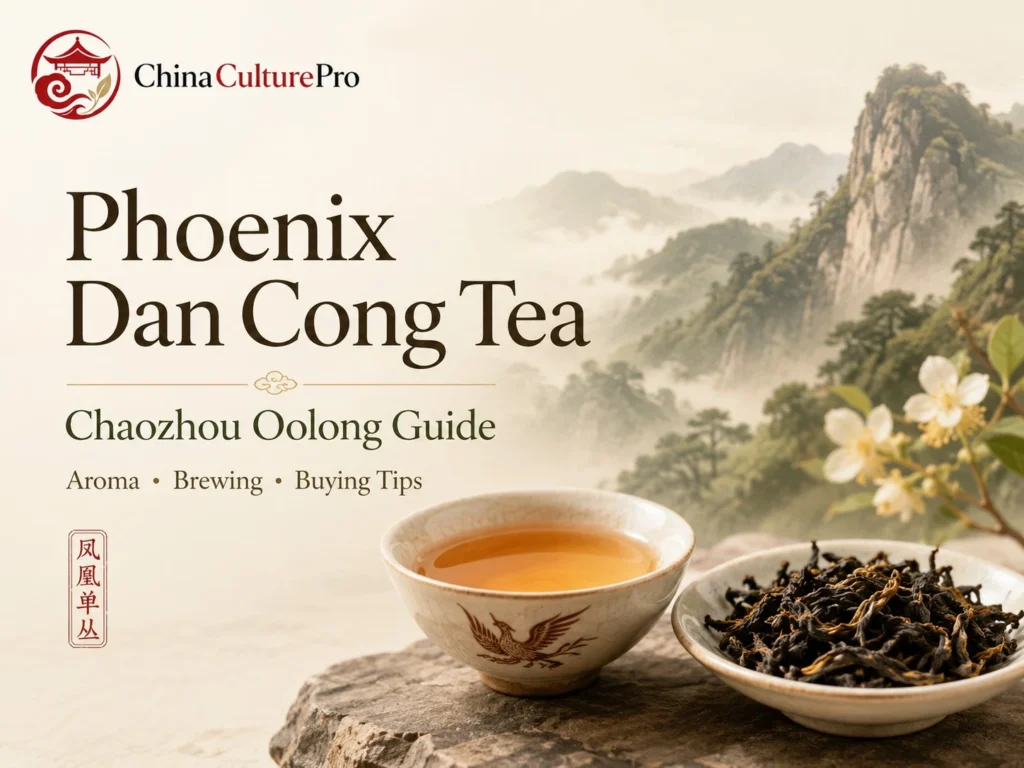

Quick Answer: What Is Phoenix Dan Cong Tea?
Phoenix Dan Cong Tea, also written as Phoenix Dancong Tea, Fenghuang Dancong, or Feng Huang Dan Cong, is a famous Chinese oolong tea from the Phoenix Mountain area of Chaozhou, Guangdong Province. It belongs to the Guangdong oolong tea tradition and is closely linked with Chaozhou gongfu tea culture.
It is not flavored tea, flower tea, green tea, or black tea. Names such as Mi Lan Xiang, Ya Shi Xiang, Huang Zhi Xiang, and Xing Ren Xiang describe natural tea aroma styles, not added ingredients.
Its basic identity is clear:
-
Tea Type: Chinese oolong tea.
-
Chinese Name: 凤凰单丛.
-
Common English Names: Phoenix Dan Cong Tea, Phoenix Dancong Tea, Fenghuang Dancong.
-
Core Region: Chaozhou, Guangdong, especially Fenghuang Town and Phoenix Mountain.
-
Famous Mountain Area: Wudong Mountain.
-
Tea System: Guangdong oolong tea / Chaozhou oolong tea.
-
Name Meaning: Dan Cong means single bush or single cluster.
-
Core Aroma: natural floral, fruity, honeyed, orchid-like, gardenia-like, almond-like, or osmanthus-like aroma depending on type.
-
Core Taste: fragrant but not perfumed, strong but not harsh, sweet after swallowing, and layered across infusions.
-
Key Quality: mountain charm, or shan yun.
-
Brewing: best brewed gongfu style with hot water, quick pouring, and many short infusions.
Among Chinese oolongs, Wuyi Rock Tea is known for roast, rock character, mineral depth, and yan yun; Phoenix Dan Cong is known for high natural aroma, floral-fruity fragrance, shan yun, and Chaozhou gongfu brewing; Tie Guan Yin is known for Anxi orchid aroma and its light or traditional roast styles.
Good Phoenix Dan Cong is judged by natural aroma, fragrance that enters the liquor, tea body, hui gan, and throat comfort—not by strange names, intense fragrance, bitterness, old-tree claims, or expensive labels alone.
To understand oolong as a category, read our [Chinese Oolong Tea] guide.
Name, Tea Type, and Basic Identity
The name Phoenix Dan Cong combines place, tea tree tradition, and processing identity. “Phoenix” refers to the Phoenix Mountain area, or Fenghuang Mountain, in Chaozhou. Dan Cong is usually translated as single bush or single cluster.
| Identity Point | What It Means |
|---|---|
| Chinese Name | 凤凰单丛 |
| Pinyin | Fenghuang Dancong |
| Common English Names | Phoenix Dan Cong, Phoenix Dancong, Fenghuang Dancong, Feng Huang Dan Cong |
| Tea Type | Chinese oolong tea |
| Regional Style | Guangdong oolong tea / Chaozhou oolong tea |
| Processing Style | partially oxidized oolong |
| Core Region | Phoenix Mountain area of Chaozhou, Guangdong |
| Related Tea Culture | Chaozhou gongfu tea |
| Not The Same As | flavored tea, flower tea, herbal tea, Wuyi Rock Tea, green tea, or black tea |
| Core Identity | single-bush selection tradition, rich aroma types, natural fragrance, mountain charm, and gongfu brewing |
The most important point is this: Phoenix Dan Cong is not flavored tea. Its aroma type names are not ingredient lists: Mi Lan Xiang is not made with honey or orchid, Ya Shi Xiang does not smell bad, Xing Ren Xiang does not contain almond, and Huang Zhi Xiang does not contain gardenia flowers.
Phoenix Dan Cong is also not Wuyi Rock Tea. Both are oolong teas, but Phoenix Dan Cong belongs to the Chaozhou and Phoenix Mountain tea world in Guangdong, while Wuyi Rock Tea comes from Wuyi Mountain in Fujian.
To compare major Chinese tea categories, read our Chinese Tea Types guide.
Origin: Chaozhou, Phoenix Mountain, and Wudong
Phoenix Dan Cong comes from the Phoenix Mountain tea region of Chaozhou in eastern Guangdong. Its identity is inseparable from Chaozhou gongfu tea culture, mountain ecology, and the long tradition of selecting individual tea trees for distinctive fragrance.
| Origin / Area | Chinese | What To Know |
|---|---|---|
| Guangdong Province | 广东省 | the home province of Phoenix Dan Cong and Guangdong oolong tea |
| Chaozhou City | 潮州市 | cultural center of Chaozhou gongfu tea and Phoenix Dan Cong drinking |
| Chao’an District | 潮安区 | administrative area associated with the Phoenix tea region |
| Fenghuang Town | 凤凰镇 | core production area of Phoenix Dan Cong |
| Phoenix Mountain / Fenghuang Mountain | 凤凰山 | main mountain area for Phoenix Dan Cong, with tea gardens across slopes and villages |
| Wudong Mountain | 乌岽山 | one of the most famous and prized mountain areas for Phoenix Dan Cong |
| Chaozhou Gongfu Tea | 潮州工夫茶 | small-vessel, high-temperature, quick-infusion tea culture closely connected with Dan Cong |
The Phoenix Mountain area is known for mountain slopes, mist, humid subtropical climate, forest vegetation, and soils that may include yellow soil, red soil, and weathered rock soil. Tea gardens sit at different elevations, and higher mountain areas are often valued for clearer aroma, slower growth, and stronger mountain character.
Wudong Mountain is especially famous, but “Wudong” should not become a price myth. A Wudong label does not automatically make a tea excellent; good Phoenix Dan Cong still needs suitable tea trees, careful plucking, skilled processing, clean roasting, and a cup that proves itself.
A key idea is shan yun, or mountain charm. It is not the same as Wuyi yan yun. In Phoenix Dan Cong, shan yun is often felt as clean high-mountain clarity, cooling sensation, mineral-like freshness, throat comfort, and a finish that continues after swallowing.
What Does “Dan Cong” Really Mean?
Dan Cong is one of the most important ideas in Phoenix tea. It is often translated as single bush or single cluster and is historically linked with preserving the unique aroma and taste of individual tea trees.
| Dan Cong Idea | Meaning |
|---|---|
| Single-Plant Plucking | leaves from a specific tea tree could be picked separately |
| Single-Plant Processing | leaves from that tree could be processed separately to preserve its character |
| Single-Plant Selection | outstanding trees were selected and propagated for their aroma, leaf form, or taste |
| Aroma-Type Tradition | different lines developed recognizable aroma styles |
| Modern Market Use | many commercial Dan Cong teas are made from the same aroma type or cultivar group, not always one single tree |
| Core Meaning Today | a tea tradition built around individual tree character, aroma classification, and Chaozhou oolong craft |
In the modern market, not every package of Phoenix Dan Cong is literally picked from one single tree. Many teas are made from groups of trees with the same aroma type, cultivar line, or production style. Even so, Dan Cong still represents single-tree selection, aroma classification, and the preservation of distinctive tea character.
Phoenix Dan Cong names can come from several sources: aroma type, leaf shape, mountain site, story, history, color, or tree form. Examples include Mi Lan Xiang, Huang Zhi Xiang, Ju Duo Zai, Da Wu Ye, Wudong Dan Cong, Ya Shi Xiang, Song Zhong, and Ba Xian.
Dan Cong does not mean “one flavor.” It means a tea world built around individuality, where different selected trees and aroma lines can express very different natural fragrances.
Phoenix Dan Cong Aroma Types
Phoenix Dan Cong has one of the richest aroma systems in Chinese tea. The famous “ten aroma types” are a common way to understand the category, but they are not the only classification. In real tea markets, there are many named types, local versions, tree lines, and producer interpretations.
Aroma type names help describe the natural direction of the tea’s fragrance. They are not recipes and not added ingredients.
| Aroma Type | Chinese | Aroma Direction | Notes |
|---|---|---|---|
| Mi Lan Xiang | 蜜兰香 | honey-like sweetness and orchid-like aroma | one of the most classic and beginner-friendly Dan Cong types |
| Ya Shi Xiang | 鸭屎香 | elegant floral aroma, honeyed sweetness, often clean and bright | famous for its strange name, not for bad smell |
| Huang Zhi Xiang | 黄枝香 | gardenia-like floral aroma | bright, lifted, and often highly fragrant |
| Zhi Lan Xiang | 芝兰香 | delicate orchid-like aroma | refined, quiet, and elegant |
| Yu Lan Xiang | 玉兰香 | magnolia-like aroma | soft, floral, and sweet |
| Xing Ren Xiang | 杏仁香 | almond-like or nutty sweetness | does not contain almond |
| Jiang Hua Xiang | 姜花香 | ginger flower-like freshness | often clean, lively, and slightly cooling |
| Gui Hua Xiang | 桂花香 | osmanthus-like sweetness | sweet floral aroma with a rich finish |
| Rou Gui Xiang | 肉桂香 | cinnamon-like warmth | not the same as Wuyi Rou Gui cultivar |
| Ye Lai Xiang | 夜来香 | tuberose-like floral aroma | distinctive, rich, and aromatic |
Aroma names are not added ingredients. Mi Lan Xiang does not contain honey or orchid, Ya Shi Xiang does not smell like duck waste, Huang Zhi Xiang does not contain gardenia flowers, Xing Ren Xiang does not contain almonds, and Rou Gui Xiang is not the Wuyi Rou Gui tea cultivar.
Good Phoenix Dan Cong aroma should be natural, clean, and integrated with the tea liquor. Perfume-like, candy-like, or essential-oil-like fragrance is not the natural aroma serious Dan Cong drinkers look for.
Ya Shi Xiang: The Famous “Duck Shit Aroma” Oolong
Ya Shi Xiang, often translated as Duck Shit Aroma, is one of the best-known Phoenix Dan Cong aroma types in English. The name is strange, but the tea itself is usually floral, honeyed, clean, and elegant.
There are several stories about the name. One common explanation says the tea was grown in a local yellowish soil sometimes called “duck-shit soil.” Another says the unattractive name was used to stop others from stealing or propagating the valuable tea tree. Either way, Ya Shi Xiang does not smell bad.
A good Ya Shi Xiang may show gardenia-like floral aroma, honey sweetness, freshness, clear tea liquor, and a smooth sweet finish. The funny name attracts attention, but the tea still needs natural aroma, tea body, hui gan, and a clean finish.
What Does Phoenix Dan Cong Tea Taste Like?
Good Phoenix Dan Cong is known for natural floral-fruity aroma, honeyed sweetness, mountain charm, hui gan, and a tea liquor with real body. It should be fragrant but not perfumed, strong but not harsh, and sweet after swallowing.
| Tasting Point | Good Phoenix Dan Cong Tea |
|---|---|
| Dry Leaf | tight, straight, even strips; dark brown or green-brown, often with a slight oily sheen |
| Dry Aroma | flower, honey, fruit, roast, or the specific aroma type |
| Main Aroma | orchid, gardenia, magnolia, honey, osmanthus, almond-like note, ripe fruit, citrus or pomelo-like brightness |
| Liquor | golden, orange-yellow, or amber; clear and bright |
| Taste | fresh, sweet, strong but elegant, with tea body |
| Mouthfeel | fragrant but not floating, concentrated but not rough |
| Hui Gan | obvious returning sweetness after swallowing |
| Throat Feel | comfortable, open, not locked or dry |
| Finish | lingering aroma and sweetness across multiple infusions |
| Leaf Base | soft, active, complete, not burnt or broken |
The core experience of Phoenix Dan Cong can be summarized as aroma, sweetness, body, and charm. Good Dan Cong should not only smell good from the lid of the gaiwan; the aroma should enter the tea liquor. Chinese tea drinkers often call this xiang ru shui — fragrance entering the water.
Different roast styles create different Dan Cong expressions:
| Roast / Style | Flavor Direction | Best For |
|---|---|---|
| Light Roast | higher floral aroma, brighter fragrance, lighter body | drinkers who like fresh high aroma |
| Medium Roast | balance of floral aroma, roast warmth, tea body, and sweetness | most Dan Cong drinkers |
| Traditional Roast | deeper roast, steadier aroma, thicker liquor, more settled finish | drinkers who like traditional Chaozhou depth |
Good Phoenix Dan Cong is not simply “the most fragrant tea.” Sharp aroma with empty liquor, throat-locking bitterness, or roast that burns away fragrance should not be mistaken for quality.
A good Dan Cong should be fragrant but not floating, strong but not astringent, sweet after swallowing, and comfortable in the throat.
How Phoenix Dan Cong Tea Is Made
Phoenix Dan Cong is made as oolong tea. It is not black tea, green tea, flower tea, or flavored tea. Its natural fragrance comes from tea tree selection, mountain ecology, leaf maturity, oxidation control, and roasting.
The process usually follows this sequence:
- Plucking / 采摘 Leaves are usually picked at a mature stage suitable for oolong processing. Depending on the aroma type and producer, the standard may include one bud with two or three leaves, or one bud with three or four leaves. Maturity matters because Dan Cong needs both fragrance and tea body.
- Sun Withering / 晒青 Fresh leaves are briefly withered under sunlight. This removes moisture, softens the leaves, and begins the transformation toward oolong aroma.
- Indoor Withering / 晾青 The leaves continue to lose moisture indoors. This step helps prepare the leaves for shaking and partial oxidation.
- Shaking And Zuo Qing / 做青、摇青 Leaves are shaken and rested repeatedly. The leaf edges are lightly bruised, allowing partial oxidation. This is one of the most important steps for Phoenix Dan Cong because it shapes floral aroma, fruit aroma, tea body, and balance.
- Kill-Green / Sha Qing / 杀青 Heat stops enzymatic oxidation and fixes the result of zuo qing.
- Rolling / 揉捻 The leaves are rolled into long twisted strips. This shapes the dry tea and helps the flavor release during brewing.
- Drying / 干燥 Moisture is reduced and the tea becomes more stable.
- Roasting And Refining / 焙火、精制 Roasting stabilizes aroma, improves smoothness, and refines the tea liquor. Phoenix Dan Cong is often roasted more lightly than many Wuyi rock teas, but roasting is still important. Without proper roasting, the aroma may be unstable and the liquor may feel sharp.
Two steps define good Phoenix Dan Cong: zuo qing and roasting. Zuo qing builds aroma and structure; roasting stabilizes the fragrance and makes the liquor smoother. The goal is not just high aroma, but aroma that enters the tea liquor.
Mountain Charm, Aroma, and Tea Body
In Phoenix Dan Cong, quality is not only about fragrance. The best teas should also have mountain charm, tea body, hui gan, throat comfort, and multi-infusion depth.
Shan yun, or mountain charm, comes from high mountain ecology, tea tree character, and skilled processing. It is not a single taste, but a combined drinking experience.
| Quality Point | What It Means In Phoenix Dan Cong |
|---|---|
| Natural Aroma | floral, fruity, honeyed, or aromatic notes that feel clean, not perfumed |
| Aroma Entering Liquor | fragrance appears in the tea soup, not only in the lid aroma |
| Tea Body | the liquor has structure and substance, not just smell |
| Cooling Sensation | a clean, cooling feeling in the mouth or throat |
| Mineral-Like Clarity | clear mountain freshness, sometimes compared with spring water |
| Hui Gan | sweetness that returns after swallowing |
| Throat Comfort | no throat locking, no rough dryness |
| Lingering Aroma | fragrance stays in the mouth and cup across infusions |
Several mistakes should be avoided: aroma is not perfume, bitterness is not strength, strong fragrance is not quality by itself, sourness is not authenticity, throat locking is a flaw, and a strange name is not a quality guarantee.
Chinese tea drinkers often say good Dan Cong should be 香入水 — the fragrance should enter the tea liquor. Another useful standard is: high fragrance but not floating, strong taste but not rough, sweet after swallowing without locking the throat. Aroma is the first attraction, but tea body and hui gan are what make Phoenix Dan Cong worth drinking across many infusions.
How to Taste Phoenix Dan Cong Like a Tea Drinker
Tasting Phoenix Dan Cong is not about chasing the strongest fragrance. The real question is whether aroma, tea body, sweetness, throat comfort, and mountain charm work together.
- Look At The Dry Tea The dry leaves should be tight, straight, even, and slightly glossy. The color may be dark brown, green-brown, or roasted brown. Avoid excessive broken leaves, dust, mold marks, or dead black leaves.
- Smell The Dry Aroma Good Dan Cong may show floral, honey, fruit, roast, or the specific aroma type. Avoid perfume-like aroma, burnt smell, mold, sourness, or stale notes.
- Check The Liquor The liquor should be golden, orange-yellow, or amber, depending on roast and brewing strength. It should be clear and bright. Cloudiness is a warning sign.
- Smell The Wet Aroma The wet aroma should be natural, clear, and layered. It should feel connected to the liquor, not like a fragrance sprayed on top of the tea.
- Taste The Liquor Look for freshness, sweetness, tea body, and balance. Some bitterness or astringency can appear, but it should transform into hui gan. Rough bitterness and throat locking are flaws.
- Feel The Mountain Charm Good Dan Cong may leave cooling sensation, mineral-like clarity, throat comfort, and lingering fragrance after swallowing.
- Look At The Leaf Base The brewed leaves should be soft, active, and reasonably complete. Avoid leaves that are charred, stiff, broken, or lifeless.
The core tasting standard is simple: natural aroma, tea body, hui gan, and no throat locking. Dan Cong with only aroma, only sharpness, or only bitterness is missing the sweetness, body, and return that define the style.
For a broader framework for aroma, mouthfeel, hui gan, and aftertaste, read our Chinese Tea Tasting guide.
How to Brew Phoenix Dan Cong Tea
Phoenix Dan Cong is closely linked with Chaozhou gongfu brewing. It performs best with hot water, quick pouring, and many short infusions. The goal is to release aroma and body without forcing bitterness.
| Brewing Method | Teaware | Water Temperature | Leaf Amount | Steeping Time | Notes |
|---|---|---|---|---|---|
| Chaozhou Gongfu Brewing | gaiwan or Chaozhou small teapot | 95–100°C / 203–212°F | 5–8g / 100–120ml | quick rinse optional, then 5–10 seconds to start | best for aroma, body, and infusion changes |
| Western Brewing | teapot or mug | around 95°C / 203°F | 3g / 250ml | 1–2 minutes | easier for daily drinking, less layered |
| Grandpa Style | glass or mug | around 95°C / 203°F | small amount of leaf | drink slowly and add hot water repeatedly | use less leaf; Dan Cong can become bitter if over-steeped |
Brewing tips:
- Use hot water: Phoenix Dan Cong needs heat to release aroma and mountain charm.
- Use short infusions: over-steeping is the most common reason Dan Cong becomes bitter or throat-locking.
- Use a gaiwan for clarity: porcelain helps show the aroma type and infusion changes.
- Use a small Chaozhou teapot for tradition: it is useful but not required.
- Use an optional quick rinse: a fast rinse can wake the leaves.
- Start lighter if you are new: use less leaf or shorter infusions before increasing strength.
- Enjoy it plain: milk and sugar cover the natural floral aroma, tea body, and hui gan.
The core method is high heat, quick pour, many infusions: high heat brings out fragrance, quick pouring prevents bitterness, and repeated infusions show how aroma, liquor, and sweetness change from steep to steep. Mi Lan Xiang is often easier for beginners, while Ya Shi Xiang suits drinkers who want a famous high-aroma Dan Cong style.
To learn practical brewing methods, read our How to Brew Chinese Tea guide. For gaiwans, Chaozhou teapots, mugs, and other brewing vessels, read our Chinese Teaware guide.
Phoenix Dan Cong vs Wuyi Rock Tea vs Tie Guan Yin
Phoenix Dan Cong, Wuyi Rock Tea, and Tie Guan Yin are all Chinese oolong teas, but they come from different regions and express different oolong aesthetics.
| Tea | Region | Oolong System | Main Character | Aroma | Best For |
|---|---|---|---|---|---|
| Phoenix Dan Cong | Chaozhou, Guangdong | Guangdong oolong | single-bush selection, many aroma types, shan yun | high floral-fruity aroma, honey, orchid, gardenia, almond-like notes | drinkers who want rich aroma types and gongfu tea experience |
| Wuyi Rock Tea | Wuyi Mountain, Fujian | northern Fujian oolong | roast, rock character, mineral depth, yan yun | roast, orchid, fruit, mineral, woody depth | drinkers who want roast, body, and mineral rock character |
| Tie Guan Yin | Anxi, Fujian | southern Fujian oolong | orchid aroma, light or traditional roast styles | orchid, floral, creamy or roasted depending on style | drinkers who want elegant orchid aroma and a softer oolong style |
None is automatically better. Choose Phoenix Dan Cong for natural high aroma, many fragrance types, mountain charm, and Chaozhou gongfu brewing; Wuyi Rock Tea for roast, mineral depth, and rock character; and Tie Guan Yin for Anxi orchid aroma and a softer oolong experience.
To compare a famous Wuyi oolong, read our Da Hong Pao Tea guide. To compare the high-aroma Wuyi cultivar, read our Rou Gui Tea guide. To compare the mellow Wuyi cultivar, read our Shui Xian Tea guide.
How to Choose Good Phoenix Dan Cong Tea
Phoenix Dan Cong has many names and aroma types, so labels can be confusing. A good name is useful, but the tea must prove itself in aroma, liquor, body, aftertaste, and leaf base.
| Checkpoint | What To Look For | Warning Signs |
|---|---|---|
| Origin | Guangdong, Chaozhou, Phoenix Mountain, Wudong Mountain, or a credible village/site name | vague origin or non-Phoenix tea sold as Phoenix Dan Cong |
| Name Clarity | Phoenix Dan Cong with a clear aroma type, such as Mi Lan Xiang, Ya Shi Xiang, or Huang Zhi Xiang | only “oolong tea” or “Dan Cong” with no aroma type or origin |
| Aroma | natural floral, fruity, honeyed, or aroma-type-specific fragrance | perfume-like smell, artificial flavor, burnt smell, mold, sourness |
| Taste | fresh, sweet, structured, fragrant but not thin, strong but not harsh | sharp aroma with empty liquor, rough bitterness, throat locking |
| Hui Gan | sweetness returns after swallowing, often with salivation | short finish, dry throat, no sweetness |
| Liquor | clear golden, orange, or amber | cloudy, dull, or muddy liquor |
| Leaf Base | soft, active, reasonably complete | burnt, stiff, broken, lifeless leaves |
Watch for flavored tea sold as Dan Cong, perfume-like aroma, very cheap old-tree or Song Zhong claims, Ya Shi Xiang used only as a gimmick, sharp fragrance with empty tea soup, throat-locking bitterness sold as “authentic,” heavy fire covering the aroma, sourness, off-flavors, and no clear aroma type.
Five buying rules matter most: clear origin, clear aroma type, natural aroma, tea body with hui gan, and a clean finish. If these are missing, the name is not enough.
Storage, Roast Resting, and Aging
Phoenix Dan Cong storage depends on roast level and aroma style. Light roast Dan Cong is more aroma-forward and usually best enjoyed earlier, while the fragrance is still bright. Medium roast is often the easiest balance. Traditional roast can become smoother after resting and may have more room for short- to medium-term storage.
Newly roasted Dan Cong may taste fiery or sharp. Resting helps the fire settle and the aroma integrate with the liquor. Not every Phoenix Dan Cong is meant for long-term aging; high-aroma, lighter-style teas should be protected for fragrance rather than stored for years without purpose.
Storage rules are simple:
- Seal It Well: Dan Cong fragrance is valuable and can fade easily.
- Keep It Dry: moisture makes the tea dull, sour, or moldy.
- Avoid Light: light weakens aroma.
- Keep It Cool: normal cool room temperature is enough.
- Avoid Odors: keep it away from spices, coffee, incense, smoke, and strong-smelling foods.
- Avoid Casual Fridge Storage: refrigerators often bring moisture and odors unless the tea is sealed very carefully.
- Do Not Confuse Resting With Staling: rested Dan Cong is smoother and more integrated; stale Dan Cong is flat, sour, dusty, or missing aroma.
The storage principle is sealed, dry, dark, cool, and odor-free. For Phoenix Dan Cong, protecting fragrance is more important than chasing age.
Benefits and Caffeine
Phoenix Dan Cong contains caffeine. Strong gongfu brewing can feel concentrated, and repeated infusions may still deliver noticeable caffeine. It is not a caffeine-free tea.
Phoenix Dan Cong also contains common tea compounds such as tea polyphenols, amino acids, and aromatic compounds. Many drinkers describe it as refreshing or stimulating, but this is a drinking experience, not a medical claim.
Important cautions:
- Phoenix Dan Cong contains caffeine.
- Strong brewing increases concentration.
- Avoid drinking large amounts before sleep.
- People sensitive to caffeine should drink moderately.
- People with stomach sensitivity should adjust strength and amount.
- Pregnant people, people taking medication, or people with medical concerns should ask a qualified professional.
- Do not treat Phoenix Dan Cong as medicine.
Do not use Phoenix Dan Cong as a promise for weight loss, detox, blood sugar control, blood pressure control, cancer prevention, or disease treatment. It is tea; its best value is natural fragrance, mountain charm, gongfu brewing, hui gan, and the experience of Guangdong oolong.
Final Thoughts
Phoenix Dan Cong Tea is not flavored tea and not ordinary floral oolong. It is a representative Guangdong oolong from the Phoenix Mountain area of Chaozhou.
Its value comes from Phoenix Mountain terroir, single-bush selection tradition, rich aroma types, oolong processing, and Chaozhou gongfu tea culture. A good Phoenix Dan Cong should show natural aroma, fragrance entering the liquor, structured tea body, clear hui gan, comfortable throat feel, and layered changes across multiple infusions.
Good Phoenix Dan Cong is not proven by a strange name, extreme fragrance, strong bitterness, old-tree claim, Song Zhong label, Wudong label, high price, or packaging. The cup must show balance: fragrant but not perfumed, strong but not harsh, sweet after swallowing, and clean in the finish.
FAQs About Phoenix Dan Cong Tea
What is Phoenix Dan Cong Tea?
Phoenix Dan Cong Tea is a Chinese oolong tea from the Phoenix Mountain area of Chaozhou, Guangdong. It is known for single-bush selection, rich aroma types, natural floral-fruity fragrance, mountain charm, hui gan, and Chaozhou gongfu brewing.
What does Dan Cong mean?
Dan Cong means single bush or single cluster. Historically, it is linked with single-plant plucking, single-plant processing, and single-plant selection. In the modern market, it also refers to the aroma-type tradition of Phoenix oolong.
Is Phoenix Dan Cong flavored tea?
No. Phoenix Dan Cong is not flavored tea. Its aroma types, such as Mi Lan Xiang, Ya Shi Xiang, and Huang Zhi Xiang, are natural tea aroma styles, not added flavors.
Where does Phoenix Dan Cong Tea come from?
Phoenix Dan Cong comes from the Phoenix Mountain area of Chaozhou in Guangdong Province. Fenghuang Town and Wudong Mountain are especially important in the Phoenix tea region.
What does Phoenix Dan Cong taste like?
Phoenix Dan Cong often tastes floral, fruity, honeyed, fresh, sweet, and aromatic, with tea body, hui gan, and mountain charm. Different aroma types can taste very different.
What are the main Phoenix Dan Cong aroma types?
Common Phoenix Dan Cong aroma types include Mi Lan Xiang, Ya Shi Xiang, Huang Zhi Xiang, Zhi Lan Xiang, Yu Lan Xiang, Xing Ren Xiang, Jiang Hua Xiang, Gui Hua Xiang, Rou Gui Xiang, and Ye Lai Xiang.
What is Mi Lan Xiang?
Mi Lan Xiang means Honey Orchid Aroma. It is one of the most classic Phoenix Dan Cong aroma types, usually known for honey-like sweetness, orchid-like aroma, smooth taste, and beginner-friendly character.
What is Ya Shi Xiang or Duck Shit Aroma?
Ya Shi Xiang is a famous Phoenix Dan Cong aroma type often translated as Duck Shit Aroma. Despite the name, it does not smell bad. Good Ya Shi Xiang is usually floral, honeyed, clean, and elegant.
How do you brew Phoenix Dan Cong Tea?
Use gongfu brewing when possible: 5–8g leaf in a 100–120ml gaiwan or small teapot, 95–100°C water, and short repeated infusions. Start around 5–10 seconds and extend gradually.
Why does Phoenix Dan Cong become bitter?
Phoenix Dan Cong often becomes bitter when it is over-steeped or brewed with too much leaf for too long. Use hot water, but pour quickly. Beginners can reduce leaf amount or shorten steeping time.
Does Phoenix Dan Cong Tea have caffeine?
Yes. Phoenix Dan Cong contains caffeine. Strong gongfu brewing can feel concentrated, so avoid drinking large amounts at night if you are caffeine-sensitive.