


Quick Answer: What Is the Five Poisons Motif?
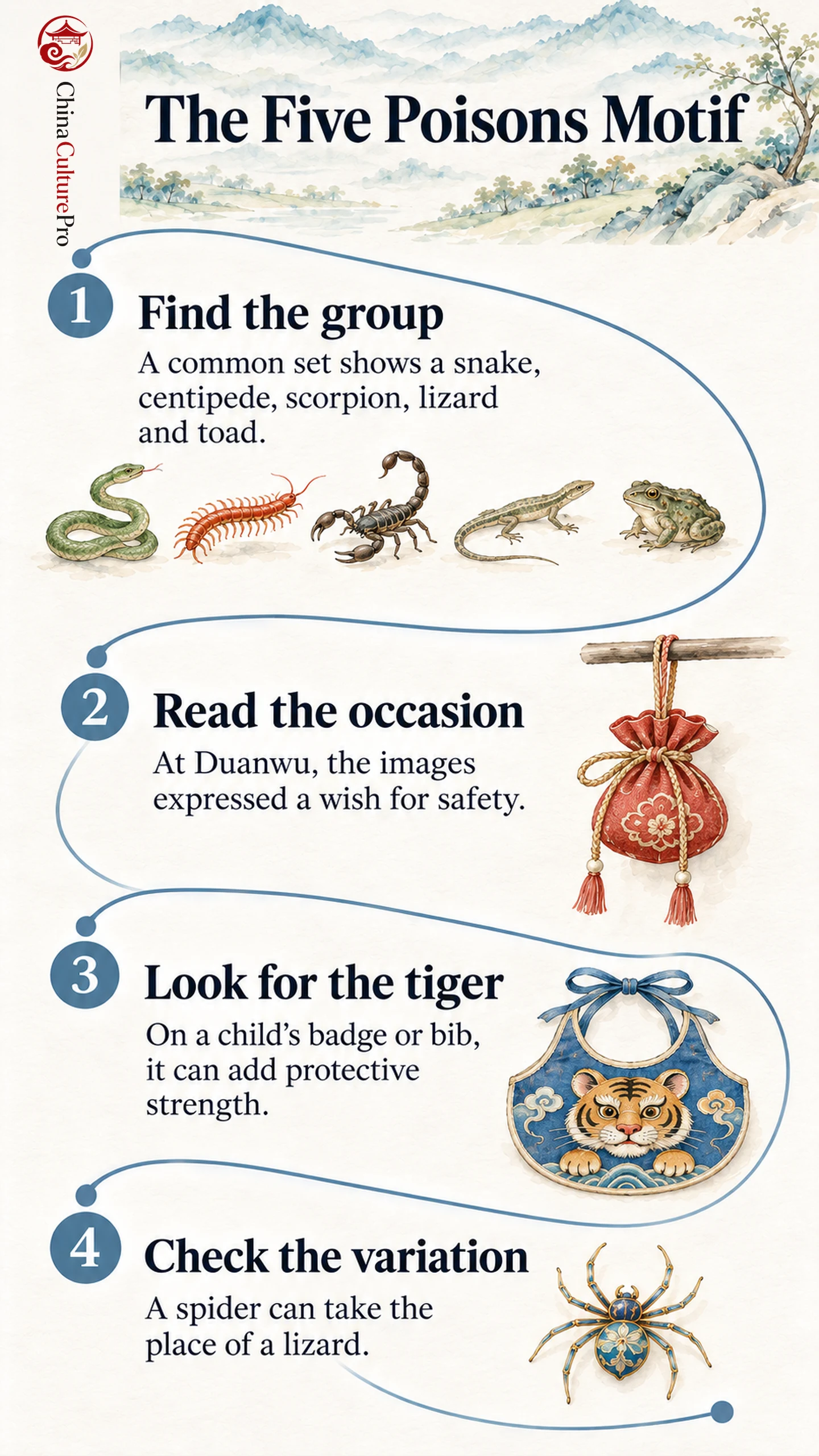
The Five Poisons motif (五毒纹, wǔdúwén) groups creatures that people associated with harm in Chinese folklore. A common group shows a snake, centipede, scorpion, gecko or other lizard, and toad. Some designs use a spider. People displayed or wore the images as a symbolic defense during the Dragon Boat Festival (端午节, Duānwǔjié).[1][2][3]
- Look for the group. On small objects the creatures can be spread across several corners.
- Check the lineup. A spider appears in some versions in place of a lizard.[2][3]
- Read the occasion. Children’s clothing, badges and sachets carry the traditional wish for safety.[1][4][5]
The group’s name records a folk belief, and the animals pictured can vary by object.
In a late Ming silk panel, the Five Poisons emerge from a subtle woven pattern. On an embroidered badge for a child, a tiger and its rider confront the creatures. The two objects show how the same group can fill a surface or act out a scene.
Which Animals Appear in the Five Poisons Motif?
The Palace Museum lists snake, centipede, scorpion, gecko and toad. The catalogue of a Wanli-period silk panel uses the broader name lizard for one member of the group. The animals appear in a pattern worked into Chinese silk gauze.[1][2]
Trace a long limbless body for the snake and a row of legs along the centipede. A scorpion’s pincers and curved tail help distinguish it from a spider. If some shapes disappear into folds, use the rest of the design or the catalogue to identify the group. The scorpion in Chinese culture and snake imagery outside the zodiac also have meanings in other settings.
Why People Wore the Motif at Duanwu
Duanwu falls on the fifth day of the fifth lunar month. Historically, people associated this time of year with harmful creatures and influences. The creatures were pictured on objects intended to ward off the very harms they represented. Families could tie patterned pieces to children’s clothing or hang them up in the home as a wish for safety.[1][2]
A festival pouch in the Palace Museum has embroidered versions of the five creatures on its exterior. Aromatic herbs were placed inside. The decoration and scent were both features of the object people wore at Duanwu. The pouch is one example of Dragon Boat Festival fragrant sachets.[4]
The Motif on a Badge, a Bib and an Enamel Plaque
A seventeenth-century embroidered badge at the Nelson-Atkins Museum of Art depicts a warrior on a tiger driving away the creatures. The badge was made for children to wear. On a Qing tiger-shaped blue silk bib in the Mactaggart Art Collection, a centipede, lizard, toad and spider appear on the tiger’s paws. The cut of the bib makes the tiger part of the protective composition. Tiger-head shoes also put a guardian animal on clothing for children.[5][6]
A nineteenth-century painted enamel plaque in the Metropolitan Museum of Art lines up the creatures across its surface. It includes a spider and omits the lizard. The museum suggests it may have served as a household charm. Its straight row puts each creature in view across the plaque.[3]
FAQs About the Five Poisons Motif
Why does a tiger appear with the Five Poisons?
The tiger can represent protective strength. A festival badge may show it carrying a warrior who drives off the creatures, while a tiger-shaped bib incorporates some of the animals into its own design.[5][6]
Do all versions of the Five Poisons use the same animals?
The lizard is present on a Ming silk panel, while a Qing enamel plaque shows a spider in its place. Describe the animals on the specific object before assigning a roster.[2][3]
Sources
[1] The Palace Museum. Five Poisons Motif, Catalogue Glossary
[2] The Metropolitan Museum of Art. Panel with the Five Poisonous Creatures, object 1987.7
[3] The Metropolitan Museum of Art. Plaque with the Five Poisonous Creatures, object 24.80.337
[4] The Palace Museum. Dragon Boat Festival Five Poisons Pouch
[5] Nelson-Atkins Museum of Art. Tuan Yang Festival Badge, object 60-50
[6] University of Alberta Museums. Ferocity and the Five Poisons: Symbolism on Qing Dynasty Children’s Clothing