

Quick Answer: What Is Jiu Zhang?
Jiu Zhang (九章, Jiǔ Zhāng), usually called Nine Pieces, is a collection of nine poems in the Songs of Chu (楚辭, Chǔcí), traditionally attributed to Qu Yuan (屈原, Qū Yuán). Its recurring concerns include loyalty, exclusion, displacement and the difficulty of making one’s character understood.[1][2]
- The form: Nine distinct works appear together, rather than nine stanzas of one short poem.
- The voice: A speaker repeatedly defends sincerity while confronting misunderstanding or separation.
- The variety: Travel, remembered places, inward debate and praise of a tree give the pieces different shapes.
The received order is a reading sequence, not a verified timeline of the poet’s life.
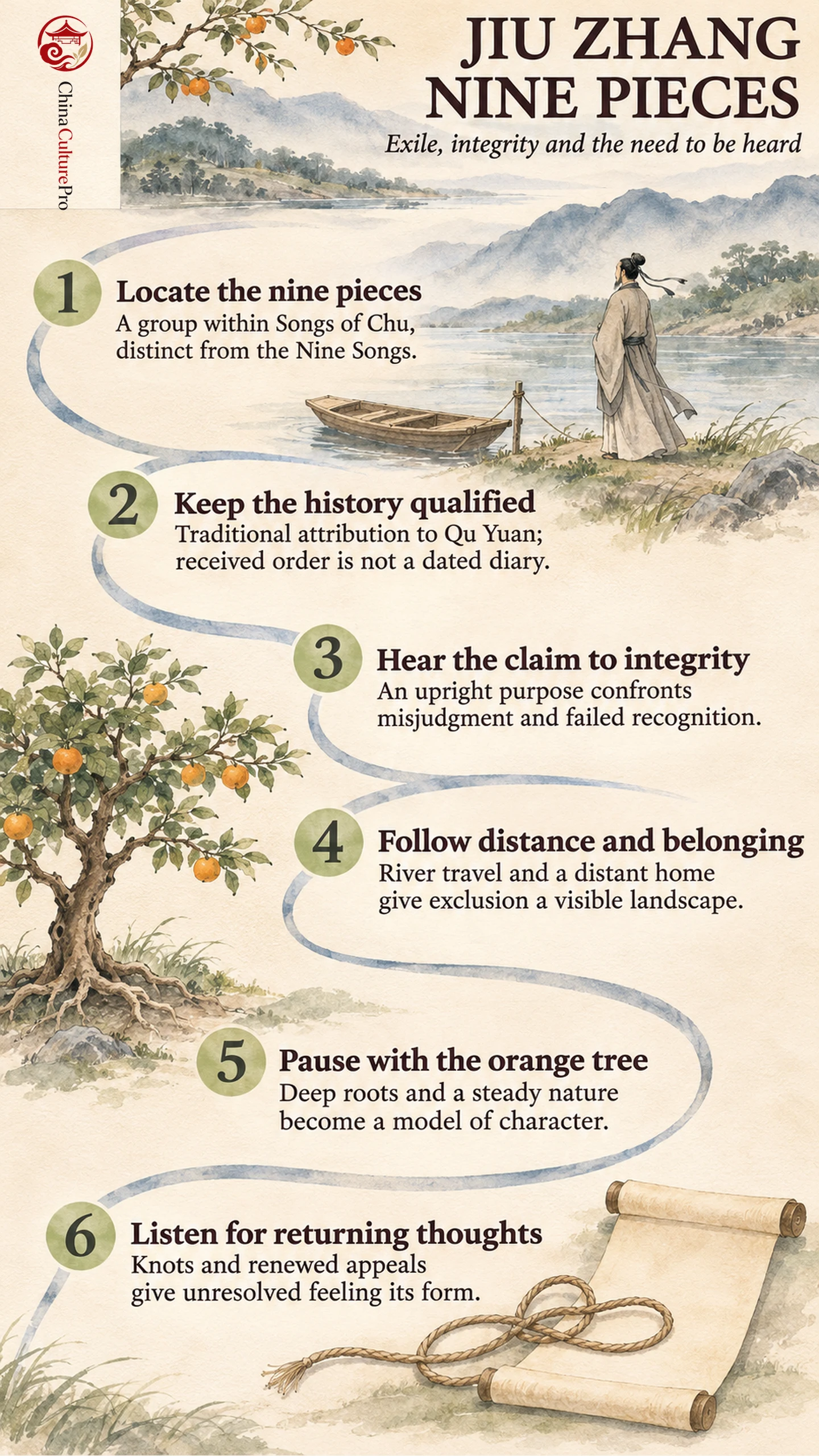
An upright heart on a difficult journey, a distant homeland, and an orange tree rooted in southern soil: these images give the collection several ways to speak about belonging. Reading each piece on its own terms reveals more than treating the whole group as one uninterrupted lament.
The Nine Pieces and Their Different Concerns
The table follows the received order. English titles differ across translations, so compare the Chinese names when locating the same piece. These descriptions identify each poem’s main reading interest rather than reconstruct a dated event behind every line.[1]
| Piece and pronunciation | A useful English title | Main reading interest |
|---|---|---|
| Xi Song (惜誦, Xī Sòng) | Grieving Recitation | Defending loyalty and trying to make hidden intentions known |
| She Jiang (涉江, Shè Jiāng) | Crossing the River | Travel through difficult country alongside a refusal to abandon principle |
| Ai Ying (哀郢, Āi Yǐng) | Lament for Ying | Dispersal, departure and attachment to a distant capital and homeland |
| Chou Si (抽思, Chōu Sī) | Drawing Out Thoughts | Anxious reflection, disappointed expectation and a message struggling to reach its recipient |
| Huai Sha (懷沙, Huái Shā) | Embracing Sand | Misjudged worth, threatened integrity and an intensely troubled confrontation with death |
| Si Meiren (思美人, Sī Měirén) | Thinking of the Beautiful One | Longing, blocked communication and renewed insistence on an unchanged purpose |
| Xi Wangri (惜往日, Xī Wǎngrì) | Regretting Former Days | Remembered trust, slander and the failure to distinguish faithful service from deceit |
| Ju Song (橘頌, Jú Sòng) | Praise of the Orange Tree | Rootedness, self-possession and the tree as a model of character |
| Bei Huifeng (悲回風, Bēi Huífēng) | Grieving the Returning Wind | Entangled grief, restless movement and repeated attempts to express an unresolved state |
The titles help navigation without settling every interpretive question. Even “Embracing Sand,” for example, should not be expanded into a literal account of an action merely because an English title suggests it.
Qu Yuan and the Formation of the Collection
The traditional attribution joins these works to the figure of the loyal, rejected poet. Wang Yi (王逸, Wáng Yì), in his later commentary, introduces them through Qu Yuan’s exile and concern for ruler and country. That account became influential in how readers understood the collection.[2]
The formation of the nine-poem group is a separate historical question. Earlier references to individual works do not establish that they already circulated as today’s complete cycle. The title and arrangement reached us through later compilation and commentary, leaving their original formation uncertain.[3]
Read “traditionally attributed to Qu Yuan” as a useful orientation, while keeping the speaker’s literary self-presentation distinct from a fully verified diary. The Qu Yuan guide provides the wider biographical and cultural background.
Loyalty, Exile and the Need to Be Understood
Much of the collection turns on a painful mismatch: the speaker presents an upright purpose, while the surrounding world rewards flattery, accepts slander or fails to recognize worth. The poems do more than announce sadness. They repeatedly argue that appearance and judgment have become unreliable.[1]
Travel makes that condition tangible. A difficult road, a river crossing or a homeland receding from sight becomes part of the experience of exclusion. Yet the speaker’s mind continues to return to the people and place from which he is separated.
This creates tension between departure and attachment. Maintaining principle does not make isolation painless, and leaving a place does not settle the wish to be heard there. The collection’s strength lies partly in letting both pressures remain active.
Three Excerpts: Travel, Home and the Orange Tree
These are selected lines with original English sense translations, not the complete text of the nine poems. Together they show three different ways an image can carry a question of character or belonging.[1]
| From | Chinese excerpt | English sense |
|---|---|---|
| She Jiang | 苟余心其端直兮,雖僻遠之何傷。 | If my heart remains upright, what harm lies in remoteness itself? |
| Ai Ying | 鳥飛反故鄉兮,狐死必首丘。 | Birds fly back toward their homeland; the dying fox turns its head toward its home mound. |
| Ju Song | 受命不遷,生南國兮。深固難徙,更壹志兮。 | Given your nature, you do not move; you grow in the southern land. Firmly rooted, hard to transplant, you hold to one resolve. |
The first passage answers distance with an assertion of inward steadiness. The second makes attachment visible through a literary image of animals returning toward home; it is not offered here as a biological rule.
The orange tree offers another model. Its rootedness becomes an image of consistent purpose, while leaves, blossoms and fruit receive close attention. Within this poem, the tree’s moral character matters more than a general association between citrus and good fortune. It is a distinct act of praise within a collection often dominated by complaint.
Why These Poems Return to the Same Pain
A reader expecting a story to progress steadily toward resolution may find the renewed complaints difficult at first. But returning is part of the poems’ method. Images of knots, constriction and blocked expression make an unresolved inward state something language can enact.[4]
Chou Si is especially useful for hearing this effect. Hope, remembered promises, frustrated communication and renewed attempts to speak circle back into one another. Instead of treating each return as spare repetition, ask what changes in the speaker’s confidence or address.
This approach complements historical context. It lets the reader attend to how a poem produces its emotional pressure, rather than use every line only as evidence for an event in a proposed biography.[4]
How Nine Pieces Differs from Nine Songs
Nine Songs (九歌, Jiǔ Gē) centers on divine encounters and ritual situations; the Nine Pieces more directly foreground a wronged speaker’s claims, memories and difficult choices. The Nine Songs guide covers that neighboring cycle. Li Sao (離騷, Lí Sāo) develops a longer journey through overlapping concerns and images; the separate Li Sao guide explains its larger structure.
All belong to the Songs of Chu reading tradition. Shared language and imagery invite comparison while leaving each work’s structure intact.
How to Begin Reading the Collection
- Start with Ju Song: Follow how the poem turns observable features of a tree into qualities of character.
- Move to She Jiang: Compare outward travel with the speaker’s stated inward purpose.
- Read one longer complaint: Mark the recipient, remembered promises and interruptions to communication.
- Revisit the ending: Ask whether the poem resolves its conflict, renews it or changes how it is expressed.
FAQs About Jiu Zhang Nine Pieces
Can the poems be dated from their order?
Their position in the received collection does not establish when each was composed. Specific historical identifications require separate evidence, and a single agreed chronology should not be assumed.[3]
Does “the beautiful one” necessarily mean a lover?
The phrase can invite a romantic reading, but the poems also use attractive figures and failed communication within arguments about recognition, loyalty and purpose. Its function needs to be considered in the particular passage.
Is this the same work as the Nine Chapters on mathematics?
The similarly named Nine Chapters on the Mathematical Art (九章算術, Jiǔzhāng Suànshù) is a different work. The guide to the mathematical Nine Chapters covers that technical tradition; this page concerns poetry.
Sources
[1] Songs of Chu. Nine Pieces: received Chinese text
[2] Wang Yi. Commentary on the Songs of Chu, volume four
[3] Martin Kern and Stephen Owen. Introduction to Qu Yuan and the Chuci: New Approaches
[4] Nicholas Morrow Williams. Tropes of entanglement and strange loops in the Nine Avowals of the Chuci, abstract