
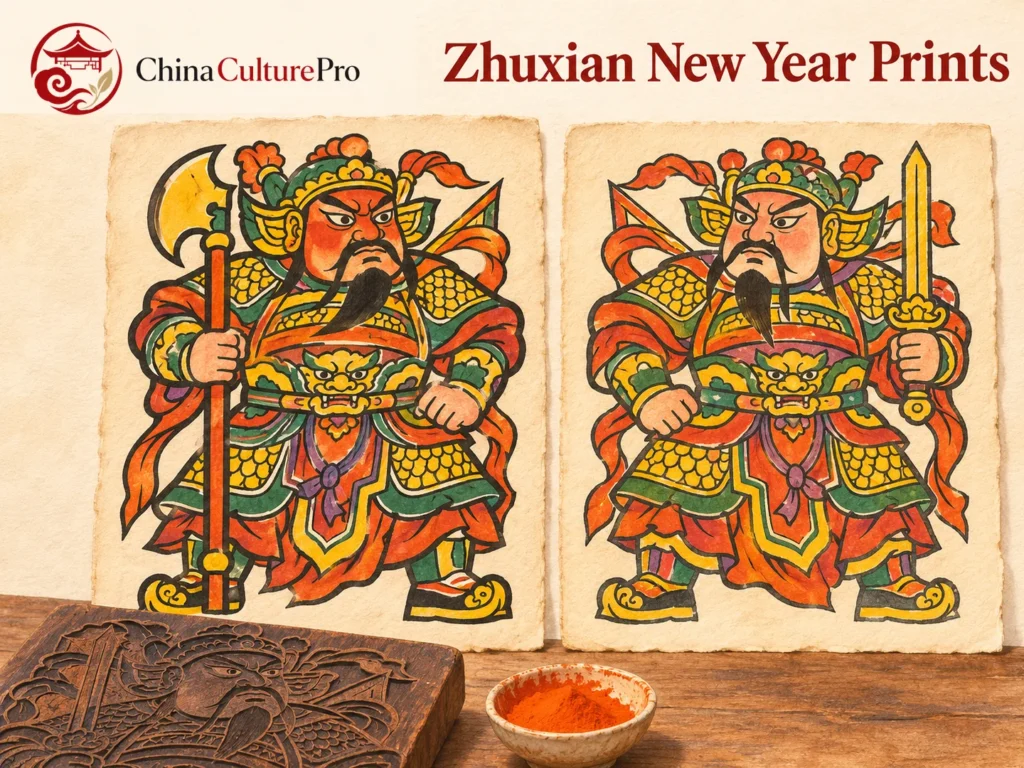

Quick Answer: What Are Zhuxian New Year Prints?
Zhuxian New Year prints (朱仙镇木版年画, Zhūxiānzhèn mùbǎn niánhuà) are woodblock pictures associated with Zhuxian Town and nearby Kaifeng in Henan. Broad black outlines and strong color impressions give many figures a compact, forceful shape.[1][2][3]
- Printing: A black line block establishes the image. Separate color blocks add selected areas of color.[2][3]
- Subjects: Door gods (门神, ménshén) are prominent. The tradition also includes festival blessings, stories and household deities.[1][2]
- Records: Kaifeng Museum holds older blocks. China added the local craft to its national intangible cultural heritage register in 2006.[1][2]
The finished paper print and the blocks that made it preserve different evidence. A color block shows which parts of the design one impression could print.[2][3]

A warrior’s face, boots and armor can all appear in one black impression. Bright color lands in selected parts of that figure when the printer brings a second carved block to the same sheet.[2][3]
How the Line Block and Color Blocks Work
Kaifeng Museum holds separate older blocks for a subject titled Prince Chai Pushes a Cart. The Henan heritage feature labels one as the line block and the other as an orange color block. Seen separately, the blocks explain why a detailed outline can cover much of the sheet while a color may appear only in selected areas. They also show why a catalog can assign the same picture title to two distinct tools.[2]
The documented Zhuxian sequence prints the black line block before successive color blocks. The national profile records plant and mineral ingredients used in preparing pigments. In the account of Zhangzhou New Year prints, the colored impressions precede the final black line. The different sequences give viewers a concrete point of comparison between regional workshops.[1][3][5]
On the finished Zhuxian sheet, the dark lines carry a surprising amount of detail. A curve can outline a cheek and also lead into a beard. Areas filled with color give the costume and accessories a different kind of emphasis. Photographs of older blocks and later impressions help separate design decisions from the individual condition of a printed sheet.[2][3]
Door Gods and Other Zhuxian Subjects
Qin Qiong (秦琼, Qín Qióng) and Yuchi Gong (尉迟恭, Yùchí Gōng), also called Jingde, are a familiar pair in Chinese door gods. A Henan heritage feature reproduces Ren Helin’s paired Qin Qiong and Jingde as warriors on foot. The same figures can be represented in other poses, so the pair’s identity is best checked against an inscription or a catalog caption.[2]
The same source records Guo Taiyun’s image of five sons attaining success in the examinations and Zhang Tingxu’s image of the Kitchen God. The examination picture expresses a wish for the children’s success. The other represents a deity tied to a particular place in the home. In the full repertoire, a print can serve a different purpose depending on its image and where it is placed.[2]
Kaifeng Markets, Workshops and Surviving Blocks
Meng Yuanlao’s account of the Northern Song capital recalls late-year markets where people printed and sold door god pictures and other seasonal goods. The passage documents a market in Kaifeng. It supplies context for the longer history of printing and household customs in Song Kaifeng city life.[4]
The national register connects Zhuxian production with that regional print tradition and describes flourishing town workshops in the Ming and Qing periods. Many workshops later moved to Kaifeng city. The name Zhuxian can therefore describe the print tradition even when a particular workshop address was in Kaifeng city. The Henan heritage account describes Guo Taiyun’s work repairing, reproducing and organizing older blocks and records.[1][2]
FAQs About Zhuxian New Year Prints
Is Zhuxian the same place as Kaifeng?
Zhuxian Town lies south of central Kaifeng. The tradition takes its name from the town, and sources record workshops and collections in Kaifeng as well.[1][2]
Why can one picture need several blocks?
One block can carry the principal lines. Other blocks print chosen parts of the design in separate colors. The Kaifeng Museum blocks for Prince Chai Pushes a Cart are a documented example.[2][3]
Are all Zhuxian New Year prints door gods?
Door guardians are a prominent type. Recorded examples also depict the Kitchen God, examination success and figures from stories and theater.[1][2]
Sources
[1] China Intangible Cultural Heritage Digital Museum. Zhuxian Town woodblock New Year prints
[2] Henan Provincial Intangible Cultural Heritage Protection Center. Zhuxian makers, prints and surviving woodblocks
[3] Henan Mobile News. Woodblock production and sequence of impressions
[4] Meng Yuanlao, via Chinese Text Project. Dreams of Splendor of the Eastern Capital, volume ten
[5] China Intangible Cultural Heritage Digital Museum. Zhangzhou New Year print project and impression sequence