

Quick Answer
Zhuang Sanyuesan (三月三, Sānyuèsān) takes its name from the third day of the third lunar month. In Guangxi, a song fair (歌圩, gēxū) can bring singers together to exchange verses. The heritage record for Wuming also describes family remembrance, offerings and other local gatherings. Public programmes vary across Guangxi.[1][2][3][4]
- Date: The traditional lunar date changes position in the Gregorian calendar each year.[1]
- Music: Listen for one singer or group answering another.[1][2]
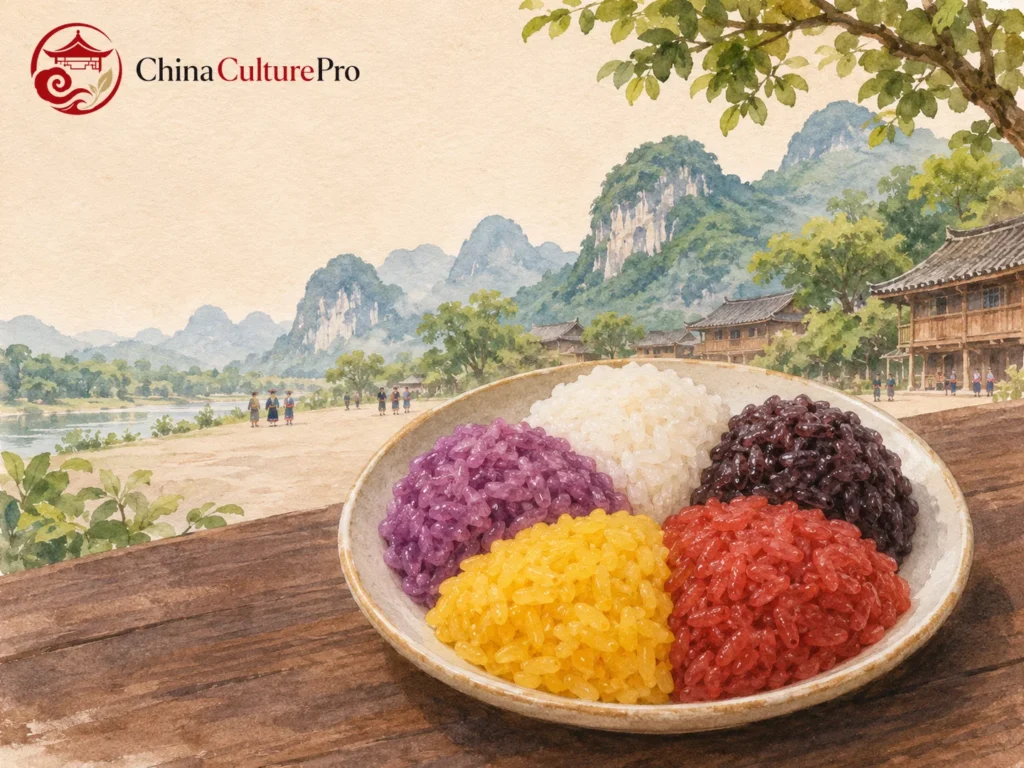
- Food and gathering: Five-colour glutinous rice (五色糯米饭, wǔsè nuòmǐfàn) appears in accounts of offerings and local food.[1][2]
A family visit, song fair and regional carnival each have their own setting.[1][2][4]

The words “March Third” can appear on a poster for an April event. The name follows the lunar calendar. The same title may lead to a song fair in one place and a larger public programme in another. Wuming’s heritage record gives one starting point for understanding those settings.[1][4]
Why March Third Is a Lunar Date
The festival name counts the third day of lunar month three. Its Gregorian equivalent changes. A public announcement may give Gregorian dates for an opening ceremony or several days of events, while the tradition is named for the lunar day.[1][4]
China’s national inventory records the Wuming submission as an extension of the March Third entry in 2014. Wuming, now a district of Nanning, is a documented setting for Zhuang observance. A comparative heritage article also describes March Third among other groups, with different local activities.[1][2]
What Happens at a Song Fair
At a song fair, singers may trade verses across an open gathering space. Listen for a reply that picks up a question, image or theme from an earlier verse. The exchange helps distinguish an antiphonal performance from a single set of songs presented to an audience.[1][2]
The fair is also a social occasion. The Wuming entry describes gatherings where young people meet, among several other customs. A public programme may put an exchange on a stage or schedule a song event at a particular venue. The credits can identify the group and location.[1][4]
What Families and Local Communities Observe
The Wuming account describes remembrance of ancestors alongside local religious and social practices. It and the wider heritage account describe multicoloured glutinous rice in festival contexts. The food can be served and can be used in offerings. The guide to Chinese ancestor worship provides context for comparing how families use food in remembrance.[1][2]
The instruments vary with the place and event. The national record for Zhuang bronze drum traditions documents bronze drums at March Third in Donglan and Tian’e. That example belongs to named communities in Hechi.[3]
How to Read a Public Programme
Xinhua’s report on the 2026 Guangxi carnival describes its opening on April 18 at Min’ge Lake in Nanning. That opening belongs to the regional programme. Wuming’s heritage record describes local practices on a different scale.[4]
When reading a listing, look for the venue and the activity title as well as the festival name. A line that names a song fair gives a different listening opportunity from one that names a food exhibition or a general stage show.[1][2][4]
FAQs About the Zhuang March Third Festival
Is Sanyuesan on March 3?
The festival takes its name from day three of the third lunar month. Check the year and calendar for its Gregorian date or the date of a public programme.[1][4]
Do All Zhuang Celebrations Include the Same Events?
The Wuming and Hechi records describe different examples, including family customs and bronze drumming. A local event programme supplies the details for that place and year.[1][3][4]
Sources
[1] China Intangible Cultural Heritage Network. Zhuang March Third in Wuming
[2] China Intangible Cultural Heritage Network. March Third among several communities
[3] China Intangible Cultural Heritage Network. Zhuang bronze drum customs in Hechi
[4] Xinhua, Guangxi. Opening of the 2026 Guangxi March Third carnival