
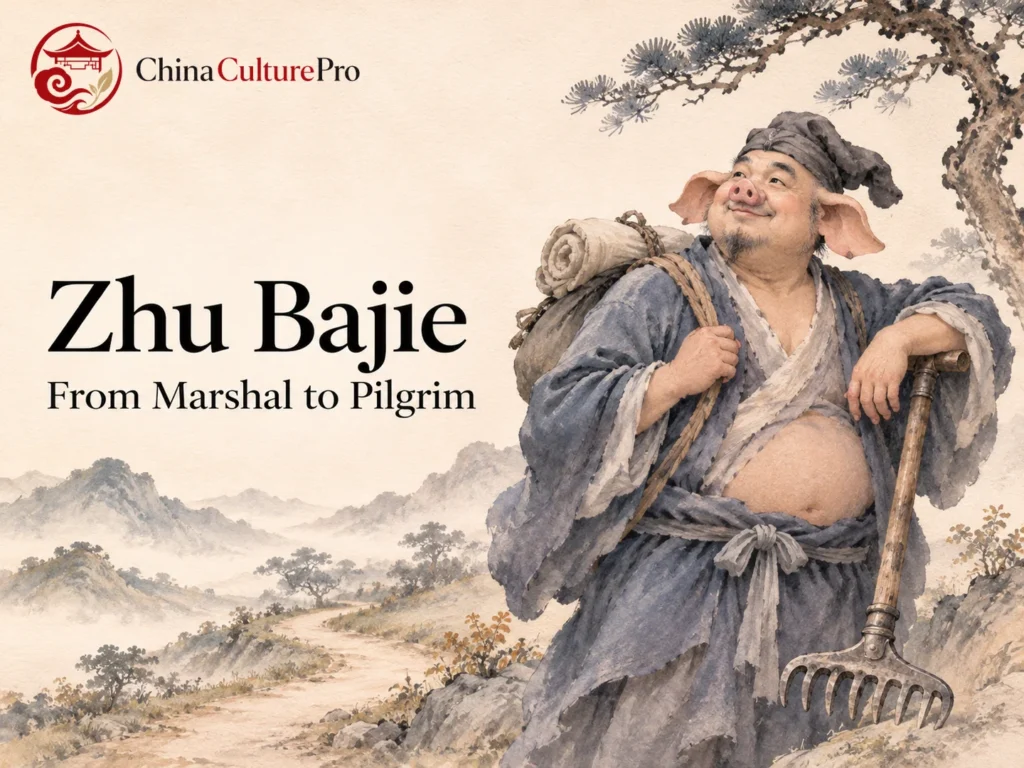

Quick Answer: Who Is Zhu Bajie?
Zhu Bajie (猪八戒, Zhū Bājiè), also called Pigsy in English, is a pig-faced disciple in Journey to the West (西游记, Xīyóu Jì). He joins the monk’s pilgrimage at Gao Village (高老庄, Gāolǎozhuāng) and carries a nine-toothed rake.[2]
- His former title is Marshal Tianpeng (天蓬元帅, Tiānpéng Yuánshuài).[4]
- His religious name is Zhu Wuneng (猪悟能, Zhū Wùnéng).[1]
- Bajie is the name he receives when he joins the party.[2]
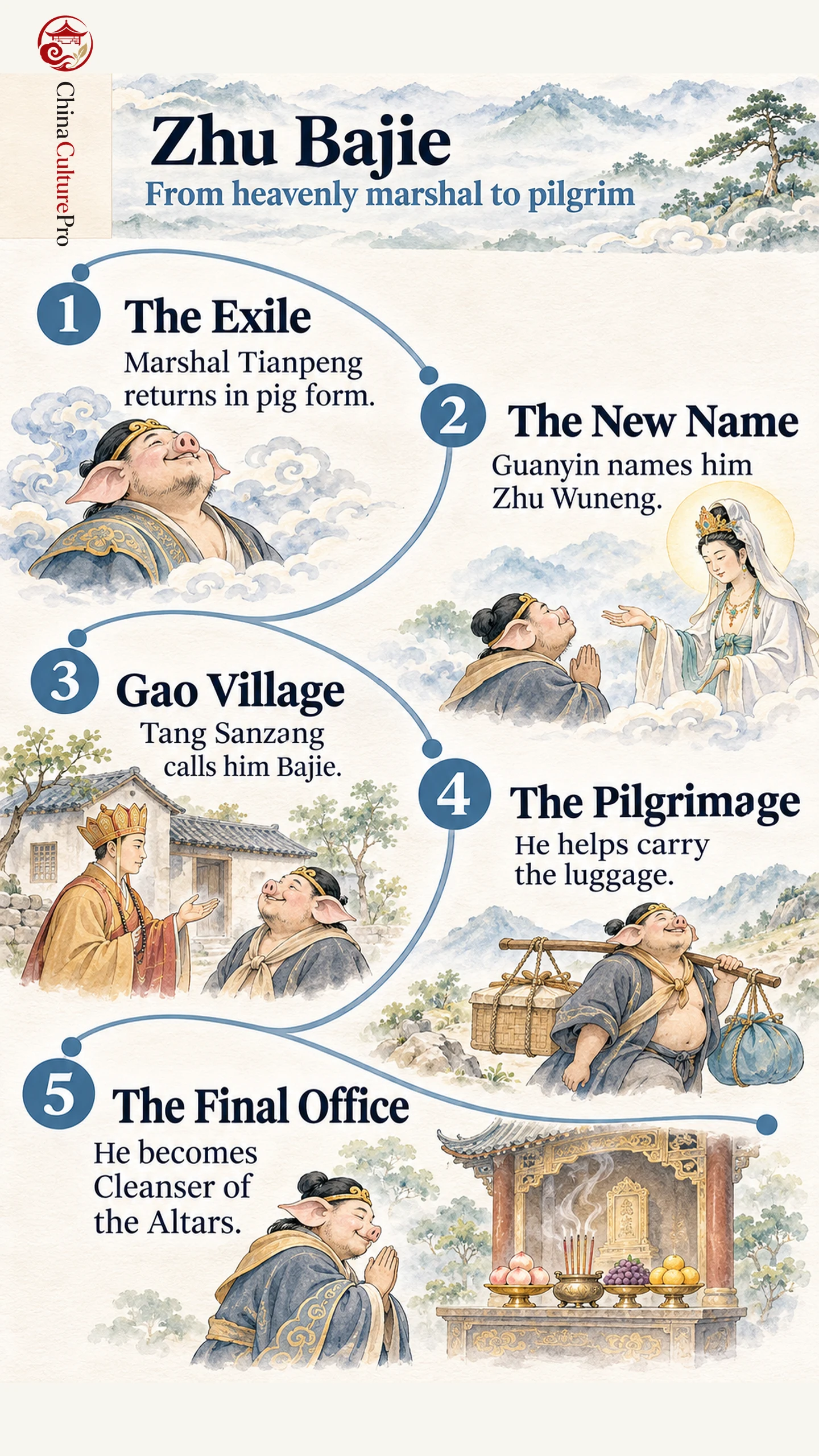
The names mark different points in his story, from exile to discipleship.
The promise Bajie makes about food when he joins the pilgrimage gives the ending its comic force. The Buddha assigns him an office that suits the appetite he has struggled to govern.
From Heaven to Gao Village
In the novel, the marshal is banished after drunken misconduct at a heavenly banquet and returns to life in pig form.[4] Guanyin gives him the name Wuneng and tells him to wait for the pilgrim. At Gao Village, he has married into the Gao household. After Sun Wukong brings him before Tang Sanzang, the monk names him Bajie, or Eight Prohibitions, in reference to the foods he says he has given up.[1][2]
What Zhu Bajie Does on the Pilgrimage
In Chapter 31, Bajie goes to find Sun Wukong when the party needs him back. He gets the Monkey King to return by playing on his pride.[3] The episode shows how Bajie uses persuasion when the party is short of help. In the final reckoning, the Buddha credits Bajie with carrying the luggage and Sha Wujing with leading the horse and protecting the monk.[4]
Why the Buddha Gives Him the Altars
The Buddha appoints Bajie Cleanser of the Altars (净坛使者, Jìngtán Shǐzhě). When Bajie protests, the Buddha explains that his appetite suits a role concerned with offerings.[4]
The Gao Village Story on Television
In episode 7 of CCTV’s television series, Ma Dehua plays Bajie. Monkey takes the appearance of the Gao daughter and confronts him before bringing him into the party. The sequence gives viewers the comic reversal at the village and the moment Bajie becomes one of the pilgrimage companions.[5]
FAQs About Zhu Bajie
Who gives Zhu Bajie his two religious names?
Guanyin gives him the name Wuneng. Tang Sanzang later calls him Bajie.[1][2]
What is Zhu Bajie’s distinctive object?
He carries a nine-toothed rake.[2]
Does Zhu Bajie become a Buddha?
He receives the office of Cleanser of the Altars after the scriptures have been delivered.[4]
Sources
[1] Journey to the West. Chapter 8
[2] Journey to the West. Chapter 19
[3] Journey to the West. Chapter 31
[4] Journey to the West. Chapter 100
[5] CCTV. Journey to the West, episode 7