

Quick Answer: What Are Yangliuqing New Year Prints?
Yangliuqing New Year prints (杨柳青木版年画, Yángliǔqīng mùbǎn niánhuà) are festive woodblock prints from Yangliuqing in Tianjin. Makers combine printed outlines and selected colors with hand painting. This approach is often called half print, half paint (半印半绘, bàn yìn bàn huì).[1][2]
- Printed: Carved blocks provide repeatable lines and some areas of color.[1][2]
- Painted: A brush can add shading, color and details such as a child’s cheeks.[2][3]
- Subjects: The tradition includes children, animals, figures, stories and festive wishes.[3][4][5]
China listed Yangliuqing woodblock New Year printing nationally in 2006.[1]

Look first at the clear contour around a face, then at the color across its cheek. A carved block can give the face its outline, and brushwork can add the gradual color across the cheek. The two kinds of mark help explain why impressions from the same design can have different details.[2][3]
What Comes From the Block and What Comes From the Brush
The documented sequence includes drawing the design, carving the blocks, printing, hand coloring and mounting. The key block lays down lines that establish the figure. Other impressions can place selected colors. The painter works on the printed sheet, adding color where the design needs a different edge, a softer change of tone or another detail.[1][2][3]
A heritage report follows Tianjin practitioner Zhao Ying and apprentices coloring the face in a well-known print. Zhao describes applying more than ten successive shading layers to that particular face. That is a description of one painter’s work on one motif. It helps explain why a painted cheek can look different from an area of flat printed color. Taohuawu New Year prints offer another regional example of how woodblock color and finishing can be combined.[2][3]
When comparing two impressions, start with the contours that define the same design. Then look at a cheek, sleeve or other painted detail. A change in tone can follow a brush gesture even where the printed line stays in the same place. The workshop descriptions give readers a reason to look for both kinds of mark.[2][3]
The Child, the Lotus and the Fish
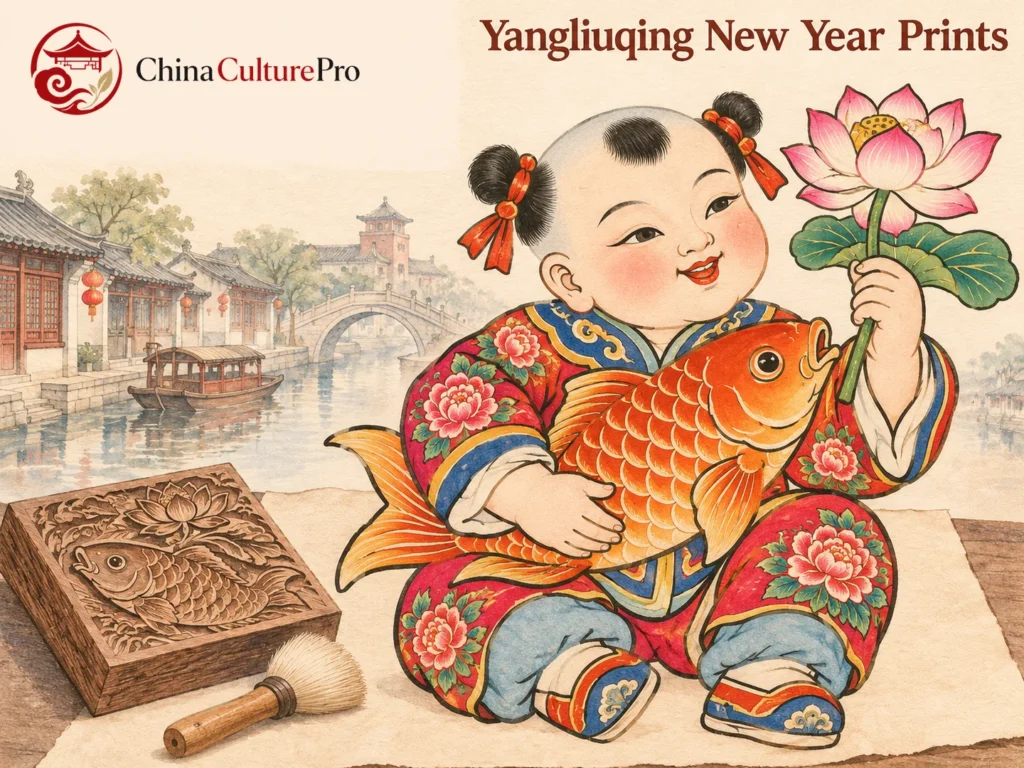
One familiar composition, *Lotus and Fish for Abundance* (莲年有余, Liánnián yǒuyú), shows a child holding a carp and a lotus. The two objects give sound clues to the meaning. The Mandarin word for fish sounds like the word for surplus, both pronounced yú. The word for lotus sounds like the word that means successive or continuous, both pronounced lián. Together the images suggest a wish for abundance year after year.[3][5]
The composition links recognizable objects to a particular phrase. A fish by itself may appear in other images and settings, and a full print often supplies the context for its meaning. The tradition’s subjects also include everyday life, fictional characters and scenes from stories. Chinese auspicious objects and symbols offers more examples of how sound and imagery can work together.[3][4][5]
Canal Trade, Family Shops and Living Practice
The national project profile places the workshops in Yangliuqing, a Tianjin town connected with Grand Canal commerce. It also notes the availability of local wild pear wood suitable for carving blocks. The town’s location and materials help explain its place in the trade without requiring a single date for the first print.[1][4]
Huo Qingyou learned drawing, painting, printing, carving and mounting in a family setting. The national record describes him and his father recovering old patterns and prints. In 1993 the family restored the Yuchenghao print shop. Another heritage account documents specialized artists in a museum workshop, where different artists handled drawing, carving, printing and coloring. The city is also home to Tianjin Clay Figurine Zhang, a separate folk art in which hand-applied color adds detail to a modeled form.[1][3][6]
FAQs About Yangliuqing New Year Prints
Does half print, half paint mean equal amounts?
The phrase names the combination of woodblock impressions and hand coloring. The amount of handwork varies by design and by the part of the image being finished.[2][3]
Why are the child, lotus and fish shown together?
In the familiar composition, the lotus and fish carry similar sounds to words in a wish for continuing abundance. The child holds the objects that make that wordplay visible.[3][5]
Where did Yangliuqing New Year prints develop?
They developed in Yangliuqing, a town in Tianjin connected to the Grand Canal trade. The national heritage record identifies Tianjin as the submitting locality.[1][4]
Sources
[1] China Intangible Cultural Heritage Digital Museum. Yangliuqing Woodblock New Year Prints
[2] China Intangible Cultural Heritage Digital Museum. Yangliuqing Printmaking and Transmission
[3] China Intangible Cultural Heritage Digital Museum. Protecting Tianjin Intangible Heritage Through Design and Practice
[4] Smithsonian National Museum of Asian Art. New Year’s Prints
[5] China Central Television. Yangliuqing Prints and New Year Wishes
[6] China Intangible Cultural Heritage Digital Museum. Huo Qingyou