
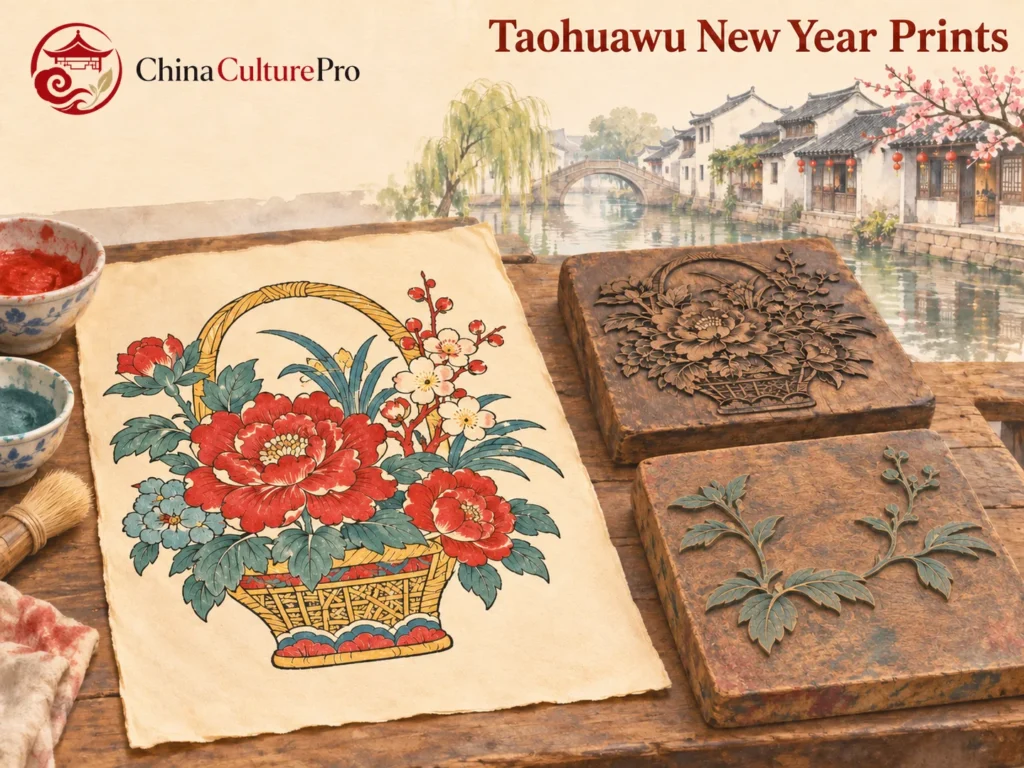

Quick Answer: What Are Taohuawu New Year Prints?
Taohuawu New Year prints (桃花坞木版年画, Táohuāwù mùbǎn niánhuà) are woodblock images made in a Suzhou tradition. They are also called Gusu prints (姑苏版, Gūsūbǎn) in local accounts. Makers can print separate colors from separate blocks, lining up the impressions on one sheet.[1][2][3]
- Making: Artists develop a drawing, carvers cut the blocks, and printers apply the colors.[2][3]
- Subjects: Prints show good wishes, opera scenes, flowers and urban life.[1][3][4][5]
- Place: Taohuawu is the Suzhou neighborhood associated with the name.[1][2]
China listed the Taohuawu craft nationally in 2006. The tradition forms one part of the broader culture of celebrating the New Year.[1][6][7]

A basket of flowers and a crowded city gate might seem to belong to different kinds of picture. Both appear in Suzhou woodblock collections. The flower print can carry a seasonal wish, while the city view draws attention to the shops and people around a landmark.[4][5]
How Separate Blocks Make One Picture
Suzhou’s heritage accounts describe three main stages: preparing a design, carving and printing. Different portions of the design can be assigned to separate blocks. On the sheet, color registration (套印, tàoyìn) means that those impressions meet in their intended positions. One block can print a petal’s outline and another can place color within it.[2][3]
In a finished print, look at the boundary between a colored area and a line. A color edge that meets the line can show how closely the printer aligned separate impressions. The same spot may show a slight shift in another impression. Some prints receive hand-applied color or further finishing, so the number of visible colors does not establish the exact number of blocks used on every example.[2][3]
What the Prints Show and Where They Went
| Example | What it shows | What the source adds |
|---|---|---|
| Chang Gate of Gusu | A Suzhou landmark in an urban scene | The Umi-Mori Art Museum dates its example to 1734 |
| The Three Hundred and Sixty Trades | A city scene organized around occupations | The same collection dates its example to 1734 |
| A Basket of Flowers | A seasonal flower subject | The British Museum describes its place in a series pairing auspicious motifs with verses |
The two examples dated 1734 show different ways to organize a city image. One names a gate that anchors the view. The other names the trades that fill it. The titles are useful starting points when looking for the building that defines the setting or the work taking place in the street.[4]
Suzhou’s local heritage record describes prints for doors, central walls and vertical panels. A door image could frame an entrance, while a long panel used the vertical space available indoors. Urban views and flower pictures broadened the subjects associated with the workshops. These images form part of Chinese folk painting, which includes several other regional printing traditions.[3][4][5]
The British Museum attributes its flower basket to the Ding family workshop associated with the Jinchang Pavilion near Chang Gate. Its catalog describes verses that use puns on depicted motifs. Here, the words and flowers help explain the subject together. Yangliuqing New Year prints offer another regional example of how printing and hand-applied color can meet on one sheet.[3][5]
From Suzhou Print Shops to Heritage Records
The national entry traces the Suzhou tradition to the Ming and describes a flourishing print trade in the Yongzheng and Qianlong reigns of the Qing. The neighborhood name also came to identify prints seen far beyond the workshops. Surviving prints in Japanese and European collections document part of that circulation.[1][4][5]
The national listing for Taohuawu woodblock New Year prints dates to 2006. UNESCO’s 2024 entry concerns the social practices of the Spring Festival across China. Suzhou’s official account says Taohuawu participated in that wider nomination. The national record names the local craft. The UNESCO entry names the festival’s wider social practices.[1][6][7]
FAQs About Taohuawu New Year Prints
Does every color in a Taohuawu print come from a block?
A block can print a color layer, and the local heritage record also describes hand coloring and other finishing. The sheet’s visible colors may therefore come from more than one technique.[2][3]
What does Gusu print mean here?
Gusu is a historical name associated with Suzhou. Here, “Gusu print” is a name used for Suzhou woodblock prints in the Taohuawu tradition.[2][3][4]
Is Taohuawu a separate UNESCO inscription?
China has a separate national listing for the craft. UNESCO’s 2024 inscription covers Chinese Spring Festival social practices, for which Suzhou’s account identifies Taohuawu as a participating tradition.[1][6][7]
Sources
[1] China Intangible Cultural Heritage Digital Museum. Taohuawu Woodblock New Year Prints
[2] Suzhou Municipal People’s Government. Taohuawu Woodcut New Year Paintings
[3] Suzhou Intangible Cultural Heritage Network. Taohuawu Woodblock New Year Prints
[4] Umi-Mori Art Museum. Chinese Woodblock Prints
[5] British Museum. A Basket of Flowers
[6] UNESCO Intangible Cultural Heritage. Spring Festival, Social Practices of the Chinese People in Celebration of Traditional New Year
[7] Suzhou Municipal People’s Government. Taohuawu Prints and the Spring Festival Inscription