


Quick Answer: What Are Wood Ear Mushrooms?
Wood ear mushrooms (木耳, mù’ěr) are edible fungi used in Chinese cooking for their crisp, flexible bite. Usually dark brown to almost black, they form folded, ear-like pieces rather than familiar umbrella-shaped caps. Their flavor is mild, so texture is often their main contribution to a dish.[1]
- Forms: Sold fresh or dried, as whole pieces or cut strips.
- Eating texture: Smooth and springy, with a noticeable crunch after cooking.
- Uses: Adds contrast to soups, stir-fries, fillings and cold dressed dishes.
Market names overlap. Compare the actual pieces rather than assuming every label identifies one identical variety.
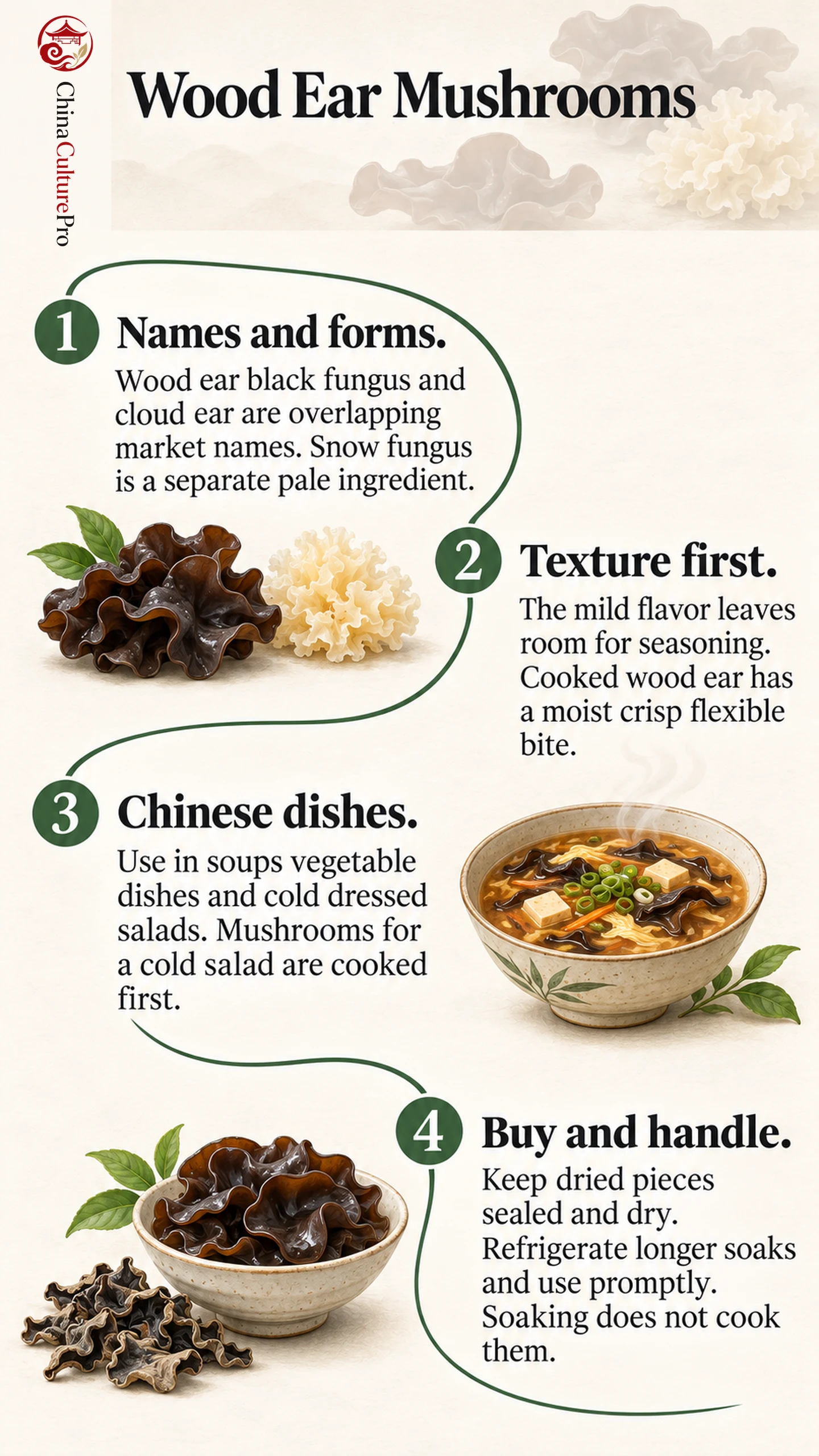
The dark, rippled pieces in a Chinese soup or cold appetizer are often wood ear mushrooms. Unlike an aromatic mushroom chosen mainly for its flavor, this ingredient supplies a crisp bite that remains distinct among soft tofu, vegetables or broth.
Black Fungus, Cloud Ear and Other Names
Black wood ear (黑木耳, hēi mù’ěr) and cloud ear (云耳, yún’ěr) commonly appear on Chinese ingredient labels. A packet sold as cloud ear may contain small, thin, ruffled pieces; other wood ears are thicker, with a paler reverse side. Thickness gives a useful clue to the bite.[2][3]
Names alone cannot reliably identify a species.[3]
Two other labels need separating: white-backed wood ear (白背木耳, bái bèi mù’ěr) and snow fungus (银耳, yín’ěr). The former belongs among the dark ear-shaped products sold with a pale back; the latter is the pale, frilly ingredient also called white fungus. Snow fungus is a separate ingredient within the wider family of Chinese culinary mushrooms.[7]
Mild Flavor and a Crisp, Flexible Bite
Cooked wood ear bends easily while retaining resistance to the bite. “Crunchy” here describes a moist, springy texture, not the brittle snap of a fried cracker. Its smooth surface and ruffled edges contrast with tender meat, soft curd or silky soup.[1][2]
Dried pieces begin hard, shriveled and brittle. Water restores their larger, flexible form, revealing folds that are difficult to see in the packet. The change is rehydration: it does not mean the mushrooms have been cooked.[4]
Their flavor stays comparatively restrained. A garlicky, vinegary or spicy dish gets most of that character from its seasoning; the mushroom supplies the dark visual accent and resilient mouthfeel. It should not be expected to create the strong fragrance associated with dried shiitake.[3][4]
Chinese Soups, Stir-Fries and Cold Dishes
In hot and sour soup (酸辣汤, suānlàtāng), thin wood-ear strips sit among soft tofu, egg and vegetables. A published family version combines several mushrooms with vinegar and white pepper. The wood ear adds a contrasting bite; it is not the source of the soup’s sourness or peppery heat.[8]
A vegetable dish can pair shredded wood ear with carrot and tofu puffs. The firm mushroom pieces contrast with the airy curd, while the sauce seasons both. Other vegetable and meat combinations use the same textural contrast.[10]
Cold-dressed wood ear (凉拌木耳, liángbàn mù’ěr) puts the fungus itself at the center. Dressings can combine soy sauce, Chinese black vinegar and a little sugar, with aromatics or chili varying by version. The mushrooms are cooked before being served cold.[9]
Wood ear can suit vegetarian meals, but the complete dish still depends on its broth, sauce and other ingredients. A mushroom listed on the menu does not establish what else is in the bowl.
Dried, Fresh and Rehydrated: Buying and Handling
Asian grocers commonly stock dried wood ear, while some also sell fresh pieces. Whole or irregularly broken pieces leave the final cut up to the cook. Pre-cut strips suit dishes where that shape is useful, but offer less freedom to change it.[3][4]
Buy food-grade mushrooms from reliable shops rather than collecting fungi based on a similar appearance. Keep dried products sealed in a cool, dry place away from sunlight. Follow the packet’s storage directions and date marking; “dried” does not promise an unlimited shelf life.[7]
Before soaking, rinse dried pieces under running water and use a clean container with room for expansion. Keep the soak refrigerated if it cannot be used promptly, and use the rehydrated batch soon after preparation. Discard it if slime or an abnormal smell develops.[5]
After rehydration, remove tough attachment points if present and rinse away grit trapped in the folds. Discard the weak-tasting soaking water. Cook the mushrooms for the intended dish; soaking alone is not a ready-to-eat treatment.[1][4]
Proper handling before cooking matters. Under unsuitable soaking or storage conditions, bacteria associated with black fungus can produce bongkrekic acid, a toxin that washing and cooking cannot remove. Extra cooking is not a way to rescue a mishandled batch.[6]
FAQs About Wood Ear Mushrooms
Are wood ear mushrooms the same as cloud ear?
The names overlap in shops. Products sold as cloud ear are often smaller and thinner; check the pieces and label rather than assuming one fixed species.
Can wood ear mushrooms be eaten raw?
Cook them before eating, including for cold salads. Rehydrating dried mushrooms changes their texture but does not cook them.
Can dried wood ear mushrooms soak overnight?
If an overnight soak is necessary, keep it refrigerated. Do not leave the mushrooms soaking on the counter overnight.
Can shiitake replace wood ear mushrooms?
They perform different jobs. Shiitake contributes a stronger mushroom aroma, while wood ear mainly adds a crisp, flexible texture; a substitution changes that balance.
Sources
[1] Maggie Zhu, Omnivore’s Cookbook. Wood Ear: Ingredient Description and Uses
[2] Woodland Foods. Dried Cloud Ear Mushrooms
[3] Andrea Nguyen, Viet World Kitchen. Wood Ear Mushrooms and Black Fungus: Buying and Cooking Guide
[4] Namiko Hirasawa Chen, Just One Cookbook. Dried Wood Ear Mushroom
[5] Hong Kong Centre for Food Safety. Soaking Mushrooms and Food Safety
[6] Hong Kong Centre for Food Safety. Black Fungus Soaked Improperly May Produce Toxic Bongkrekic Acid
[7] Hong Kong Consumer Council. Dried Edible Fungi: Types, Storage and Safe Soaking
[8] Daddy Lau, Made With Lau. Hot and Sour Soup
[9] Wei Guo, Red House Spice. Wood Ear Mushroom Salad
[10] Everbest Soya Bean Products. Tofu Puffs with Shredded Black Fungus and Carrot