


Quick Answer: What Is Wild Geese Descending on the Sandbank?
Wild Geese Descending on the Sandbank (Pingsha Luoyan, 平沙落雁, Píngshā Luòyàn) is a traditional work for guqin (古琴, gǔqín). The 1634 Guyin Zhengzong preserves an early score under a related title.[1][2]
- Image: An autumn sandbank and distant geese suggest stillness and a mind free to roam.[2][3]
- Versions: The Chinese Music Archive lists a solo and a qin-and-flute duo with different score credits.[4]
- Same title: Chaozhou music has a separate piece with a different melody.[2]
Check the score and performer fields when a catalog lists more than one version.
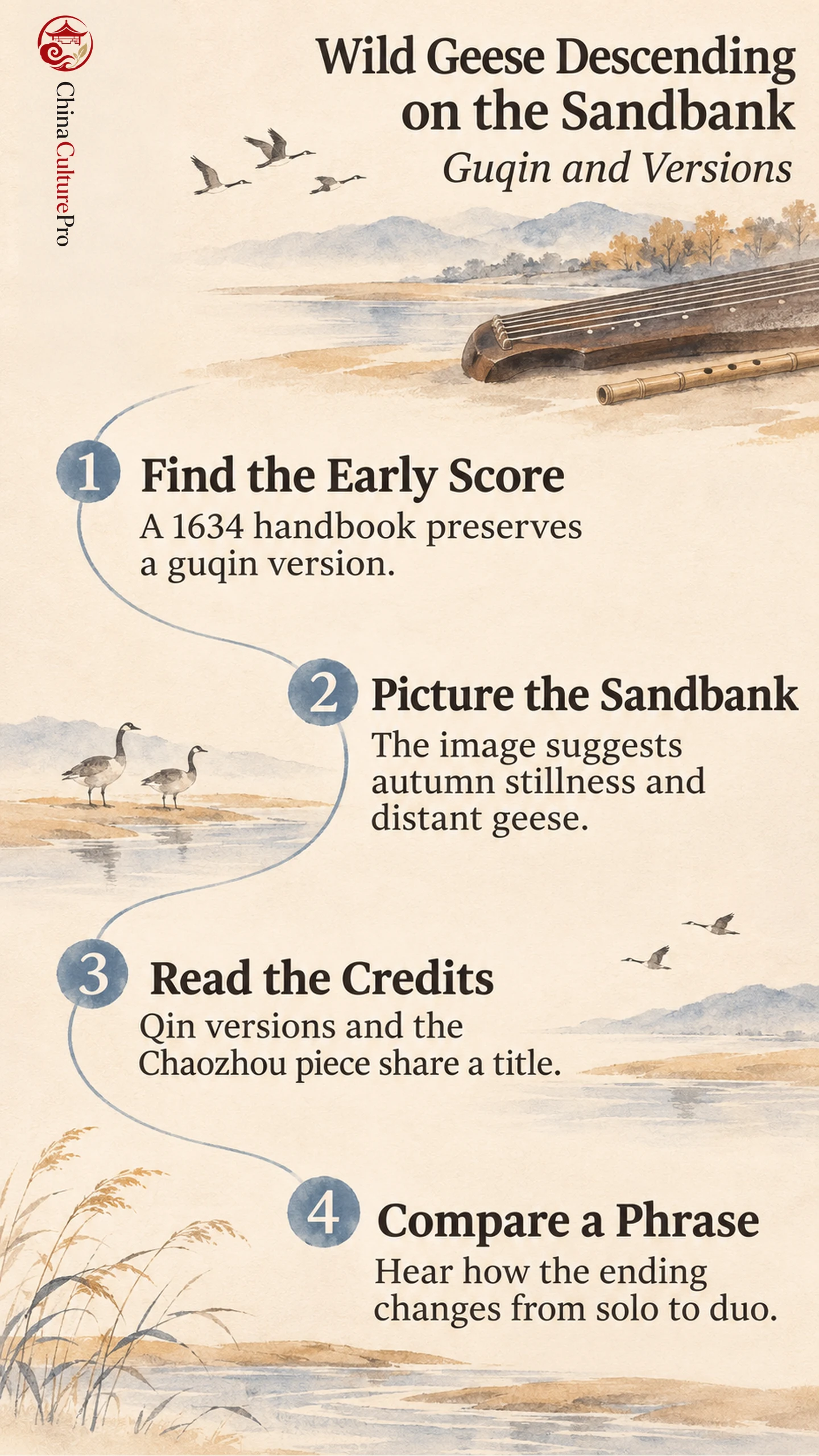
The image gives the ear a sense of scale. Let the first plucked notes fade before following the next phrase. Listen for the contrast between a phrase that moves quickly and the moment when it comes to rest.
The 1634 Score and Its Names
The earliest printed source usually cited is the Guyin Zhengzong from the late Ming dynasty. In that collection the title appears as Yan Luo Pingsha, with the geese named before the sandbank. Later sources and modern recordings use several Chinese and English titles.[1]
Program notes list several traditional composer attributions. A comparison of historical scores also shows differences in structure and melody. Look for the handbook named in the credit if you want to match a performance to a version.[3][5]
From a Sandbank Image to a Musical Phrase
A qin handbook note cited in a Hong Kong program imagines a still autumn landscape, smooth sand and the sound of geese in the distance. The image also suggests a life away from worldly concerns. It has much in common with the themes of Chinese nature poetry.[2]
Listen for how a player moves between a clear pluck and a note allowed to fade. Landscape titles in qin music, such as High Mountains, give the listener an image for hearing a phrase unfold.
Read the Solo, Duo and Chaozhou Credits
| Setting | Credit to look for |
|---|---|
| Solo guqin | Wei Zhongle, Guyin Zhengzong, A1004-01074 |
| Guqin and xiao | Wu Jinglue and Sun Yude, Jiao’an Qinpu, A1004-01128 |
| Chaozhou ensemble | A performance based on Wang Anming’s 1976 recording |
The Chinese Music Archive supplies the first two credits. The third comes from a Hong Kong recital program that identifies the Chaozhou work as a separate melody. Match the ensemble and tradition as well as the title.[2][4]
Compare the Shape of a Phrase
Try the guqin solo and the qin-and-xiao duo. Compare a phrase ending in each. Listen for whether the flute sustains sound while a string note fades, as it also can in the duo version of Moon over the Mountain Pass. For a contrasting qin sound, Three Variations on Plum Blossom offers clear recurring harmonic passages.
FAQs About Wild Geese Descending on the Sandbank
Who composed Pingsha Luoyan?
Later sources give several attributions. The 1634 score provides a documented source for the guqin piece.[1][3]
Is the Chaozhou piece the same as the guqin work?
The two works share a title and have different melodies.[2]
Which recording uses the early score credit?
The Chinese Music Archive lists Wei Zhongle’s solo with the Guyin Zhengzong score credit.[4]
Sources
[1] Silkqin. Yan Luo Pingsha and Pingsha Luo Yan: Guyin Zhengzong
[2] Hong Kong Leisure and Cultural Services Department. Wild Geese on the Sandbank: Concert Programme Notes
[3] National Culture and Arts Foundation, Taiwan. Guqin Recital Programme
[4] Chinese Music Archive. Guqin Audio Music Archive