
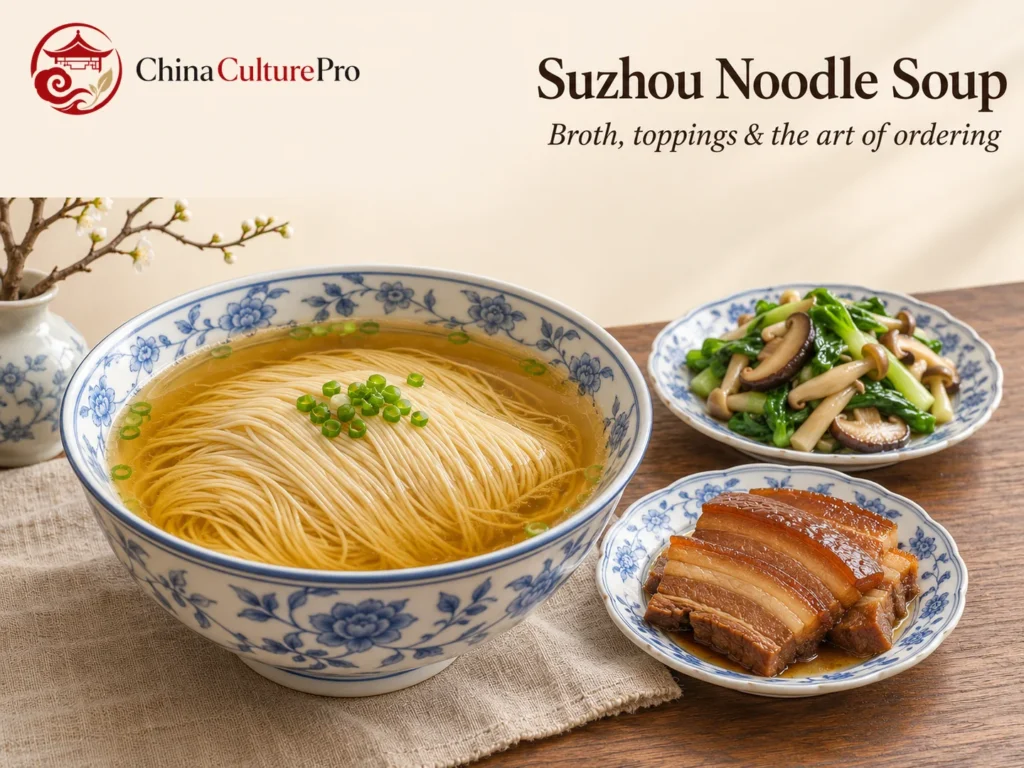

Quick Answer: What Is Suzhou Noodle Soup?
Suzhou noodle soup (苏式汤面; Sūshì tāngmiàn) combines fine wheat noodles, a prepared broth and a cooked topping. Its character depends on the relationship between those components, with noodle texture, soup quantity and greens adjusted to the diner.[1]
- Broth: Red and white preparations offer different seasoning directions.
- Topping: Braised pork, fried fish and vegetables are familiar choices.[2]
- Ordering: You can ask for more or less soup, firmer or softer noodles, and toppings served separately.[3]
A pale broth or vegetable topping does not by itself establish that the whole bowl is meat-free.

A topping name tells only part of the story. Choosing soup and noodle texture completes the order within Jiangsu cuisine.
The Three Parts of a Suzhou Noodle Bowl
The noodles provide the staple, the broth carries the liquid seasoning, and the topping supplies a distinct cooked dish. A pork topping can be tender and rich; a fish or eel topping brings a different texture and sauce. The pieces should not be treated as interchangeable decorations.[1]
The topping can sit directly on the noodles or arrive separately. Keeping it on a plate lets you decide how much of its sauce enters the soup. That arrangement also makes a contrast between two toppings easier to notice.
The Chinese noodles guide compares other regional forms. Suzhou’s identity here lies in the bowl’s assembled components, rather than in a special rice noodle or a single compulsory topping.
Red Broth, White Broth and Hidden Ingredients
Red preparations commonly gain color and seasoning from soy sauce and the liquid used to braise meat; sugar can also be part of that seasoning. White preparations omit that dark-soy direction, but can still use meat-based braising liquid and stock.[4]
Broth recipes vary. Kunshan Aozao red stock, for example, can combine river ingredients with chicken and pork bones, while a documented white version uses chicken, duck and pork bones. These are regional examples, not one universal formula.[5]
This makes two questions useful when ordering: what is in the stock, and what is on top? A bowl can have vegetables above a meat stock, or a poultry topping above a stock that includes pork. Ask about both layers when choosing ingredients matters.
How the Bowl Comes Together
Traditional preparation separates the stock, the seasoned braising liquid and the topping before the final bowl is assembled. Hot stock is added to the bowl’s seasonings, while the noodles cook in a separate pot of water. The cooked strands are then transferred for serving.[4]
Draining and arranging the noodles are skilled parts of the service. A traditional presentation gathers the strands neatly, with a raised center likened to a fish’s back. That tidy shape is a result of handling the noodles, not a different ingredient.[1]
For home cooking, choose directions suited to the noodle product and a tested stock recipe. A very fine fresh strand and a thicker dried noodle need different cooking instructions. The Chinese cooking methods guide provides the wider distinction between boiling noodles and simmering a stock.
Toppings, Seasons and Nearby Styles
Pork, fried fish and mixed vegetables offer familiar starting points. A local summer pork-noodle preparation uses a clear stock using pork and eel bones and a rice-alcohol note. Early-summer shrimp and autumn crab preparations show how seasonal ingredients can change the offering.[2]
Seasonal associations are useful clues, not guaranteed availability dates. Ask what the kitchen is serving that day rather than assuming every menu follows the same calendar or has the same specialty.
For the specific red-fish and white-duck tradition, see the Aozao noodles guide. For a simpler comparison centered on noodles and broth, the Yangchun noodles guide follows a different regional bowl.
How to Order the Bowl You Want
These terms describe preferences, not a test of whether a visitor knows the local culture. Say which change matters most; a plain-language request or pointing to the menu can work alongside the phrase.[3]
| Ordering term | Meaning |
|---|---|
| kuantang (宽汤; kuān tāng) | More broth relative to noodles |
| jintang (紧汤; jǐn tāng) | Less broth relative to noodles |
| yingmian (硬面; yìng miàn) | Firmer cooked noodles |
| lanmian (烂面; làn miàn) | Softer cooked noodles |
| zhongqing (重青; zhòng qīng) | More scallion or garlic greens |
| mianqing (免青; miǎn qīng) | Omit the scallion or garlic greens |
| guoqiao (过桥; guò qiáo) | Serve the topping on a separate plate |
Soup quantity and texture choices belong to the same order, while serving the topping separately changes its presentation. The separate-plate meaning of guoqiao should not be confused with the name of Yunnan’s crossing-the-bridge rice-noodle dish.[4]
FAQs About Suzhou Noodle Soup
Is white broth vegetarian?
A pale stock can still contain pork, chicken or duck.[5]
Does red broth always contain chili?
No. Soy sauce and braising liquid can supply the darker seasoning; ask about chili separately.[4]
Does guoqiao mean Yunnan crossing-the-bridge noodles?
On this Suzhou menu, it means the topping is served on a separate plate.[4]
Sources
[1] Suzhou Intangible Cultural Heritage Office. 苏式汤面制作技艺
[2] Suzhou Municipal Government, Pocket Suzhou. Delicacies
[3] Suzhou Broadcasting, original reporting. 过酥年 品“酥”面
[4] Suzhou market-regulation published consultation draft. 苏式面制作技艺与文化传承(征求意见稿)
[5] Kunshan Municipal Government. 奥灶面与红白汤