


Quick Answer: What Is Sichuan Water-Boiled Beef?
Sichuan water-boiled beef (水煮牛肉, shuǐzhǔ niúròu) is a dish of sliced beef cooked in seasoned liquid and served over vegetables with an aromatic oil finish.
- Beef: Thin slices sit above a bed of vegetables, whose selection varies by restaurant.
- Cooking: The meat cooks in the broth before the final hot oil is poured over the surface seasonings.
- Flavor: Mala (麻辣, málà) means numbing and spicy: fermented chili bean paste, chilies and peppercorns build a layered savory flavor.[1]
“Water-boiled” does not mean oil-free or bland. Neither deep-frying the beef nor relying on the finishing oil alone describes the usual preparation.
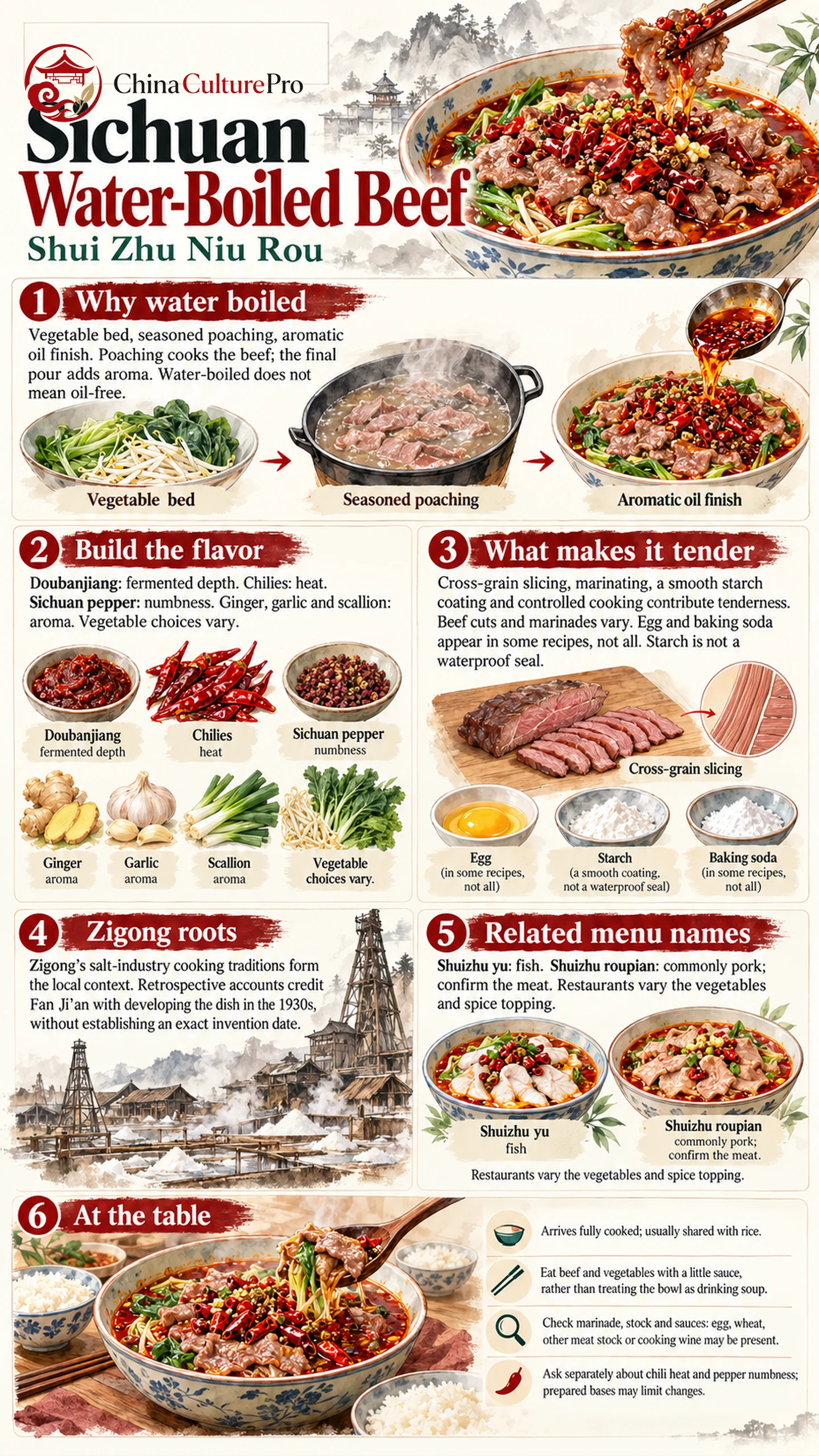
“Water-boiled” sounds mild, until a large bowl arrives with red oil and dried chilies covering the beef. The name describes how the meat cooks, rather than the amount of oil. This Chinese food guide explains that distinction, the tender texture and the questions worth asking before ordering.
Why Is It Called Water-Boiled Beef?
The term shuizhu (水煮, shuǐzhǔ) identifies cooking the main ingredient in seasoned liquid. In this dish, three components come together:
- Vegetable base: Vegetables are cooked separately and arranged in the serving bowl. Blanching and stir-frying are both used, depending on the preparation.
- Seasoned poaching: Aromatics and seasoning paste flavor the liquid in which the beef cooks. The cooked slices and broth join the vegetable base.
- Aromatic finish: Chili, peppercorn and garlic toppings receive hot oil, releasing their aroma over the assembled dish.[1][2]
Oil can therefore appear at more than one stage: it helps fry the seasoning base and contributes to the final finish. The beef itself is cooked in liquid. The last pour adds fragrance; it cannot replace cooking the meat beforehand.
This distinction between the cooking medium and the finishing treatment helps explain other Chinese cooking methods too. A dish’s translated name rarely lists every technique involved.
Beef, Vegetables and Mala Seasonings
The bowl combines meat, vegetables, broth and a strongly seasoned surface. Each has a different job. Its red appearance tells you less about the exact heat level than the chili variety, quantity and seasoning mixture do. These are recurring components, not a fixed shopping list.[2][3]
| Ingredient or group | Main role | What varies |
|---|---|---|
| Beef slices | Tender meat that carries the broth’s seasoning | Tenderloin and flank are among the cuts used; no single cut defines the dish. |
| Vegetable bed | Crunch, softer leaves and contrast with the beef | Bean sprouts, lettuce, celery, cabbage or mushrooms may appear; a restaurant need not include them all. |
| Sichuan chili bean paste, or doubanjiang (豆瓣酱, dòubànjiàng) | Fermented, salty depth and chili flavor in the base | Paste brands and seasoning combinations differ. It is a distinct ingredient from fermented black beans. |
| Dried chilies or chili flakes | Chili heat, fragrance and color | Whole, chopped or ground forms appear, with differing levels of heat. |
| Sichuan pepper (花椒, huājiāo) | A numbing, tingling sensation and distinctive aroma | Amount and variety vary; its numbing effect is separate from chili heat. |
| Ginger, garlic and scallion | Aromatic layers in the base or topping | Some enter the broth; others finish the bowl. Not every recipe places them identically. |
| Liquid and cooking oil | A medium for cooking the beef and carrying seasoning | Water or stock may be used; stock can contain chicken or pork even when the named meat is beef.[1][2][3][4] |
Soy sauce may also season the base or marinade. Ingredient names alone cannot establish the complete contents of a restaurant’s sauce.
How the Beef Gets Its Tender Texture
Tenderness begins with the beef and how it is sliced. Cutting across the grain shortens the muscle fibers in each piece, making the slices easier to chew. Different cuts can work, so the use of tenderloin, flank or another suitable cut matters less than treating that cut appropriately.[1][4]
Marinating and coating contribute another part of the texture. A starch coating gives the meat a smooth surface when heated in broth; some preparations include egg or egg white, while others do not. Baking soda is used in certain recipes as a tenderizer, but it is not a defining ingredient.[2][3][4]
These treatments work together with controlled cooking. Thin slices do not need the long simmer associated with a beef stew. Excessive cooking can toughen them despite a well-prepared marinade. Starch is not an impermeable seal that guarantees juicy meat, and pouring hot oil over the finished bowl does not reverse overcooking.
The intended contrast is supple beef against the vegetables beneath it. A silky surface is a texture characteristic, not proof of one mandatory tenderizing formula.
Zigong Roots and Salt-Industry Traditions
The dish is closely associated with Zigong, a salt-producing city in southern Sichuan. Local food history connects the area’s many beef dishes with its salt industry, which historically employed large numbers of cattle. That relationship helps explain why beef became prominent in local cooking.[5]
Retrospective accounts credit chef Fan Ji’an (范吉安, Fàn Jí’ān) with developing water-boiled beef in the 1930s from an earlier boiled-beef preparation. The described change brought seasoning into the cooking process, rather than depending only on a separate dipping mixture. Provincial cultural information also records the beef, vegetables, seasoned liquid and finishing oil as parts of the dish.[5][6]
This is a useful account of the modern dish’s local development. It does not establish an exact invention day or show that every technique called “water-boiled” began with this chef. Stories linking the finished chili-rich dish to much earlier salt workers should be distinguished from evidence for its present form.
Related Shuizhu Dishes and Restaurant Variations
Shuizhu describes a preparation used with several main ingredients. On a menu, the word following it helps identify what you will actually eat:
- Shuizhu yu (水煮鱼, shuǐzhǔ yú): A fish version using the same broad combination of seasoned poaching and an aromatic oil finish.
- Shuizhu roupian (水煮肉片, shuǐzhǔ ròupiàn): A sliced-meat dish that commonly uses pork; confirm the meat rather than assuming beef.[7]
Restaurants also change the vegetable bed, the amount of liquid and the spice topping. Those choices do not by themselves establish rigid city-by-city styles or one nationwide recipe. Compare the named protein and preparation first; the number of floating chilies is a poor substitute for asking about flavor.
Serving, Ordering and Dietary Checks
Water-boiled beef normally arrives fully cooked as a shared main dish, often with steamed rice ordered alongside it. A serving spoon can lift out beef and vegetables with a little sauce. It is not necessary to drink the remaining broth or transfer all the surface oil to your rice.[3][7] A simply seasoned vegetable dish or Chinese cold dish can provide a contrasting accompaniment.
When reading Chinese food names, use the name as a starting point, then confirm:
- Contents and portions: Which vegetables are underneath, how large the serving is, and whether rice is separate.
- Chili and pepper: Ask for less chili heat and less Sichuan pepper numbness separately. A prepared seasoning base may limit adjustments.
- Marinade and stock: Check egg, oyster sauce, cooking wine and any chicken or pork stock, rather than relying only on the word “beef.”
- Sauces and preparation: For a gluten-free requirement, check compound sauces and kitchen arrangements. Some soy sauces explicitly contain wheat.[8][9]
Let freshly served pieces cool enough to eat comfortably. The appearance of the surface oil cannot tell you the temperature of the meat or broth below it.
FAQs About Sichuan Water-Boiled Beef
Is Sichuan water-boiled beef always spicy?
The classic flavor is numbing and spicy, but intensity varies. Chili heat and Sichuan pepper numbness are separate sensations, so ask about both when requesting a milder version. Restaurants using a prepared base may be unable to remove either completely from an individual serving.
Do you drink the broth in water-boiled beef?
The broth mainly cooks and seasons the ingredients. Diners generally eat the beef and vegetables, taking a little sauce with rice if they wish. It is not served as a bowl of drinking soup, and there is no expectation that you finish all the liquid.
Is water-boiled beef the same as hot pot?
No. Water-boiled beef is a finished dish cooked in the kitchen and brought to the table. In the familiar hot-pot format, diners cook ingredients in a pot at the table. A large bowl, red broth and sliced meat do not make the two interchangeable.
Is Sichuan water-boiled beef gluten-free?
Do not assume so. Beef and a starch coating cannot establish the status of the whole dish. Soy sauce, doubanjiang or a compound marinade may introduce gluten, depending on their ingredients. Check actual labels and ask about preparation and shared equipment as well.[8][9][10]
Sources
[1] Red House Spice. Sichuan Boiled Beef
[2] China Sichuan Food. Shui Zhu Beef
[3] Omnivore’s Cookbook. Sichuan Boiled Beef
[4] The Woks of Life. Sichuan Boiled Beef
[5] Zigong News. Why Zigong Has So Many Beef Dishes
[6] Sichuan Provincial Culture and Tourism Information Center. Sichuan Specialty: Water-Boiled Beef
[7] The Mala Market. Sichuan Water-Boiled Beef
[8] Lee Kum Kee USA. Premium Soy Sauce
[9] NIDDK. Eating, Diet, & Nutrition for Celiac Disease
[10] Lee Kum Kee Home. Chili Bean Sauce — Toban Djan