


Quick Answer: What Is Chinese White-Cut Chicken?
White-cut chicken / Bai Qie Ji (白切鸡, bái qiē jī) is a Cantonese dish of gently poached chicken, cut into pieces after cooking. Its appeal comes from the chicken’s own flavor rather than a heavy glaze.[1]
- Chicken: A whole, skin-on bird is the traditional starting point, commonly served in bone-in pieces.
- Texture: Moist meat sits beneath smooth, springy skin, with a mild savory taste.
- Serving: A separate dip adds seasoning; the chicken may be shared or served as a rice meal.
This guide focuses on the Cantonese preparation. Chicken selection, dips and serving arrangements vary between kitchens.
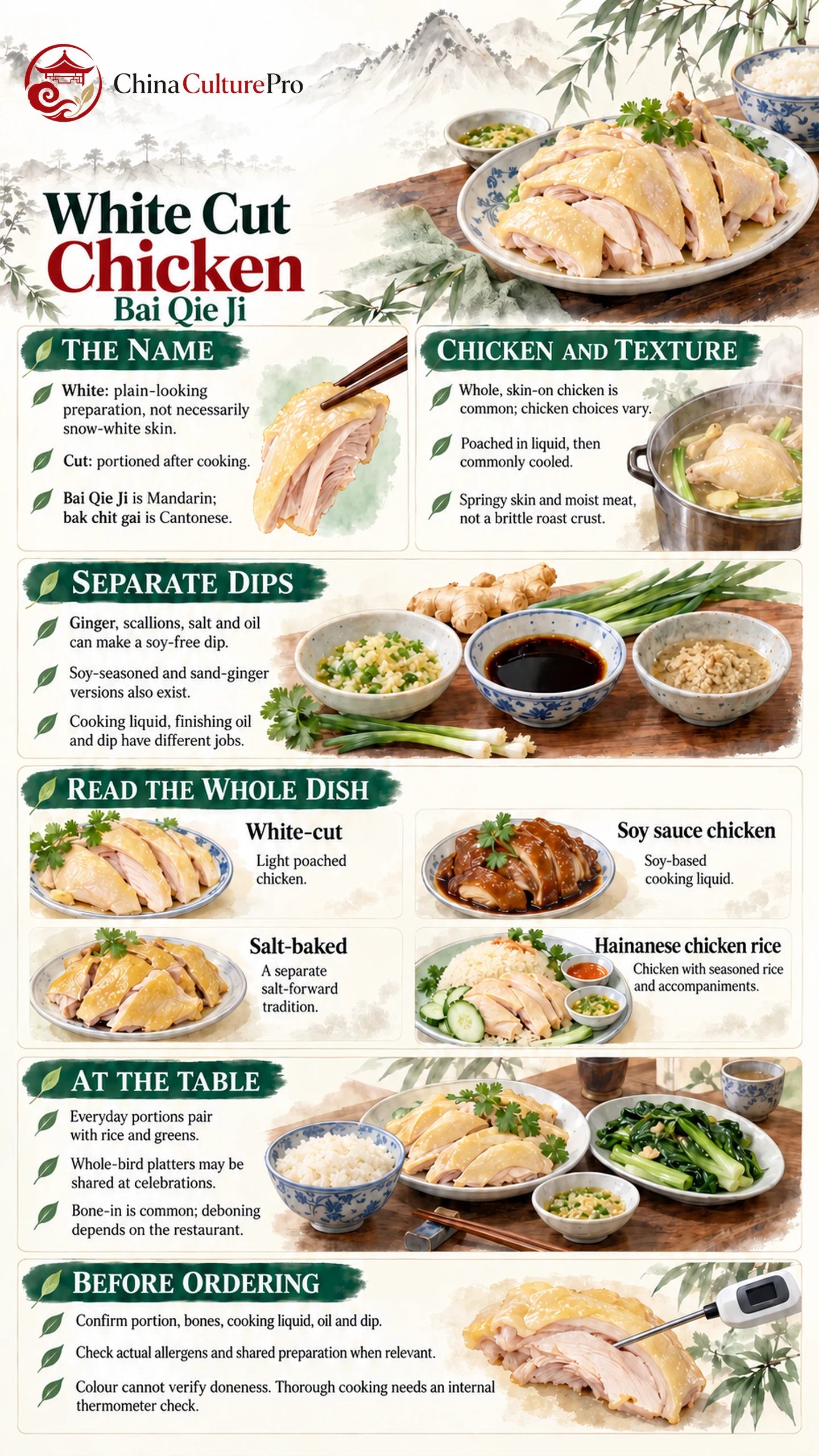
Pale, skin-on chicken pieces and a small dish of aromatic oil make a restrained first impression. Yet this Chinese dish has distinct flavors and textures: gently savory meat, resilient skin and a lively dip. The differences become clearer when you separate the bird, its preparation and its accompaniments.
Why Is It Called White-Cut Chicken?
“White” describes the plain-looking preparation, without the dark coating associated with soy-braised or roasted chicken. It does not mean that the bird must have snow-white skin or that the cooking liquid contains no salt, ginger or scallions. “Cut” refers to portioning the bird after it is cooked.[2]
Bai zhan ji (白斩鸡, bái zhǎn jī), often translated as “white chopped chicken,” is another name you may encounter. Bak chit gai is a Cantonese menu spelling; bai qie ji is Mandarin pinyin. Both refer to the dish, rather than a particular chicken breed.
Chicken, Poaching and the Finished Texture
Chicken Choice and Skin-On Presentation
A whole bird brings breast meat, darker leg meat and intact skin to the same platter. The pieces need not have identical softness: the appeal can include a firm, satisfying bite rather than meat that falls apart. Qingyuan chicken is one documented local choice, associated with its own white-cut cooking tradition.[3]
Three-yellow chickens provide another example used in Guangdong. These names help explain local selection, but neither is compulsory for every restaurant. Breed, age and handling can influence the finished texture; the dish has no single required bird size, sex or age. Pale-yellow skin is compatible with the name.[4]
Poaching, Cooling and Texture
Poaching cooks the chicken in liquid rather than surrounding it with dry roasting heat. In the Chinese cooking methods vocabulary, that distinction matters: the surface remains supple instead of developing a browned, brittle crust. The cooking liquid can include ginger, scallions and salt while retaining a light flavor.
Cooling after cooking is a common part of the preparation. It reduces continued cooking from residual heat and firms the skin, producing its characteristic springiness. A soft, jellylike layer may be visible between skin and flesh. This is different from the crackle of roast chicken skin. The result depends on the bird and its handling; cooling is one influence on texture, not a guarantee of juicy meat.[1]
Ginger-Scallion Sauce and Other Dips
Ginger-scallion sauce (姜葱酱, jiāngcōng jiàng) gives the chicken a contrasting aromatic accent. Minced ginger and scallions contribute warmth and freshness, while salt and oil carry the seasoning. A soy-free version is well established; another version adds soy sauce for a deeper savory flavor. The name of the dip does not settle which one you will receive.[2]
Sand ginger (沙姜, shājiāng), a different aromatic from ordinary ginger, appears in some Guangdong accompaniments, including combinations with soy sauce, garlic or oil. These are examples of local variation, not ingredients required in every bowl. Sesame oil, peanut oil and chili are also recipe choices rather than universal essentials.[4]
Keep the dip distinct from the liquid used to cook the bird and from any oil brushed onto its skin. They perform different jobs, even when a restaurant uses some of the same ingredients in more than one place.
White-Cut Chicken Compared with Other Chicken Dishes
Similar-looking chicken dishes can differ in both seasoning and meal structure. Use the preparation and accompaniments together when reading a menu; skin color alone is an incomplete guide.
| Dish | Main preparation and flavor | What distinguishes it |
|---|---|---|
| White-cut chicken | Lightly seasoned poached chicken, commonly with a separate dip | The chicken’s flavor and skin texture remain prominent; rice is an accompaniment rather than part of its name. |
| Soy sauce chicken | Chicken cooked in a soy-based aromatic liquid | Brown skin and sweet-savory sauce flavor come from the cooking liquid, rather than only a dip added at the table. |
| Salt-baked chicken | A salt-forward Hakka chicken tradition, historically associated with cooking in heated salt | It is a separate dish; contemporary restaurant methods vary. See salt-baked chicken for that preparation. |
| Hainanese chicken rice | Chicken served with stock-flavored rice, sauces and commonly soup | This is a complete chicken-and-rice meal. Its seasoned rice is a defining part of the combination, not simply plain rice beside a chicken platter. |
Soy sauce chicken may also be poached, so poaching alone does not distinguish the two chicken dishes.[5] Hainanese chicken rice is distinguished here by the complete meal, not just the appearance of its chicken.[6]
Serving White-Cut Chicken at Everyday and Celebration Meals
At an everyday meal, half a chicken or an individual portion may arrive with steamed rice and greens. A traditional platter is chopped through the bones, so expect pieces to pick up and eat around rather than uniformly boneless slices. Eating the skin is a matter of preference.
Some Cantonese families also present a whole bird, portioned for sharing, at celebrations and banquets. That setting differs from an ordinary lunch portion: heads and feet may be retained for a complete presentation, but they are not required on every serving. The custom is not a rule for all Chinese households.[1][3]
Ordering White-Cut Chicken and Checking Ingredients
- Portion and bones: Ask whether the order is a whole bird, half bird or individual portion, and whether deboning is available. Confirm the serving style rather than assuming it must arrive chilled.
- Dips and cooking liquid: Check both, including seasoning powders and finishing oil. Depending on the recipe, soy, wheat, sesame, peanuts or seafood-based flavorings may be relevant. Plain chicken does not make every sauce or complete meal gluten-free. For allergies, ask about actual ingredients and shared preparation; shared equipment does not prove that cross-contact has occurred.[7]
- Thorough cooking: Pinkness near a bone, clear juices and a tender texture cannot by themselves confirm safety. Reliable verification uses a food thermometer to check the chicken internally. If concerned, ask the restaurant to verify adequate cooking. A customary cool or room-temperature serving style is not permission for prolonged unrefrigerated holding.[8]
FAQs About White-Cut Chicken
Is white-cut chicken boiled or steamed?
The classic Cantonese preparation is poached in liquid. A menu may loosely call it “steamed chicken,” but steaming is a different method. Ask how the kitchen actually prepares it.
Is white-cut chicken always served cold?
No. Cooling is common during preparation, but the chicken may be served cool, near room temperature or warm. The dish name does not prescribe one serving temperature.
Does white-cut chicken always come with bones?
Bone-in chopped pieces are common in traditional presentations. Some restaurants offer boneless portions, but this is a service option to confirm rather than an adjustment every kitchen provides.
Does ginger-scallion sauce always contain soy sauce?
No. Ginger, scallions, salt and oil can make a complete dip without soy sauce. Soy-seasoned versions also exist, so check the particular sauce rather than assuming either formula.
Does pink meat near the bone mean the chicken is undercooked?
Color alone cannot establish whether the chicken is safely cooked, and pinkness is not an authenticity or safety guarantee. Doneness requires adequate internal cooking verified with a thermometer, not a visual judgment. Raise any concern with the restaurant.[8]
Sources
[1] Made With Lau. White Cut Chicken with Ginger Scallion Sauce
[2] Bill Leung. Cantonese Poached Chicken
[3] Qingcheng Culture and Tourism Bureau. Qingyuan White-Cut Chicken Cooking Tradition
[4] Guangdong local-history and agricultural-university contributors. Guangdong Chicken Traditions
[5] MICHELIN Guide. Hong Kong Siu Mei Guide
[6] Singapore National Heritage Board. Chicken Rice
[7] US Food and Drug Administration. Food Allergies
[8] US Centers for Disease Control and Prevention. Preventing Food Poisoning