


Quick Answer: What Is Shoushan Stone Carving?
Shoushan stone carving (寿山石雕, Shòushān shídiāo) is a Fuzhou craft that uses stone from Shoushan and nearby areas in the mountains north of the city. Makers turn it into objects ranging from shallow reliefs to seals and sculptures in the round.[1][2]
- Material: Shoushan stone comes in several colors and varieties. Tianhuang (田黄, tiánhuáng) is one prized variety.[1][3]
- Color: With deliberate color placement (巧色, qiǎosè), makers assign a naturally colored area to part of the design.[2]
- Form: A stone can carry shallow imagery, a raised seal knob or a figure viewed from several sides.[1]
China added the Fuzhou craft to its first national intangible heritage list in 2006.[1][4]
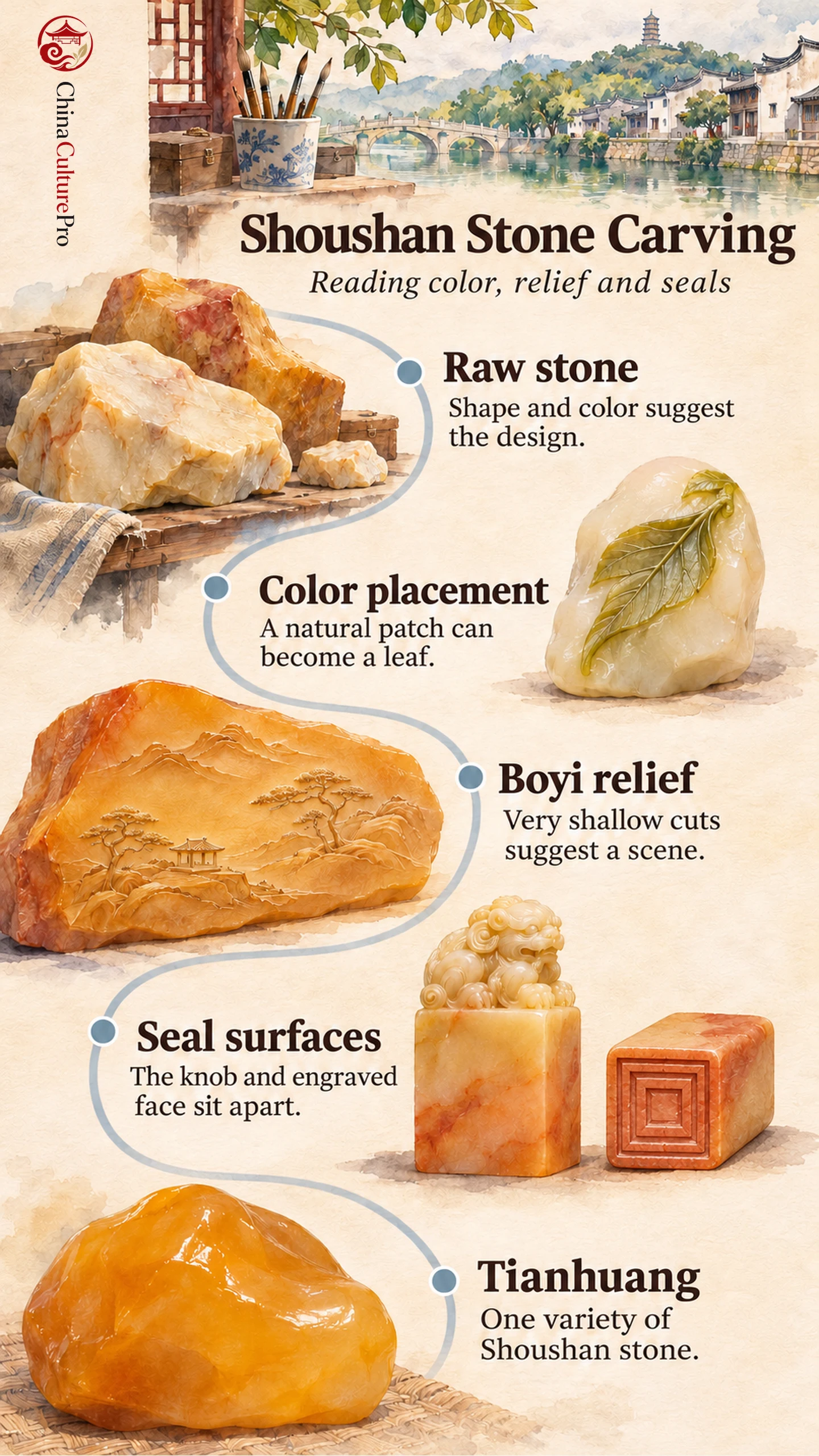
A pale ridge on a carving can read as the edge of a distant mountain. A darker patch can become foliage beside it. The way a carver reads the stone helps determine which subject appears and how deeply it is cut.[1][2]
How Carvers Use the Stone’s Color
A Fuzhou craft directory describes the maker examining the stone’s shape, texture and color before committing to a design. A color boundary can suggest where to put a leaf, an animal or part of a landscape. The maker has to judge how much of that color will remain when the surrounding surface is cut away.[2]
Turning the finished piece can show where an image follows the stone’s coloring. Look for a cut edge where two shades meet and for a natural patch carried into the raised part. Follow the boundary between two colors to see where the carver used it to mark the edge of the subject. A similar question about natural color and deliberate placement also matters in Qingtian stone carving.[1][2]
Reading Relief, Sculpture and Seal Knobs
| Carving form | What to look for |
|---|---|
| Carving in the round | A figure shaped to be seen from several sides |
| Seal knob carving | A sculpted top above the block, separate from the seal face |
| Shallow relief | A raised image with little depth above the surface |
| Openwork | Gaps cut through the stone, leaving connected forms |
One recognized Shoushan approach is boyi (薄意, bóyì), a very shallow form of relief that draws on the visual language of painting. Modest changes in depth can suggest a branch, mountain ridge or group of leaves while preserving much of the stone’s surface. The national project account associates this tradition with Lin Qingqing and describes a wider range of high relief, openwork and sculptural methods.[1][4]
The national account describes two Fuzhou workshop schools that took shape in the late Qing. It associates East Gate makers with figures and animals carved in the round, and traces the West Gate school’s shallow relief to work on seal knobs. These are histories of technique within the same regional craft.[1]
On a seal, a carved knob sits at the top and the engraved characters or design sit on the stamping face. If a display includes an impression, compare its printed design with the knob above the seal block. The two occupy different surfaces. Chinese seal carving explains how that face produces a printed image.[1][3]
Tianhuang, Court Seals and Fuzhou Workshops
The Palace Museum traces Tianhuang to deposits beneath fields in the Shoushan area north of Fuzhou. Its collection includes a group of three Qianlong seals joined by chains. The museum identifies the seals and their stone links as a carving from a single piece of Tianhuang. The linked form shows how a piece of stone can supply both the working seal blocks and the connections between them.[3]
The craft extends beyond court seals. Feng Jiuhe’s national heritage profile records animal and flower carving, seal knobs and his use of naturally colored areas. A more recent account from Fuzhou describes Sun Zhaoyong working in relief and in the round, with still-life subjects. Both accounts document the role of individual makers in a Fuzhou workshop tradition within Fujian culture.[4][5]
FAQs About Shoushan Stone Carving
Is all Shoushan stone Tianhuang?
Tianhuang is a variety of Shoushan stone. The broader material family includes stones with different colors and textures used in seals, reliefs and sculpture.[1][3]
What is boyi carving?
Boyi is a very shallow relief technique associated with Shoushan carving. Small changes in surface depth can suggest motifs associated with Chinese painting.[1][4]
Where is Shoushan stone carving practiced?
The national entry is based in Fuzhou, Fujian, and connects the craft to stone from the mountainous area north of the city.[1][2]
Sources
[1] China Intangible Cultural Heritage Digital Museum. Shoushan Stone Carving
[2] Fuzhou Municipal Bureau of Industry and Information Technology. Fuzhou Directory for the Protection of Shoushan Stone-Carving Skills
[3] The Palace Museum. The Qianlong Emperor’s Three Linked Tianhuang Seals
[4] China Intangible Cultural Heritage Digital Museum. Shoushan Stone Carving and Its Practitioners
[5] Fujian Provincial People’s Government. Savoring Cultural Heritage While Welcoming Fresh Ideas