
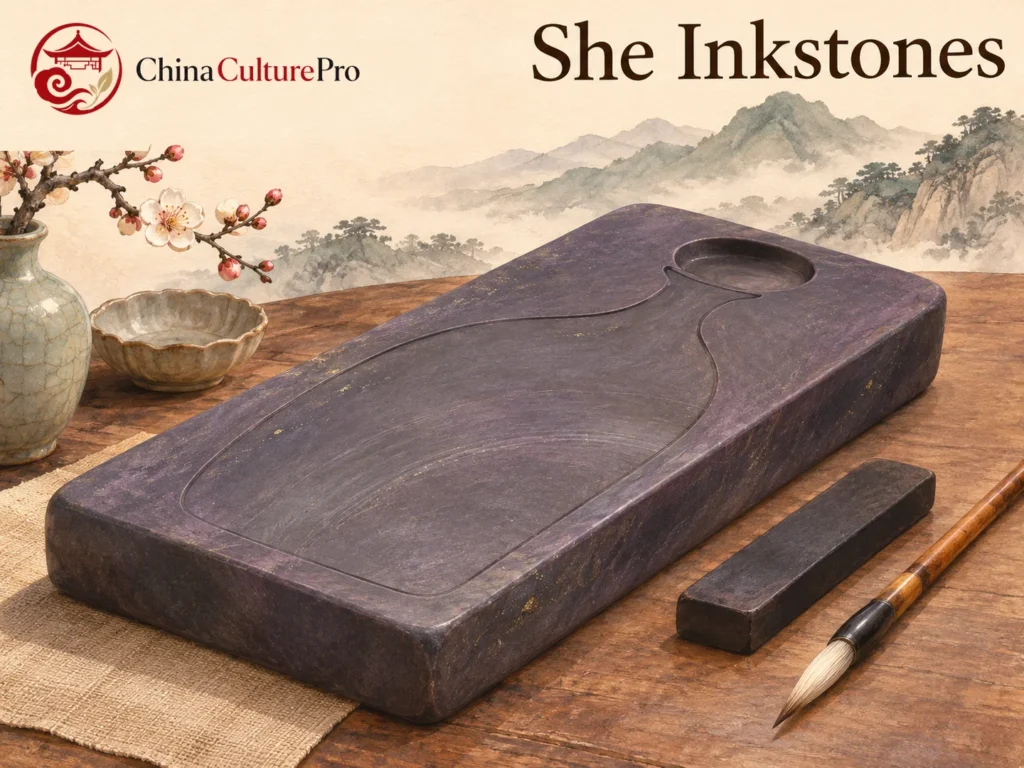

Quick Answer: What Are She Inkstones?
A She inkstone (歙砚, Shèyàn) is a carved stone used to grind an inkstick with water for brush writing and painting. The name comes from She, a historical place in the Huizhou region. The prized material from Mount Longwei in what is now Wuyuan, Jiangxi, also gives the object the name Longwei inkstone (龙尾砚, Lóngwěiyàn).[1][2][3]
- Stone: She stone is usually dark gray or black with fine markings.[1]
- Working parts: A flat area grinds the ink. A recessed well collects it.[4]
- Making: Artisans carve the selected stone around its grain.[2][3]
She County in Anhui and Wuyuan County in Jiangxi both have national entries for the making tradition.[2][3]
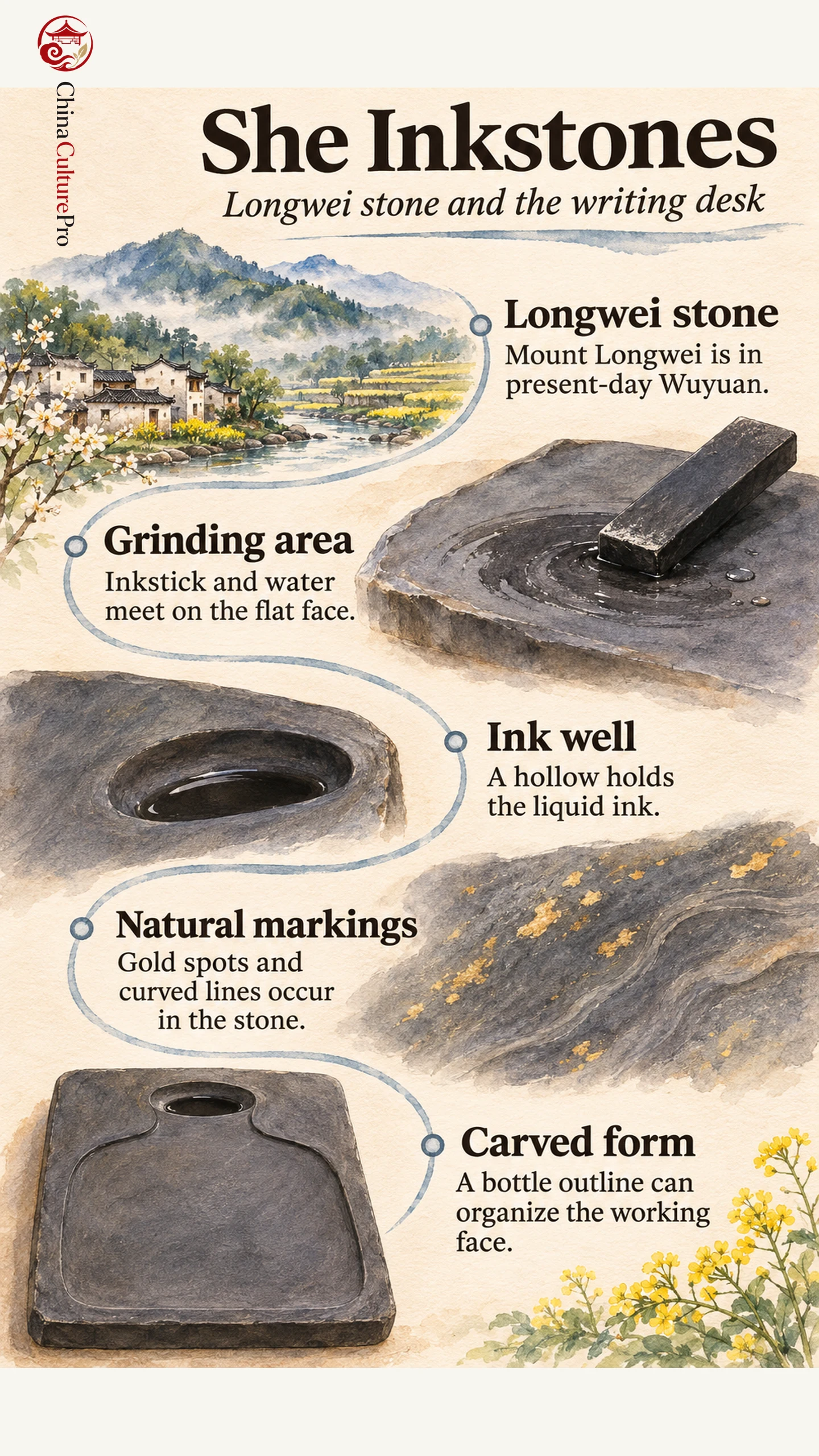
A dark inkstone can look plain in even light. Hold it at an angle and fine lines or gold-colored specks may become visible. A recessed pool and an incised outline belong to a different part of the story. A carver shaped them so the object could work on a writing desk.[1][4][5]
Why She and Longwei Appear on the Same Label
She County, now in Anhui, was a center of inkstone making and gave the tradition its name. Wuyuan, now in Jiangxi, once belonged to the same historical Huizhou region. Mount Longwei in Wuyuan supplied a valued stone used to make these inkstones. A label can therefore name Huizhou as the historical setting, She as the tradition and Longwei as the stone source.[1][2][3]
The Palace Museum dates quarrying at Longwei to the Tang and describes heavier extraction during the Song. The national heritage inventory records both She County and Wuyuan in its first batch of representative projects in 2006. Read the two county names alongside the history of Huizhou culture to understand why the craft appears under two modern provinces.[1][2][3]
How Stone Patterns and Carving Work Together
The inkstone belongs to the Four Treasures of the Study (文房四宝, wénfáng sìbǎo), alongside brush, paper and inkstick. On a Chinese scholar’s desk, it provides a working surface where water and the inkstick meet. The adjoining depression holds liquid ink that can be picked up with the brush. Look for the broad, accessible grinding area before following any decorative border.[2][4]
The carver works with patterns that already occur in the stone. Among the named examples are gold star markings (金星, jīnxīng), which appear as small golden spots, and eyebrow markings (眉纹, méiwén), which can form curved lines. The national descriptions record several named grain families and a sequence of work from selecting the slab through carving, polishing and fitting a case. Natural markings and carved decoration can be visible on a single face.[1][2][3][4][5]
The pattern names describe appearances rather than shapes a carver is expected to reproduce. The Palace Museum, for example, identifies fine silklike lines in one She stone and paired eyebrow marks in another. A dark surface may reveal these details best under light from the side.[1][4][5]
Reading a Qing Court Inkstone
A rectangular She inkstone from the Qianlong reign in the Palace Museum measures 15.5 by 10 centimeters. Its carver used the outline of a bottle as part of the design. The broad bottle body forms the grinding area, while the mouth is hollowed into a small oval well. The catalog also records gold-colored specks across the stone and faint eyebrow markings on the working face.[4]
The Palace Museum records She inkstones among tribute presented by Anhui governors to the Qing court. Another inkstone from the court collection takes the form of a lotus leaf. Its catalog highlights fine grain and eyebrow markings that appear in pairs. Compare the two objects to see how the same kind of stone can carry different working shapes. Taohe inkstones show how a separate quarry tradition supplies another kind of stone for the same task.[1][5]
FAQs About She Inkstones
How do you pronounce She inkstone?
An approximate English guide is “shuh” for the first syllable. It takes a falling tone in Mandarin. The full name is Shèyàn, with a falling tone on each syllable.
Where did Longwei stone come from?
Mount Longwei is in Wuyuan County in present-day Jiangxi. Wuyuan belonged historically to Huizhou, which links the source to the She inkstone name.[1][2][3]
Are the gold specks in She inkstones painted on?
The spots cataloged as gold star markings are features of the stone. The Palace Museum records them on its Qianlong inkstone alongside deliberately carved features such as the oval well.[1][4]
Sources
[1] The Palace Museum. Select Qing Court Inkstones from the Palace Museum Collection
[2] China Intangible Cultural Heritage Digital Museum. She Inkstone Making: She County
[3] China Intangible Cultural Heritage Digital Museum. She Inkstone Making: Wuyuan
[4] The Palace Museum. Rectangular She Inkstone with Bottle-Shaped Design
[5] The Palace Museum. She Inkstone Carved in the Form of a Lotus Leaf