
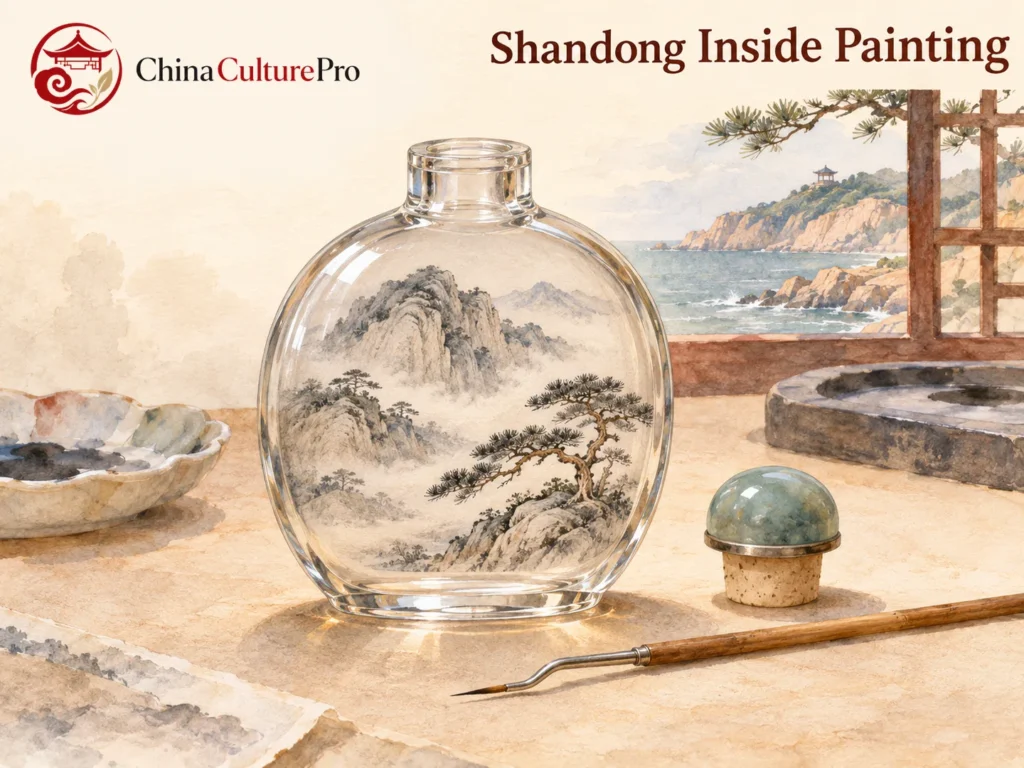

Quick Answer: What Is Shandong Inside Painting?
Shandong inside painting (鲁派内画, Lǔpài nèihuà), also called Lu-school inside painting, is the Zibo tradition of painting on the interior wall of a small transparent vessel. Its best-known surface is the inside of a glass snuff bottle (鼻烟壶, bíyānhú).[1][2]
- Tool: A bent brush passes through the opening and turns toward the inside wall.[1]
- Surface: A prepared glass interior gives the pigment a surface it can adhere to.[2][3]
- Viewing: The finished image and any writing are read through the glass from outside.[1][4]
The national heritage inventory added the Lu school as a regional extension of inside painting in 2014.[1]
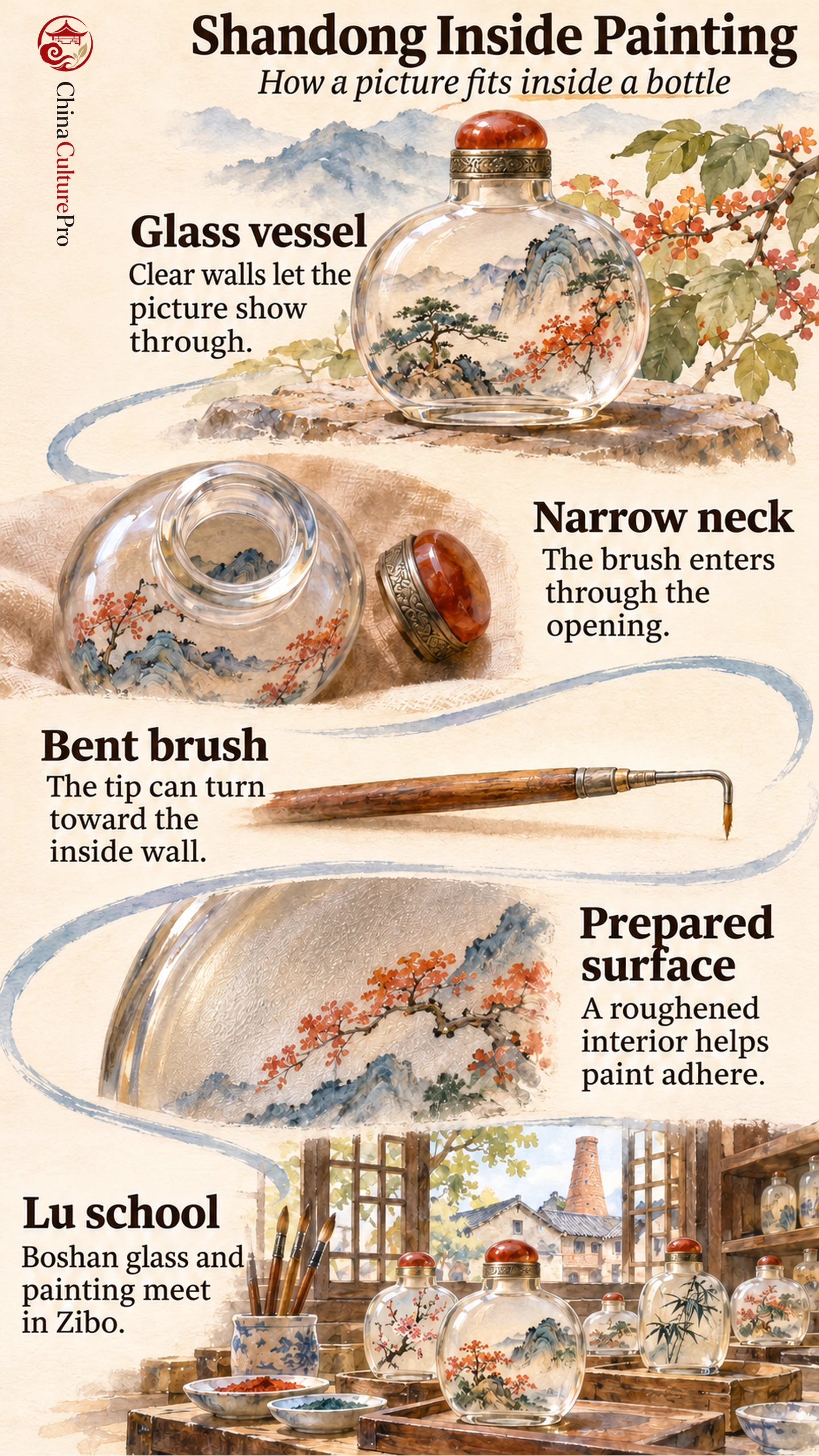
Viewed from the front, a glass snuff bottle can resemble a tiny framed picture. Its stopper and polished edges frame a scene that follows the inner wall. In Shandong, making this kind of vessel became a specialty of Zibo workshops.[1][3]
How a Brush Reaches the Inside Wall
The bottle’s neck limits the angle at which the brush can reach the wall. The Lu-school painter uses a brush with a bent working end so the tip can meet the wall from within. The hand stays outside, and small motions at the neck guide the tip on the side of the vessel.[1][2]
The painter sees the work through the wall and has to judge each mark from the side where it will be viewed. This is particularly important with writing. Lu-school examples can pair lines of text with figures or a landscape, drawing on techniques used in Chinese brush painting. These marks are only one type of decoration found on Chinese snuff bottles.[1]
What the Glass Changes
The bottle body can be made from clear local glass. Roughening the interior can help the pigment adhere. A Zibo cultural account credits the late Qing painter Bi Rongjiu with resolving difficulties in roughening the interior of local glass blanks. The University of Michigan Museum of Anthropological Archaeology likewise describes his use of diamond sand to help the pigment adhere.[1][2][3]
The Michigan museum illustrates how a single bottle can tell more than one story. Its Boshan example is made of glass and has a turquoise-and-silver lid and a silver spoon. The catalog says it bears the signature of Bi’s father, Yu Ting, and may predate Bi’s surface innovation. The signature is an observed detail. The relationship between this bottle and Bi’s method remains the museum’s qualified interpretation.[3]
On a glass bottle with inside painting, reflections on the outer wall can move across the scene as you change your viewing angle. The lid, spoon and painted scene occupy different parts of the object. A museum label can describe them separately because each tells you something different about how the bottle was made or used.[1][3]
From Boshan Workshops to the Lu School Today
Zibo’s cultural record connects the regional school with the glassmaking district of Boshan. It describes the transmission of inside-painting technique from Beijing in the late Qing and associates Bi Rongjiu’s work in local glass with the emergence of the Lu school. The name Lu refers to Shandong. Qilu culture provides wider context for regional names used for the province.[1][2]
In 2014 the national inventory recorded Lu-school inside painting under traditional fine art. Teaching continues through studios and educational partnerships. Xinhua’s account of Zhang Luhua describes classes developed with local colleges and recent work on vessel forms including brush holders and tea canisters. The narrow-necked bottle remains the form described in the national project entry.[1][4]
FAQs About Shandong Inside Painting
Is the painting inside the glass itself?
Pigment is applied to the inner wall. The viewer looks at it through the glass. The vessel’s clear wall and the painted layer are separate features.[1][3]
How can a brush reach the side of the bottle?
The brush has a bent end. The painter feeds it through the neck, then angles the tip toward the inside wall while controlling it from outside.[1][2]
Where does the Lu school come from?
The Lu school is associated with Zibo in Shandong, with Boshan central to accounts of its early development and use of local glass.[1][2]
Sources
[1] China Intangible Cultural Heritage Digital Museum. Inside Painting: Lu School
[2] Zibo Municipal Bureau of Culture and Tourism. Lu-School Inside Painting
[3] University of Michigan Museum of Anthropological Archaeology. A Glass Snuff Bottle from Boshan
[4] Xinhua. Lu-School Inside Painting and Its Transmission