


Quick Answer: What Are Shaanxi Window Paper-Cuts?
Shaanxi window paper-cuts (窗花, chuānghuā) are designs cut from paper for display on windows. In northern Shaanxi, families have used them to decorate for the Lunar New Year and other occasions. The window’s pale backing or light helps the solid shapes and cut openings read clearly.[1][2][3]
- Placement: In Ansai, families paste cuts on freshly papered windows before the New Year.[1]
- Design: Folded cuts can repeat a shape. Single-sheet cuts allow an uneven outline or scene.[2]
- Motifs: Local work can show tigers, flowers or scenes of rural life.[2][3]
A window cut is one use of paper-cutting. Other designs decorate walls, ceilings and lanterns or provide patterns for embroidery.[2][3]
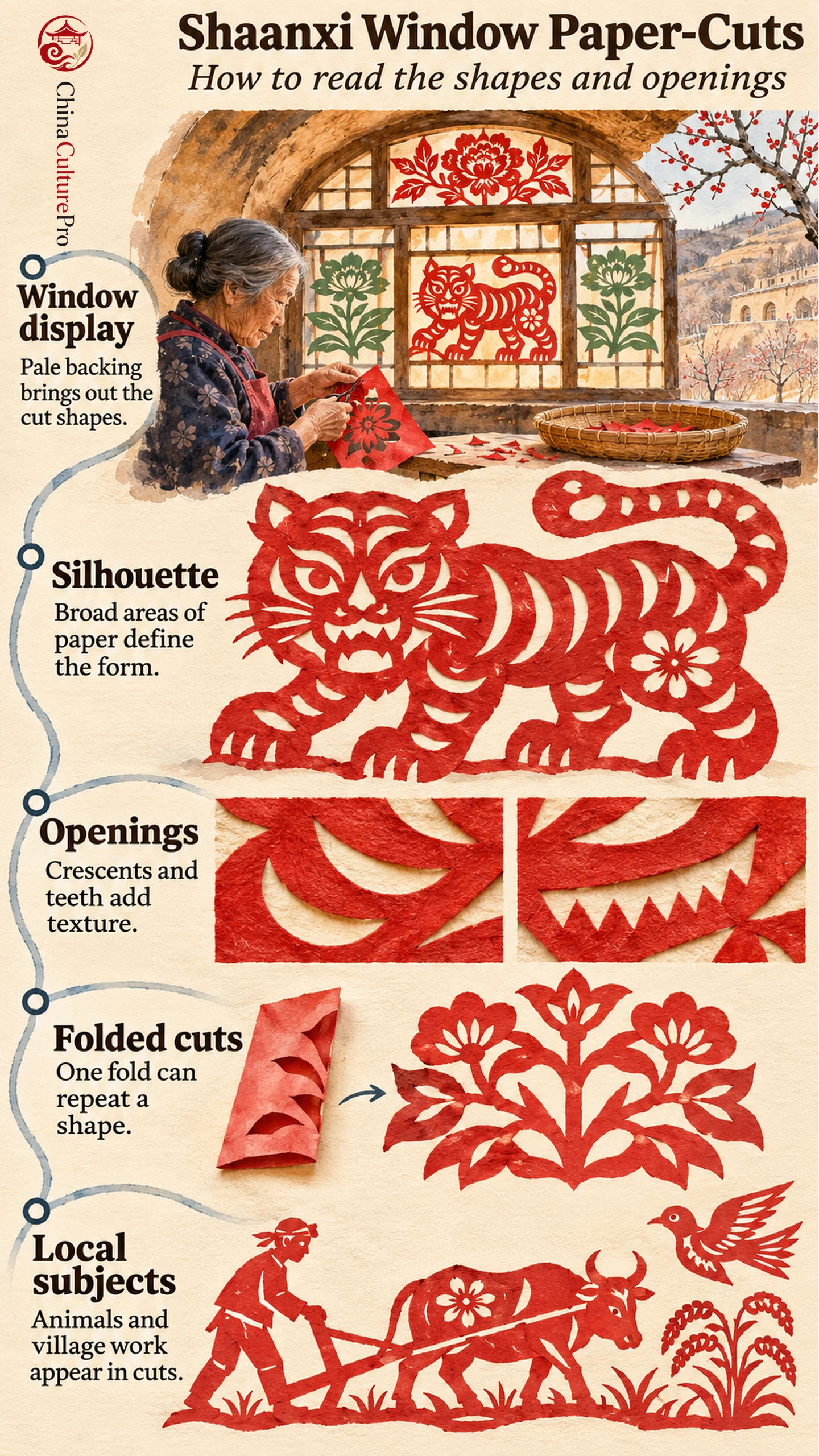
A cut tiger on a window is made from both the paper the maker kept and the shapes cut out of it. From across a room, the silhouette catches the eye. At close range, small crescents and sawtooth cuts can give the animal markings and texture.[1][2]
What the Window Adds to the Design
The national record for Ansai paper-cutting (安塞剪纸, Ānsāi jiǎnzhǐ) describes women gathering to cut designs in the last lunar month. As the New Year approached, families applied red and green cutouts to newly pasted white window paper. The white field made the colored shapes easy to read. Seen together across a village, decorated windows made the holiday preparations visible beyond any one home.[1]
Where the cut was placed also changed how people read it. An Ansai account mentions tigers and lions in New Year decorations associated with household protection and pairs of figures among bridal-room designs. These are documented uses in a particular community. A tiger seen in a collection may need a label or a maker’s account to explain its original occasion. The practice offers one example of the household traditions covered in Shaanxi culture.[2]
How to Read an Ansai Paper-Cut
Look first at the silhouette and then at the openings. A broad area of intact paper can make the body of an animal or figure stand out. Small openings break up that surface. An Ansai account records crescents, serrations and diamond shapes among the treatments makers used for internal decoration.[2]
| Approach documented in Ansai | What it makes possible |
|---|---|
| Cutting folded paper | A repeated shape across a fold |
| Cutting an unfolded sheet | An irregular silhouette or a scene with different sides |
| Joining separately cut shapes | A larger composition assembled from several pieces |
The same work can contain a folded detail and an asymmetric figure. The Ansai account also describes different local styles, including forms with simple outlines and others with more intricate interiors. The cut edges and any repeated details give better clues to the cutting method than the color does. Compare this with Yuxian paper-cutting, where the relationship between cut outlines and applied color is a defining subject of its own.[2]
Ansai, Yanchuan and Two Levels of Recognition
Yanchuan paper-cutting (延川剪纸, Yánchuān jiǎnzhǐ) offers another northern Shaanxi example. Its national project profile lists window, wall, ceiling and lantern decorations. Subjects include farming, spinning and weaving, plants and animals, and scenes from stories. One paper-cut tradition can thus show an ordinary task or express a wish associated with a celebration.[3]
China listed Ansai paper-cutting nationally in 2006 and added Yanchuan paper-cutting as an extension in 2011. UNESCO inscribed Chinese paper-cut in 2009, covering a much wider tradition practiced in different communities across China. Those dates identify different records. The distinction also applies when reading about other forms of Chinese intangible cultural heritage.[1][3][4]
FAQs About Shaanxi Window Paper-Cuts
Are Shaanxi window paper-cuts always red?
Ansai’s heritage profile describes red and green cutouts on white window paper. Red is a familiar New Year color, and the documented display includes other colors too.[1]
Does every cut use folded paper?
Ansai makers can cut folded paper for symmetry, work an unfolded sheet for an irregular shape, or join separate cuts into a larger picture.[2]
What did UNESCO recognize in 2009?
UNESCO inscribed Chinese paper-cut as a practice found across China. UNESCO’s materials illustrate the entry with examples from Ansai, and the inscription applies to the wider Chinese tradition.[4]
Sources
[1] China Intangible Cultural Heritage Digital Museum. Paper-Cutting: Ansai
[2] China Intangible Cultural Heritage Digital Museum. Ansai Paper-Cutting and Its Uses
[3] China Intangible Cultural Heritage Digital Museum. Paper-Cutting: Yanchuan
[4] UNESCO Intangible Cultural Heritage. Chinese Paper-Cut