


Quick Answer: What Is Yuxian Paper-Cutting?
Yuxian paper-cutting (蔚县剪纸, Yùxiàn jiǎnzhǐ) is a tradition from northwestern Hebei that combines knife-cut openings with painted color. The county’s designs are often called window flowers (窗花, chuānghuā), a term that describes their use as window decorations.[1][2][3]
- Carving: A small knife cuts the design into absorbent paper. Artists can carve several sheets together.[2][3]
- Coloring: With spot dyeing (点染, diǎnrǎn), brushes apply color to areas of paper left after cutting.[2][3]
- Subjects: Opera actors and faces are distinctive examples. Flowers, birds, animals and stories also appear.[1][3]
The outline, holes and brush color all contribute to the image. A finished piece may use a different color for each part of a costume.[1][3][4]
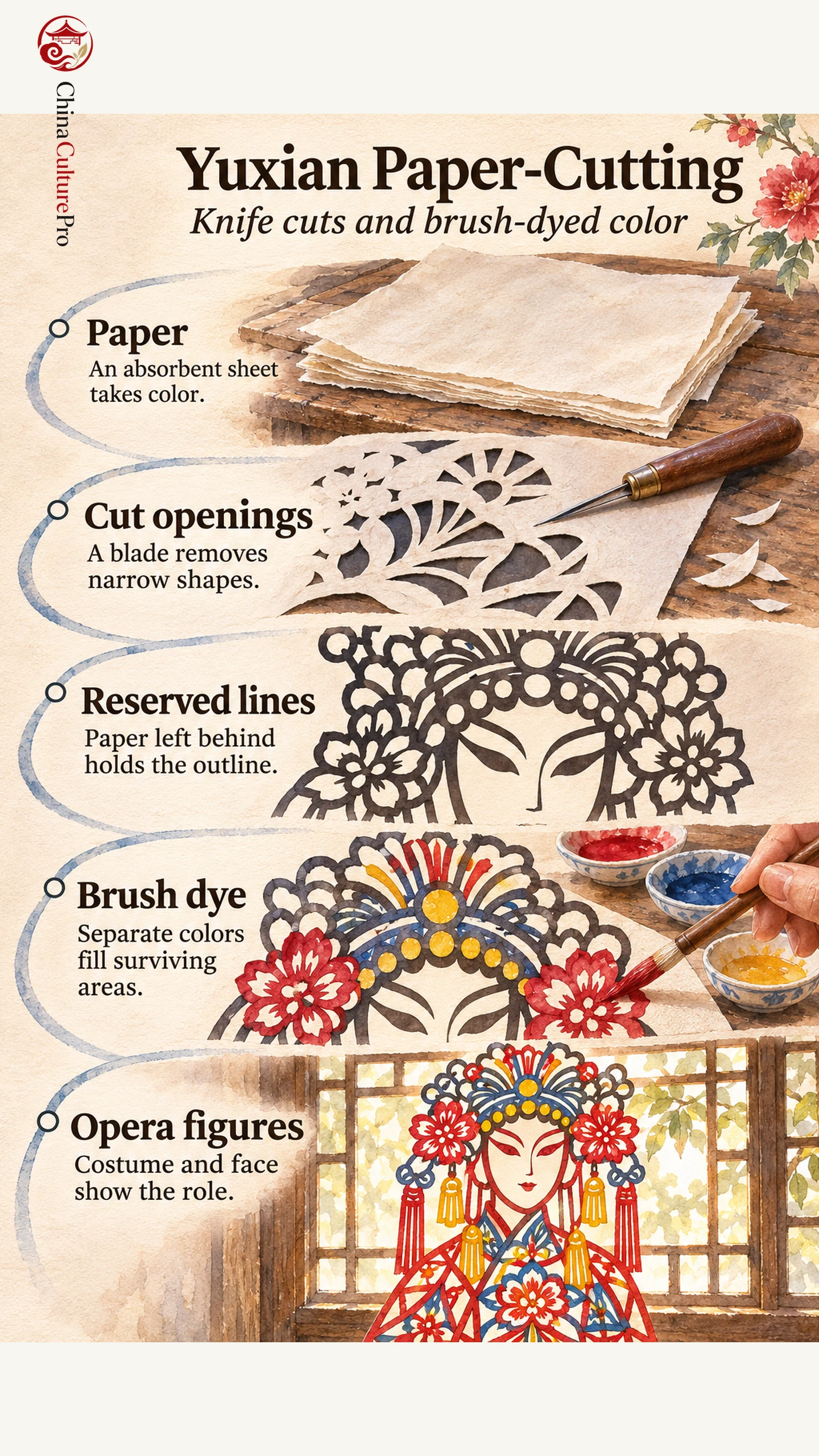
An opera figure on a paper window can have a pale opening where the light comes through, dark cuts that define the face and several colors in one sleeve. Cut lines and colored paper preserve details a theatergoer might recognize from the stage.[3][4]
How the Cut Lines and Painted Colors Work Together
A design establishes the outline and the details the knife must pick out. Hebei’s cultural department describes how tools developed by the silversmith Liu Laobu and other artists made it possible to carve batches instead of cutting individual sheets. Fine, absorbent paper gives the maker a surface that can take several colors. See how Xuan paper is made for the wider tradition behind one of the materials used for these cuts.[2][3]
| Part of the image | How to read it |
|---|---|
| Negative cuts (阴刻, yīnkè) | Narrow pieces are removed to draw lines through a larger area of paper. |
| Reserved lines (阳刻, yángkè) | The maker removes surrounding paper, leaving the lines as part of the surviving sheet. |
| Dyed areas | Brushes place contrasting colors on intact parts of the paper, such as a face, robe or flower. |
The Hebei register describes a preference for recessed cuts in Yuxian, with reserved lines used alongside them. A colored sleeve can still show a cut fold where the backing or light comes through. The knife determines the edge of that fold, and the brush determines the color around it.[1][2][3]
Window Flowers, Opera Roles and Wang Laoshang
A window flower can depict an animal, a flower, or a character with no flower in the picture. Early Yuxian designs included auspicious floral motifs. The national record describes how local makers drew on New Year prints from Yangliuqing and Wuqiang, as well as local designs, as the repertoire expanded.[1][2]
Wang Laoshang (王老赏, Wáng Lǎoshǎng) was an early twentieth-century artist particularly associated with opera figures. A Tsinghua University Press excerpt reproduces one figure attributed to him. A survey of regional paper-cutting records that traditional Yuxian opera window decorations could come in groups of four. Grouping the figures gave a household several related pictures to arrange across its windows.[2][3][4]
The figure’s headdress, beard or robe can supply clues before a viewer recognizes the story. Small cuts articulate facial features and folds, while color can give two neighboring areas of clothing clear edges. A mask by itself is another documented subject, distinct from a full figure.[1][3][4]
Reading a Yuxian Paper-Cut
Look at the openings first. Follow one line across a sleeve or plant stem to see whether the line is a piece of paper or a gap. Then look at how the color sits on the surface. The same close look works for related crafts. In Yangzhou paper-cutting, a chrysanthemum’s curves can carry most of the design. In Yueqing fine-line paper-cutting, narrow bands of repeated cuts recall dragon-boat lantern decorations.[1][3][5]
Yuxian entered China’s national heritage register in 2006. UNESCO’s 2009 inscription covers the broader element Chinese paper-cut and includes an example from the Hebei county. That record gives context for the craft and its regional name. An individual piece still needs a maker, workshop or collection record for a confident attribution.[1][5]
FAQs About Yuxian Paper-Cutting
Is Yuxian paper-cutting the same as Weixian paper-cutting?
In sources that identify the county as Hebei’s 蔚县, Yuxian and Weixian refer to the same place. Yuxian reflects the local place-name reading Yùxiàn.[1][2][5]
How does a Yuxian paper-cut get several colors?
The maker cuts the paper, then applies color with brushes. The remaining paper takes the dye and the open cuts still show the surface or light behind the sheet.[2][3]
Did UNESCO list Yuxian paper-cutting separately?
UNESCO inscribed Chinese paper-cut in 2009 as an element encompassing many local traditions. China’s national register lists the Yuxian tradition specifically from 2006.[1][5]
Sources
[1] China Intangible Cultural Heritage Digital Museum. Yuxian paper-cutting project record
[2] Hebei Department of Culture and Tourism. Yuxian paper-cutting materials, tools and methods
[3] China Intangible Cultural Heritage Digital Museum. Regional traditions of Chinese folk paper-cutting
[4] Tsinghua University Press. Paper-cutting examples including Wang Laoshang’s opera figure
[5] UNESCO. Chinese paper-cut