
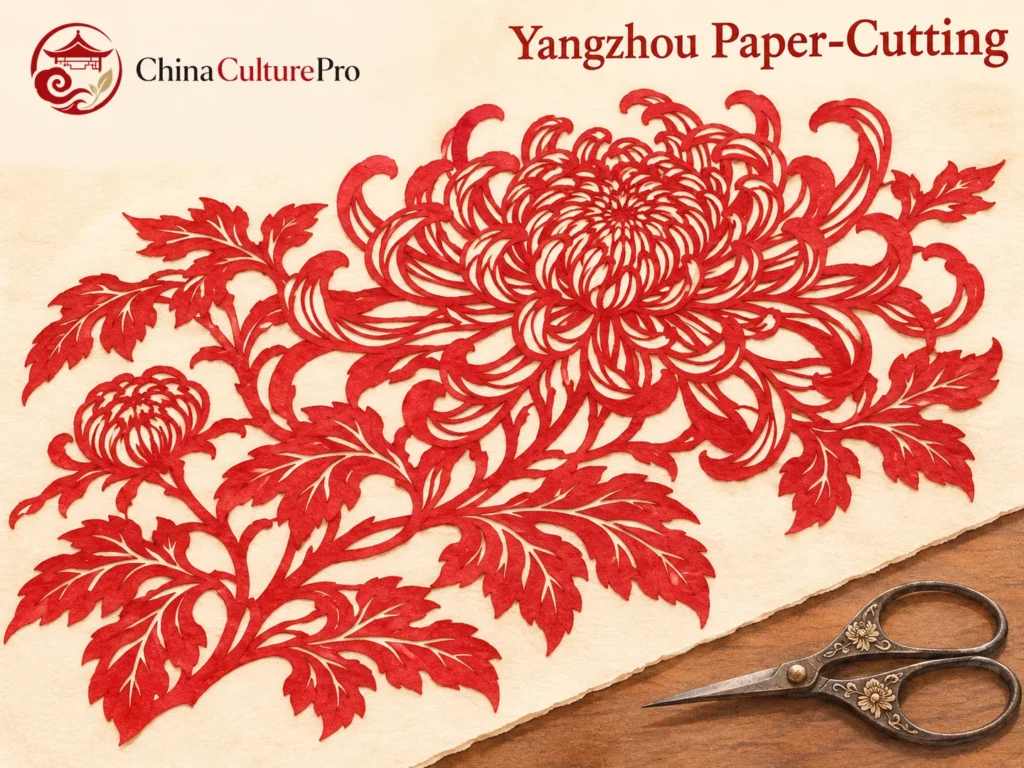

Quick Answer: What Is Yangzhou Paper-Cutting?
Yangzhou paper-cutting (扬州剪纸, Yángzhōu jiǎnzhǐ) is a Jiangsu tradition of cutting pictures and patterns from sheets of paper. Its flower studies are especially well known for fine, flowing contours and carefully spaced openings.[1][2]
- Material: Local heritage records describe uncolored, hand-made Xuan paper (宣纸, xuānzhǐ) from Anhui among the materials used.[1]
- Design: A single petal can be outlined by a fine strip of paper and shaped from within by several narrow cuts.[1][2]
- Uses: Surviving designs include patterns for other crafts as well as compositions intended to be seen on their own.[1][3]
Flowers are a useful starting point. Artists in this tradition have also cut birds, insects, fish and other subjects.[4]
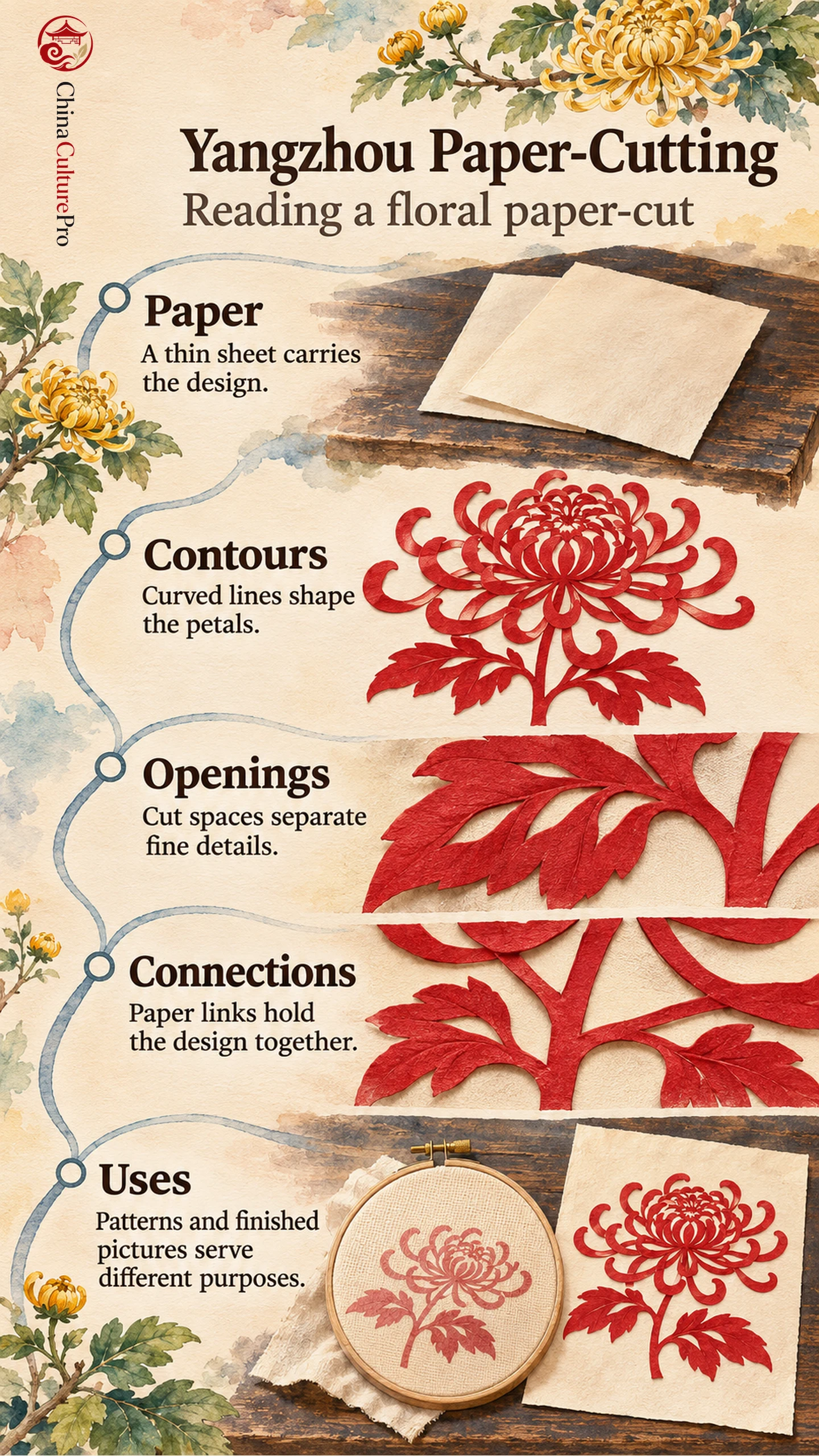
Look closely at a cut chrysanthemum and the spaces between its petals become almost as distinctive as the petals themselves. The direction of each opening can tell you where a leaf bends, or where a petal curls behind the next one.
How Yangzhou Paper-Cuts Hold Together
With a cut-paper picture, the light areas may be gaps that show whatever lies behind the sheet. A narrow bar of remaining paper can link two leaves or carry the curve of a stem across an opening. In a one-piece design, these connections keep the silhouette intact when it is lifted. These unbroken lines also guide the eye from the stem to the flower head.[2][3]
The national heritage profile describes smooth, moderately thick, uncolored hand-made paper. The broader regional survey records both scissor cutting and knife work in Jiangsu, including work that combines the two. The paper itself can contribute to the effect. How Xuan paper is made explains why the name covers a material tradition with several kinds of paper.[1][2]
| Where to look | What the cuts can show |
|---|---|
| Edge of a flower | Smooth sweeps and pointed tips give individual petals a direction. |
| Openings within a leaf | Small, repeated gaps can suggest a central vein or a serrated margin. |
| Connections between motifs | Fine bands of remaining paper carry a stem or bind several shapes into one sheet. |
Start with the whole silhouette before looking for the smallest line. The balance between open space and solid paper can matter as much as the fineness of a cut. Yueqing fine-line paper-cutting offers another regional example for comparing the arrangement of small openings.[2][5]
From Embroidery Patterns to Flower Studies
The national record describes a shift in the work of Zhang Yongshou (张永寿, Zhāng Yǒngshòu) from practical patterns to decorative compositions with their own themes. The earlier pattern could guide embroidery. In a flower study meant to be displayed, the cuts themselves carry the description of the plant. Zhang’s collected works include studies of many flowers, a chrysanthemum series, and butterflies among blossoms.[1][2]
One way to read Zhang’s chrysanthemums is to compare the movement of the inner and outer petals. Close cuts at the center compress the visible paper into a dense cluster. Longer curves on the outer edge give the flower room to open. The design uses the contrast between the two areas to convey the shape of the head.[2]
Zhang Xiufang (张秀芳, Zhāng Xiùfāng) began learning from her uncle Zhang Yongshou as a teenager. Suzhou’s heritage film archive records her participation in several of his major series and describes her own cutouts of flowers, birds, fish and insects. Her work shows how a family practice can pass on a way of handling line and space while making room for new compositions.[4]
Yangzhou Paper-Cutting in the Heritage Records
Yangzhou’s local project appears on China’s national intangible cultural heritage register. UNESCO inscribed the broader element Chinese paper-cut in 2009, covering a range of communities, techniques and regional styles. Yangzhou is one local tradition within that larger record.[1][3][5]
The Jiangsu safeguarding account describes fieldwork that collected more than two thousand Yangzhou folk designs, as well as school teaching and public exhibitions. The archive preserves working designs alongside pieces made for display. Finished works and teaching records add evidence of individual makers and how they learned. Yangzhou lacquerware offers a companion example of how the city preserves a different decorative craft through objects and workshop knowledge.[3]
FAQs About Yangzhou Paper-Cutting
Is Yangzhou paper-cutting always done with scissors?
Scissors are associated with the tradition, and the Jiangsu regional survey also describes knife cuts and combined techniques. A finished outline can be difficult to assign to a tool without seeing the maker at work.[2]
Why are chrysanthemums associated with Yangzhou paper-cutting?
Zhang Yongshou was particularly known for chrysanthemums. Their many overlapping petals gave him scope to alternate open gaps, fine lines and denser patches of paper within a single flower.[1][2]
Is every Yangzhou paper-cut red?
Colors vary. The national project description records uncolored paper in Yangzhou, while the broader Chinese paper-cut tradition includes both colored and uncolored work. Look for a maker or collection record when identifying a piece.[1][5]
Sources
[1] China Intangible Cultural Heritage Digital Museum. Yangzhou paper-cutting project record
[2] China Intangible Cultural Heritage Digital Museum. Regional traditions of Chinese folk paper-cutting
[3] Jiangsu Department of Culture and Tourism. Safeguarding Yangzhou paper-cutting
[4] Suzhou Intangible Cultural Heritage Information Network. Zhang Xiufang’s paper-cutting practice
[5] UNESCO. Chinese paper-cut