
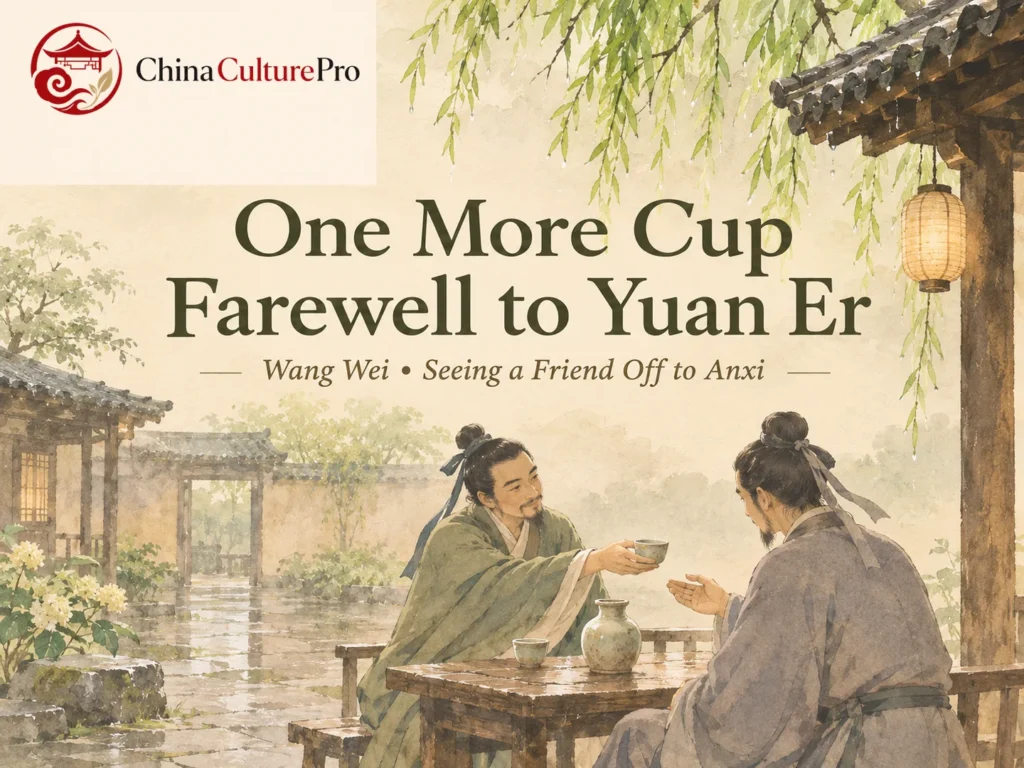

Quick Answer: What Is the Poem About?
Seeing Yuan Er Off to Anxi (送元二使安西, Sòng Yuán Èr Shǐ Ānxī) by Wang Wei (王維, Wáng Wéi) expresses friendship at the moment of departure through a simple invitation to drink again.
- Present scene: Morning rain and fresh willows surround a traveler’s inn.
- Human gesture: The speaker urges his friend to finish another cup, briefly extending their time together.
- Future distance: The final line imagines the traveler beyond the pass, away from the old friends who know him.
It is a seven-character quatrain (七言絕句, qīyán juéjù), with four lines and 28 Chinese characters. Its emotional force lies in the relationship between the cup offered now and the companionship that will soon be absent.[1]
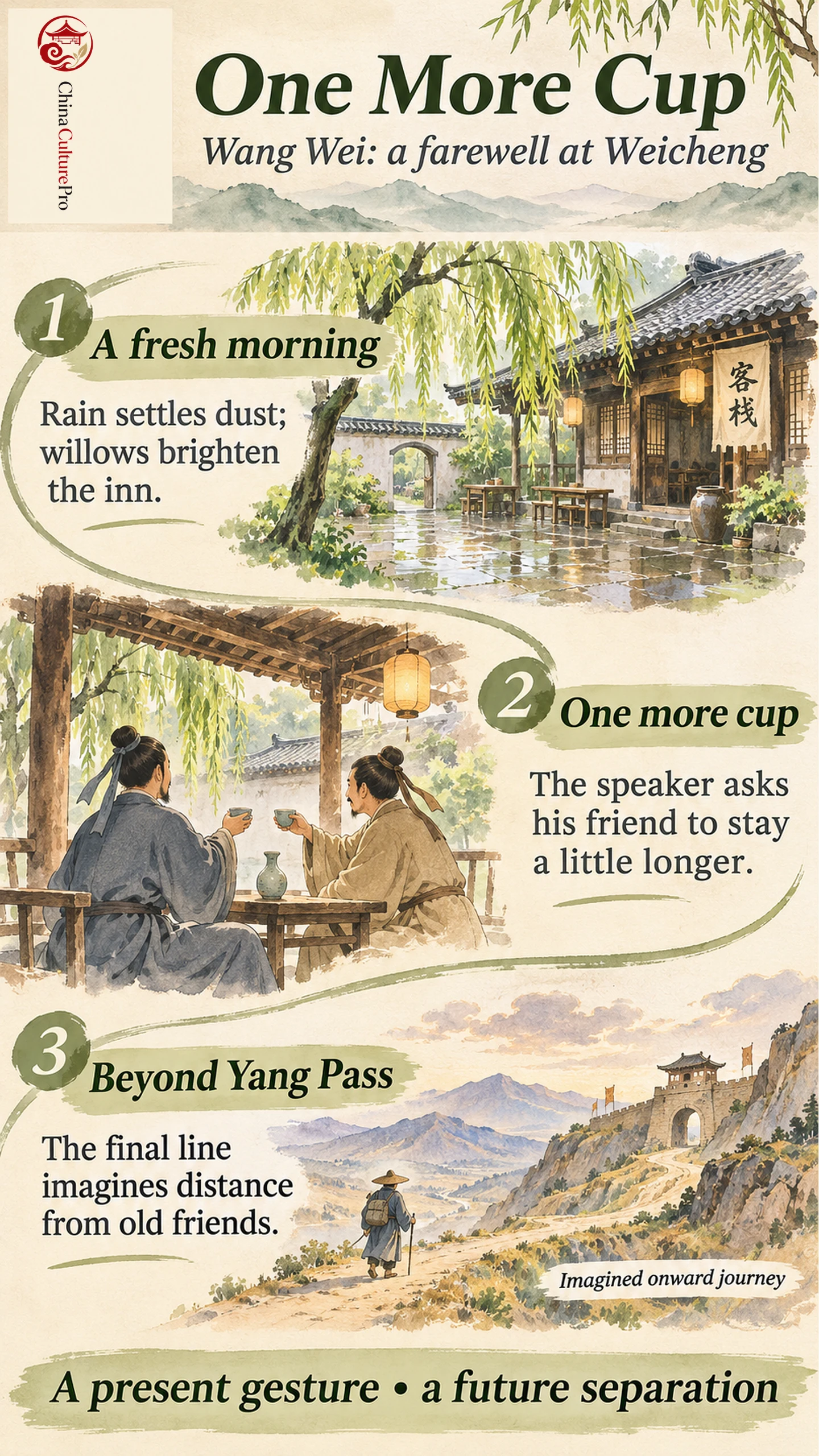
The rain has settled the dust, and the willows look newly green. Against this welcoming morning scene, a host asks his departing friend to finish one more cup. The reason comes last: a long journey will carry the friend beyond familiar company.
The Complete Poem and an English Sense Translation
The Chinese below uses 浥, “to moisten”; editions also print 裛 with the same sense here. The English is an original sense translation of all four lines.[1][2]
| Chinese text | English sense |
|---|---|
| 渭城朝雨浥輕塵, | At Weicheng (渭城, Wèichéng), morning rain dampens the fine dust. |
| 客舍青青柳色新。 | Around the travelers’ inn, the willows have a freshly green color. |
| 勸君更盡一杯酒, | I ask you to finish another cup of wine. |
| 西出陽關無故人。 | Westward beyond Yang Pass (陽關, Yángguān), there will be no old friends. |
“Old friends” means familiar companions, not elderly people. The last line gives the farewell its urgency; it is spoken from the relationship between the friends, rather than as a literal inventory of everyone the traveler might meet.
Weicheng, Yang Pass and the Friend’s Mission
Yuan Er (元二, Yuán Èr) is the friend named in the title. “Er,” meaning second, indicates his ranking among brothers; it should not automatically be treated as his personal given name. The title says he is traveling on a mission to Anxi (安西, Ānxī), the Tang protectorate administration for the western regions.[2]
The poem’s two locations have different jobs. Weicheng, north of the Wei River in the capital region, is the place of farewell. Yang Pass, southwest of present-day Dunhuang, lies in the imagined onward journey. The friends are not shown sharing wine at the remote pass.[2]
That separation of present setting and future destination is enough to orient the reading. The Wang Wei guide provides the wider literary context.
Rain, Willows and One More Cup
The first two lines notice small changes: rain settles the dust, and the willows appear fresh. The setting feels briefly renewed just as the friends must part. The poem lets a pleasant morning carry the strain of leave-taking.[1]
The invitation then brings the two people into the foreground. “Another” matters: the request briefly prolongs a shared action. The final line makes the invitation personal. Here there is someone to offer the cup; beyond the pass, that familiar company will be missing.
Willows belong to a wider Chinese farewell tradition. Within this poem, however, their immediate task is visual: their new green color refreshes the inn scene. No branch is described as being broken or given away.[1][2]
From the Poem to the Song of Weicheng
The poem entered musical performance and became known as the Song of Weicheng (渭城曲, Wèichéng Qǔ). It is also associated with Three Variations on Yangguan (陽關三疊, Yángguān Sāndié), whose name points to repeated musical treatment.[2]
Later settings used different scores and patterns of repetition. The four-line poem and its musical arrangements have related but distinct forms. The guide to Three Variations on Yangguan follows that related performance tradition.[2]
How to Read the Farewell’s Present and Future
- Locate the morning: Keep the rain, willows and inn together as the immediate setting.
- Hear the request: Let “another cup” become a spoken invitation between friends.
- Imagine the distance: Read the pass as part of the journey still ahead.
- Return to the cup: Notice how future separation gives weight to the small gesture in the present.
FAQs About Seeing Yuan Er Off to Anxi
Are the friends drinking at Yang Pass?
No. The farewell scene is at Weicheng. Yang Pass appears in the speaker’s anticipation of the friend’s westward journey.[1][2]
Does “no old friends” mean he can never make new friends?
No. It emphasizes separation from familiar companions. The poem does not predict that the traveler will remain permanently friendless.
Does the poem describe breaking a willow branch?
No. It describes the fresh color of willows around the inn. A branch-giving ceremony is not narrated in these four lines.[1]
Sources
[1] Wang Wei; Chinese Wikisource. Seeing Yuan Er Off on His Mission to Anxi
[2] Hong Kong Education Bureau. Recommended Classical Passages: Seeing Yuan Er Off to Anxi