


Quick Answer: What Is a Ruyi Gate?
A ruyi gate (如意门, rúyì mén) is a common roofed street entrance to a Beijing courtyard house. Brickwork fills the space between the front eave posts, leaving a central opening for a timber doorframe and leaves. Some entrances carry elaborate carved brick above that opening.[1][2]
- Find the wall: Brickwork frames the doorway at the street-facing post line.[1][2]
- Look at the opening: The door occupies a smaller area within the brick front.[1][2]
- Check the details: Carved lintels and door fittings vary from one house to another.[1][3]
The masonry around the opening is the structural clue. Auspicious decoration is common, with simpler examples also documented.[1][3]
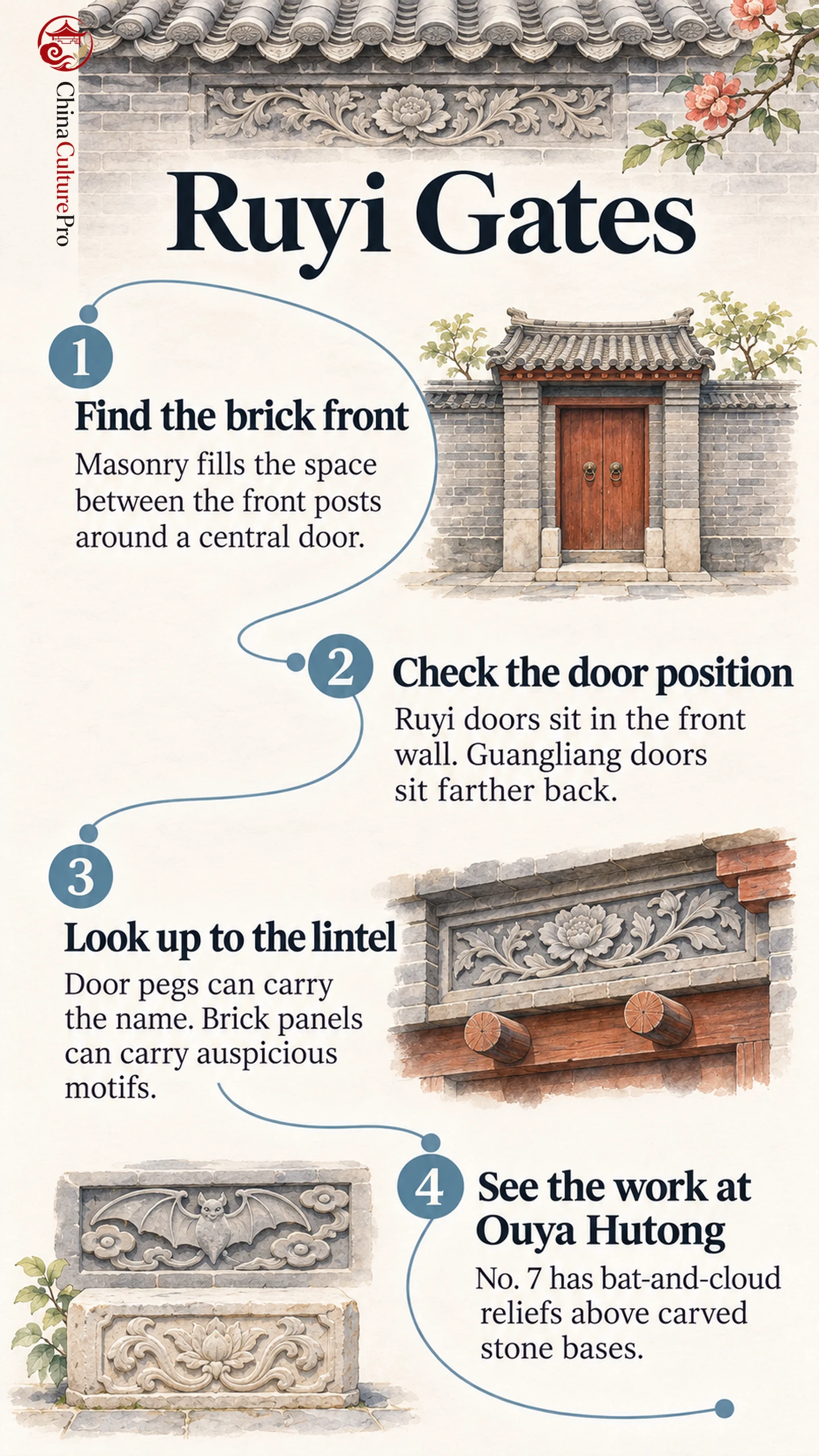
On a narrow lane, look first at how the door sits in the gatehouse. Once you have found the surrounding masonry, look above the door for the small details that give a particular gate its character.[1][2][3]
How the Door Fits into the Brick Front
Look up to locate the front eave and the uprights beneath it. Between them, the brick wall closes off the front except for the centered doorway. The opening contains its own frame and threshold. From the street, the wall and the door read as a single front beneath the eave.[1][2]
A Manzi gate also sets its door at the front eave, with the door assembly mounted directly between the posts. A ruyi front adds masonry around the opening. In a Guangliang gate, the doors sit farther back at the middle posts. The brickwork framing a smaller opening distinguishes ruyi in this group of Beijing courtyard entrances.[1][2]
What the Name and Carvings Tell You
The word ruyi means something like “as you wish.” Beijing’s preservation guidelines describe versions with the two characters on the door pegs (门簪, ménzān), small projecting pieces above the doorframe. The housing guide also records an explanation linking the name to ruyi-shaped details in the brickwork.[1][2]
A carved panel can carry motifs drawn from flowers, animals or auspicious phrases. Begin at the lintel and follow the carved bands outward. At ground level, stone blocks flank the threshold on some gates. A carving on the stone belongs to the doorway assembly, while the panels above the door belong to the decorated front.[1][3]
Two Documented Beijing Examples
Visit Beijing records the ruyi gate at No. 7 Ouya Hutong near Shichahai. Its account identifies bat-and-cloud brick reliefs beside the doorway, with additional floral and other motifs in the bands above it. The same account records chest-shaped stones at the base of the doorway, carved with different designs from the panels above. The doorway brings carved stone, brick and timber together in a small area.[3]
Dongcheng’s protection document for No. 71 Dongsi Batiao records a small ruyi gate with carved brick at the lintel. Compare the scale of the openings and the placement of the reliefs to see how the form accommodates different degrees of decoration.[3][4]
FAQs About Ruyi Gates
Do ruyi gates always bear the characters ruyi?
Some gates have the characters on their door pegs. The brick front with a central framed opening is the more dependable clue.[1][2]
Are all ruyi gates elaborately carved?
The amount of carving varies. Historic examples include plain gates and highly decorated ones.[1][3]
Where in the house compound is a ruyi gate?
The form discussed here is a street entrance from the lane into a Beijing courtyard compound.[1][2]
Sources
[1] Beijing Municipal Commission of Planning and Natural Resources. Historic District Preservation Design Guidelines
[2] Beijing Municipal Commission of Housing and Urban-Rural Development. Gate Forms and Courtyard Elements
[3] Visit Beijing. Ouya Hutong and Its Carved Brick Gatehouse
[4] Dongcheng District Government. Conservation Boundary for No. 71 Dongsi Batiao